| |

Stringing Baby Seed Pearls (and “Opening to Grace”)

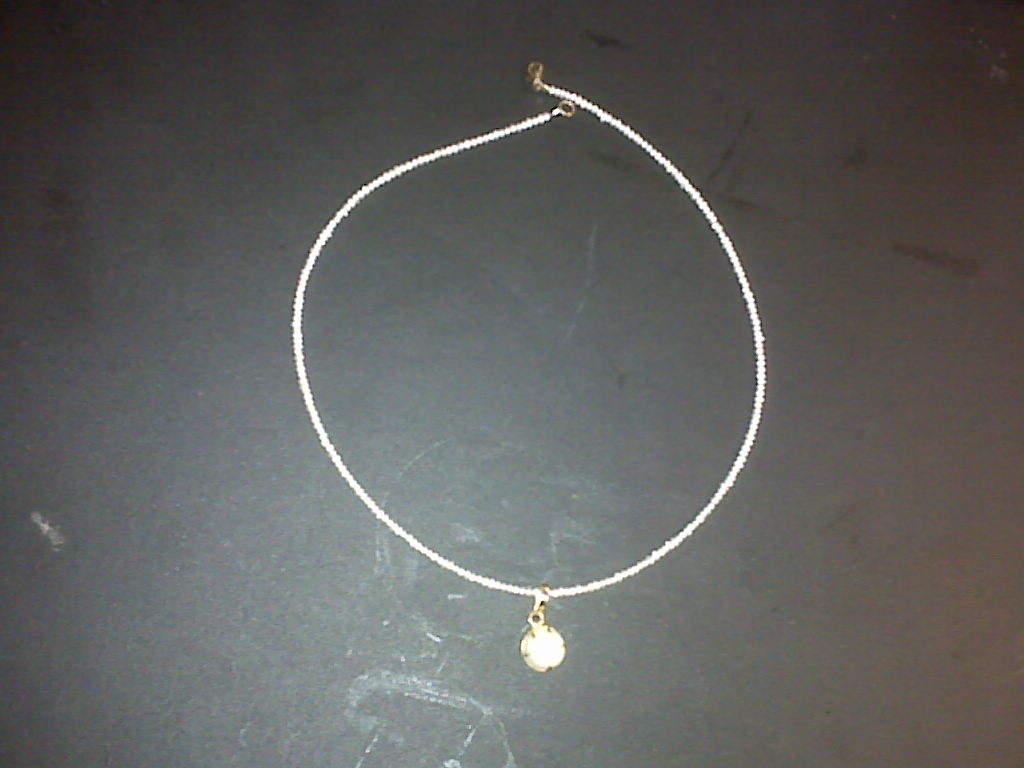
Last night I sat down at my kitchen table to string baby seed pearls for a mother-of-pearl charm I had gotten from Manoj a few years ago.

When I took the pearles off of the thread they came on and put them on my jeweler’s mat, several challenges were revealed:  even with the lights on bright and my reading glasses, it was almost impossible to see the bead hole; if I touched the wire other than on the hole, the pearl bounced; if I tried to hold the pearl still, the hold was obscured by my fingernail. Using a needle was not a viable option because the holes were too small for a wire-threaded needle.

At this point, since I was doing this after a long and frustrating day at the office, the tendency was to get more frustrated. Should I just give away the pearls? Get stronger glasses or a loupe? Try to return them?

Instead I softened. There was no mandate I get the pearls strung. I was doing this solely for enjoyment.

In softening, I discovered — to mix philosophical underpinnings — the zen of baby seed pearl stringing. If I grouped a bunch of pearls together, not only was it easier to see holes in certain pearls, but the others around it held the pearl in place for the wire to pierce the pearl. By softening, it occurred to me to use the technique of cutting the wire on a bias (and repeating it every several pearls strung), which gave me a smaller, sharper point, making the threading much easier. Most important, though, I stopped trying so hard. I let the wire and each pearl meet each other instead of my trying to force the meeting. When I did that, the openings were revealed, and I entered a quiet and serene meditative state during which the project completed itself through my agency.

It is for discovering, experiencing, and always being able to engage this essential and blissful merging of being and acting that I meditate and practice asana. We practice the Anusara principle “opening to grace” so that we can experience grace itself (whatever grace means to you) doing our acting, both on the mat and off.  As such, “opening to grace” is both the primary and ultimate activator of this merged state of being that is yoga--union..
Similar Posts

  • | | |

    Prayer

    As a nontheist, I’ve not been much called to prayer throughout my life. In these days of social crisis though, in addition to taking concrete action, though not directed at a being, I find myself praying as a mode of personal comforting.

    We leave Delhi before dawn tomorrow to go up into the Himalayan hills where we will be meditating and chanting in a place of great beauty.

    I’m told there’s WiFi. I will no doubt find myself reading the news, signing petitions, and sending comment letters, as well as posting photos, but perhaps not every day.

  • | |

    “Culture Wars” (and Mayiya-Mala)

    When I saw this headline the other day, the first thought that came to mind was how much pleasanter life would be if those spending huge amounts of effort and money to “fight” gay marriage would pour that energy into educating children, tending gardens, and being friendly with their neighbors. The next thought, which was not unrelated, was that the headline was a prime example of how the action of mayiya mala serves to alienate us and cause unnecessary rancor.

    The three malas or cloakings, in tantric philosophy, are aspects of consciousness that prevent us from recognizing the unifying spirit in all beings. We tend to hear a fair amount in yoga class about the first of these —anava mala, which clouds or covers over our recognition of the divine in ourselves, thus leading to feelings of unworthiness–but there is less focus on the other two (the third is karma mala, which is the illusion that we are doing everything all by ourselves–that’s an oversimplification. Perhaps more another time).

    At an elemental level, mayiya mala is the distinction between subject and object that leads us to feel separate from other beings. When this separateness makes us feel threatened or needy, then we can behave very badly indeed (mild understatement). I believe that our superficial requirements of outer sameness–think dress codes or neighborhood rules on what one can plant in one’s front yard–are exactly because we fear difference. If we can instead accept difference as part of the play of what actually connects us (see through mayiya mala, then we can more easily love and embrace others and widest variety of creative expression.

    On our mats, one of the things that leads to injury is mayiya mala. When we forget that we the purpose of the practice is to seek the peaceful joyous space within ourselves and instead get competitive or acquisitive about postures (or external emblems of “spiritual advancement”), we are getting caught up in the differences and comparisons generated by mayiya mala and get compelled to push and strive in unhealthy and dangerous ways. When we remember the true purpose of practice, we will seek to expand, but with such sensitivity that we do not hurt ourselves. This, of course, is easier said than done.

    Peace and light, E — Posted with WordPress for BlackBerry.

  • | |

    Picture Within a Picture

    This afternoon, I went with my friend Dan, who was here just for the day from California, to the National Gallery. I kept talking to him. “Look at the pictures,” he said. “Pay attention.”

    “I am paying attention, but to you,” I replied. “The Gallery is always across the street from work, and I come here frequently, but you’re not often able to visit.”

    The sign on the dogs back said not to disturb him: he was working. How do we decide to what to give our attention? When do we decide and when do we let things decide for us? Part of a deepening yoga and meditation practice is being better able to choose where to direct our attention and to be able to give our attention more fully where we choose to direct it.

Leave a Reply

Your email address will not be published. Required fields are marked *

This site uses Akismet to reduce spam. Learn how your comment data is processed.