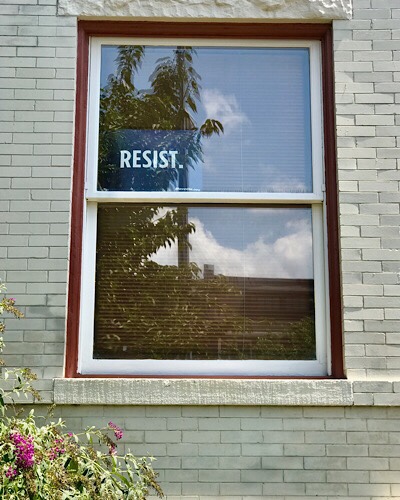
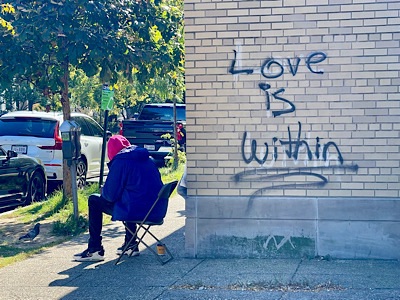
Signs Around Town
I was not able to go to the Washington, DC event for Global Mala Day because I am scheduled to do my regular volunteer work. I did, however, include the focus of this call for a unified, intentional offering in my morning meditation and asana practice.
Do join in, remembering to celebrate yourself as part of the community however and whatever your offering. Be mindful of your body and energy as you choose a practice to be sure that the repetition of 108 will serve rather than deplete.
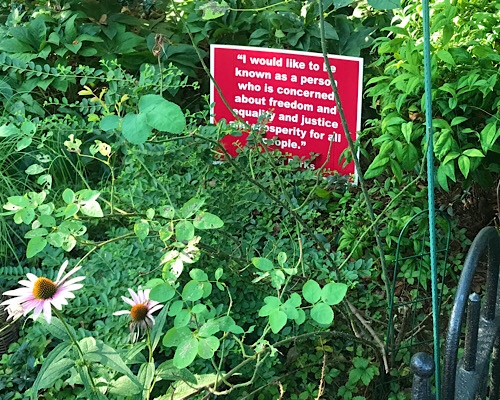
May his spirit continue to inspire action.
Dear Friends,
Hope you all enjoyed the big snow. I missed seeing Saturday regulars and drop-ins with the snow canceling the last day of Willow Street classes and December’s Serenity Saturday.
If you are in need of a little last minute, holiday yoga, come join us tonight at William Penn House, 6:30 pm, all levels class.
For a great way to begin the year, on New Year’s Day itself, come to Capitol Hill Yoga for “Flow Into Grace” a heart-opening, body-shifting (gently), and intention-setting workshop with a combination of all-levels flow and yoga nidra. To register, please visit, www.capitolhillyoga.com. Late night revelers welcome; it doesn’t start til mid afternoon!
I’ll be taking my own holiday break so no Wm Penn or house classes next week, while I am in NY visiting friends, family, and enjoying the delights of the city.
Wm. Penn and house classes resume the first week of January. That week is also free class week at Willow Street Yoga Center (www.willowstreetyoga.com). I’ll be offering 8:30 am level 2 and 12 noon Gentle/Therapeutics on Saturday, January 9th.
If you were registered for Serenity Saturday in December, call Capitol Hill Yoga to switch your registration to New Year’s “Flow into Grace” or January’s Serenity Saturday (January 16th).
May you all have healthy and delightful holidays whether traveling or staying at home.
Peace and light,
Elizabeth
Yesterday morning, before I read the article in the Washington Post I discussed in yesterday’s post, a memory of an acquaintance from Quaker youth camp entered my seated meditation. I had not thought about C in at least 30 years. He was a couple of years older than me, and all the parents were a buzz with talk and worry when C decided that instead of going to college, he wanted to give away his possessions, live in a community devoted to simple living, a vegetarian diet, daily worship, a like-minded community, and spreading what they believe is the word of God. Nowadays, many of the people who are in my broad social network would have nothing but admiration for someone who lived by and practiced such tenets, including the daily chanting of the name of Krishna (or some other deity). In the late 70s, the parents were deeply concerned: “He is in a cult, he is brainwashed, we need to get him back.” “Back to what?” I remember thinking at the time.
I have not seen a member of ISKON (International Society for Krishna Consciousness) in years. Why not? Not because the “cult” has disbanded. Rather, it has grown substantially and become part of the fabric of our global religious society. Now, by virtue of its longstanding existence, its members blend in with accepted norms of social and religious behavior.
What makes a cult? What makes a religion? How do cults and religions foster, spread, or interfere with our own relationship to spirit and our recognition of spirit in others. What is the difference between ritual and religion? Ritual and spiritual belief and practice?
ps Craig made a good point yesterday about being sensitive to the practicing Hindus when we take part in some of their practices, but not in the context of the Hindu religion. He also noted a number of rituals that have morphed and shifted with changing religious groupings in society. ISKON “took” something that was part of the Hindu religious practice and opened it to the masses (proselytizing with enthusiasm). Is that not analogous to the development of any religious sect? Think about the meaning of the word “protestant.” When is an off-shoot of a religion a cult, a “legitimate” religious group, or an offense to the group from which it parted in terms of stated belief or practice? Does it matter that some take offense? What if offense is taking because of a disturbance of a status quo that diminishes and constrains large elements of society (such as women or people of certain classes)? What about practicing a ritual to honor members of another religion — I am thinking, in this regard, of the recent example of the White House seder?
pps. How is this relevant to our yoga practice in the United States? Many of us listen to and practice our asana to the music of “chant.” Krishna Das has a CD called “All One” that has nothing on it but variations of the maha mantra “Hare Krishna” that became so notorious when ISKON was just being known here. What does it mean when we listen to such music, buy such music, share such music, chant these words?