Asana Practice?
This week, I am resigned that Anusara has finally dissolved too completely for it to live on in any way that resembled its former self, the most sweetly and bravely hopeful having at last been pushed away by the concatenation of energetic forces. Though I never actually said: “I have resigned,” during these months of observing the intense communications of other members of the community,” I have said with resignation: “what is there to resign from?” “from what would I be resigning?” and have wondered whether and to what end I should express it out loud.
I haven’t felt able to say anything specific until I was sure I could trust that whatever I said was coming from my heart and truly honored all the gifts of learning and friendship from this decade of practice in the Anusara community. The joy, the knowledge, and the healing fruits of the practice remain part of my being and teaching even if the relationship that facilitated them is no longer tenable. I have an idea that being a part of this break up/break apart/act of Siva/Kali/Durga — what should we call it?–might itself have been meant by the universe as a teaching for me about relationship and community (perhaps sort of like being whacked on the head for fidgeting in meditation–though I never sought out the whacking on the head kind of teacher or practice).
Since the first posting on the internet in the extraordinary world of social media, I felt a relunctance to engage in the on-line conversation and a deep call and responsibility to practice. When I am sitting in meditation, when I am practicing asana — and when I am dancing at the contact improv jam — is when I know to my core that the gift of the practices and the opportunity to share the practices in community as an ongoing exploration of mind, body, and relationship matters more to me than the structure of the community or who is leading at any given time. Along with asana, meditation, and studying, I have been practicing bhavana (deep meditative contemplation) on the inextricably intertwined processes of dissolution and creation. Having been forced to go deeper from this whack on the head as it were, I am seeing better than I have before in this embodiment patterns in my actions/reactions for which ways to rework, undo, shift, reweave into more harmonious ways of being are revealing and unfolding themselves.
During these weeks, I kept thinking the time was ripe to write publicly about my reaction to what was happening and then I would contemplate whatever words I had thought I should say and realized that I still was not ready. I suppose some part of me was hopeful, though I have also been from the first resigned to the imminent scattering and shifting and dancing into different constellations of all of our voices as teachers trained in this style that no longer has a referent for its name nor a precise shape.
I confess that I am more concerned about Mitt Romney, Scott Walker, Trayvon Martin, global climate change, the recession, my garden, and my friends and family, than I have been with John Friend, though I miss the delight of getting together to practice en masse and the comfort of being recognized as part of a skilled community of teachers together under the banner of a respected trademark. And how joyous at its heyday our collective explorations on the mat of the exquisite, elegant, and healing universal principles of alignment. I am doing my best to take what I have learned from yoga practice (Anusara and not) and study to inform how I act, speak, and relate to the community in its evolving incarnations and to the how and what I offer my students. To support my practice and the community, I have been continuing to attend workshops with friends and teachers who have inspired me over this decade. It is good to practice in smaller groups closer to home. It is good to see my practice buddies.
I never did formally resign (perhaps I was stuck like Arjuna’s sitting paralyzed on the battlefield, perhaps it was something more or less than that), but I am resigned, in the way of a graduate who liked the comfort of the structure of school but who knows she must go out into the world and make her way, that there is no choice left but to move into relationship with this community of fellow students and teachers in a different way.
Perhaps I will have more to say, but I cannot yet say when (though if you’ve been following my blog, you may have noticed how much I was saying in pictures and stories that were on one level about something completely different).
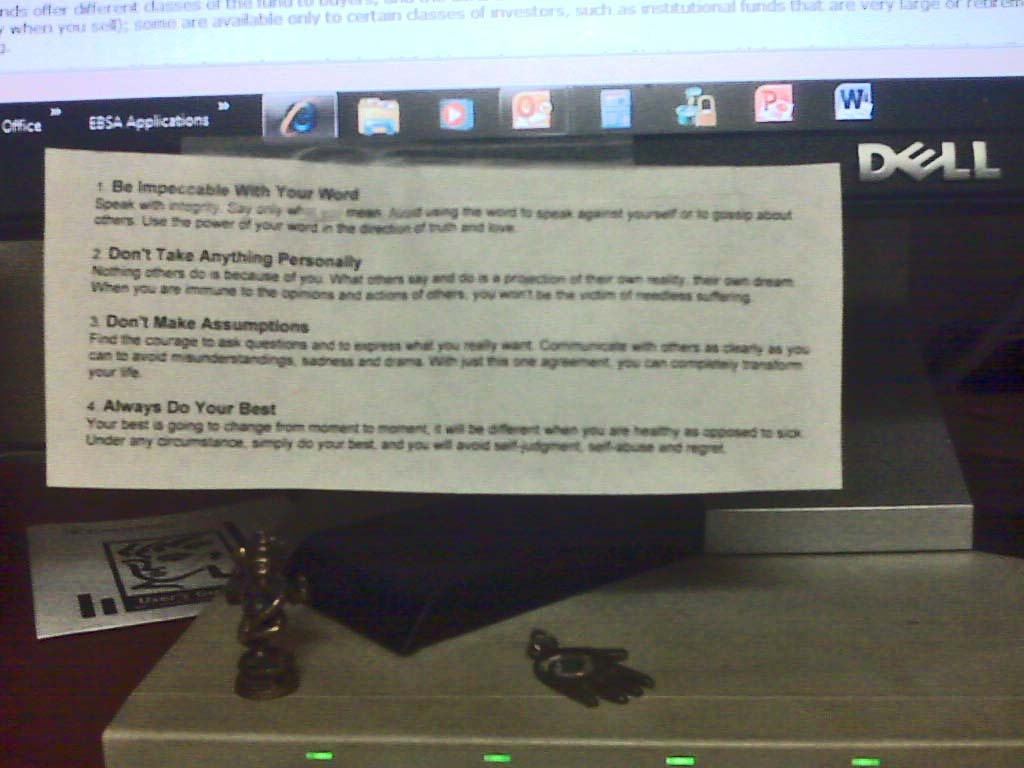
This is my desk at the office. The quote is “The Four Agreements” by Miguel Ruiz. I read “The Four Agreements” at the recommendation of Betsy Downing at the first Anusara yoga retreat I attended, and though it could be seen as so much New Age psychology, I think the agreements themselves are useful guides for considering how to respond when someone pushes my buttons. Betsy will be at Willow Street Yoga June 22-24 and it would be great to see many of you there. In the meantime, on and off the mat, I continue to contemplate these “agreements” along with the “four gates of speech” and how they can positively shape how I relate and speak to others in my world, especially when things get tough.
Last night I went to see the revival of the Bernstein musical version of Voltaire’s Candide, now playing at the Shakespeare Theater’s Harmon Hall (discount tickets available), which was absolutely a delight — fantastic staging and direction, luxurious costuming, enthusiastic performances. Throughout his journey, which is beset with cruelty, hardship, natural disaster, and other mishaps wherever he goes, Candide sings of his tutor’s optimistic advice that “all’s for the best in this best of all possible worlds.” The application of this philosophy leads to some silly results, including the Monty Python-worthy lyric “it’s a great day for an auto da fe.”
I have a friend who, after telling me of various life challenges and griefs, inevitably signs off with the phrase “it’s all good,” though I am not sure she believes it. I thought of her repetition of the phrase “it’s all good,” while I was watching the musical. Later in Candide’s travels, he encounters a second philosopher scholar who (I’m paraphrasing loosely) contradicts the “it’s all for the best” philosophy of Candide’s tutor by telling Candide to just look around and he will know that things are not in fact always for the best. A fluffier version of the debate in the novel, as to whether things are all for the best when there is so much cruelty and devastation, is interwoven into the rest of the play.
I’ve never had a desire to wear the t-shirt proclaiming that “it’s all good.” I look around me, and I simply do not believe it. I do believe wholeheartedly, though, Voltaire’s premise that we have the responsibility to “cultivate our garden.” As my teachers John Friend and Paul Muller-Ortega espouse, we should “respond from the highest,” regardless of what we experience and encounter. By having our response make the best of all possible worlds from things that are not evidently for the best, we bring more light into the world, whatever is our world view. I can only hope that with steady practice of yoga and meditation, I can keep ever truer to these teachings when I am seriously challenged.
Or instead of or in addition to writing, practice of any kind that feeds and expands your soul.

Peace and light, E — Posted with WordPress for BlackBerry.
This past weekend I went to a group meditation practice with a friend because I was in the mood for companionable silence. I am not formally trained in “mindfulness meditation,” but I attend group practices occasionally and have read a number of books and incorporated aspects of the practice into my own over the years, so I expected to be comfortable attending.
Because I was new to the group, the leader asked me questions about what I experienced after most of the segments of the practice.
After the “meditation” segment, the leader asked me whether I’d had any thoughts. Of course I had thoughts. If not, as I think of thought, I would be brain dead.
For me the question is not whether I had thoughts (I include meditative awareness as thought), but whether I got stuck in dwelling on something from the past or some kind of planning or problem-solving. My training would have me let go of attention on such thoughts to refocus on the chosen focus for my meditation, i.e., the breath or a mantra, but for me, that is not the absence of thought.
Some of the quibble might be semantics. Part may be an underpinning philosophy to a practice that categorizes an ideal of pure awareness/consciousness as something higher or better than human thought.
If you practice or teach meditation, feel free to weigh in.

Peace and light, E — Posted with WordPress for BlackBerry.