|

Celebration and Loss (last of the arugula)

last arugula

As you can see from the photo, this tender arugula was not likely to make it through the night (temperatures forecast to be in the mid-20s).  It is a cause for great celebration that it made it through last weekend’s snow storm, several nights below freezing, and provided a little spice to my salads for a couple of months.  It lasts this long because I over plant, first eat the greens as I thin them, then pick them by the leaf rather than by the root to encourage the plants to grow more vigorously, and finally start pulling them up by the handful when the danger of hard frost calls for the inevitable demise.  Tonight, I cut everything in the pot down to about a 1/2 inch.  It is possible, though not likely based on the current forecast of a cooler than normal winter, that if we got a couple of warm weeks in late January or early February that it would come back.

I am celebrating what I have grown in this tiny space and the exquisite delight of eating greens from right outside my door this late into the year.  I am sad that the outdoor gardening season is just about over; I will miss it.  If I had more space or a firmer intention (maybe the latter will come in another year or two),  I could build a cold frame or go for plastic tunnels.  In my little micro-climate, that would probably get me through the winter.  I rather like, though, a space of time with no obligation to the outdoor garden.  A time to dream rather than work.  I know what a luxury it is to be able to rest in such a way and still have bountiful food.
Similar Posts

  • |

    Roasted Brussels Sprouts and Other Vegetables (and the Goddess of Sequencing)

    Cooking is not only an exquisite opportunity to notice and appreciate the various characteristics of the elements of our meal and how they react to heat and fat and cooking times and methods, but a wonderful way to appreciate how everything is ordered in time and space and to honor Kali — the Goddess of Sequencing.

    Brussels sprouts seem to be fashionable this year.  I’ve always liked them.  My preferred method is to braise them:  saute lightly in olive oil and/or butter in a heavy pot with a lid, splash some dry sherry, wine, or vermouth into the cooking pot and stir until the liquid is absorbed, add some broth or water (not quite to cover) plus salt and herbs of your choice, simmer until the brussel sprouts are tender and the liquid is absorbed.

    My friends are gushing about roasted brussels sprouts.  I think the tenderizing, fat-adding delight of roasting has made the much maligned brussels sprout more accessible:  toss with olive oil, salt, garlic, and herbs such as rosemary and thyme.  Roast at 400F until tender and browned (15-20 minutes).  Use peanut oil, ginger, garlic, and soy sauce or Braggs amino liquids for an Asian meal.  Try safflower oil, turmeric, ground ginger, garlic, and ground coriander seeds to serve with Indian food.  Use just butter (or if vegan a light, relatively flavorless oil such as safflower or canola), salt, paprika, and pepper for an Eastern European flavor.

    Whenever I roast vegetables, I toss in an extra head of garlic (separated into cloves), and serve some with the vegetables and reserve some for cooking something else with roasted garlic.  Include a variety of vegetables.  Just remember that different vegetables need different cooking times.  To recognize the mysteries of the Goddess of Sequencing in time and space — you have two choices in roasting vegetables.  You can cut the vegetables into different sizes (so you would leave brussels sprouts whole, cut winter squash or turnips into cubes a little smaller than the brussels sprouts, and potatoes into wedges or rectangles that are narrower than the brussels sprouts for them all to be golden and tender, but not overcooked at the same time.  As an alternative (as we do with sauteing or stir-frying), you can add different vegetables at different times.  You might need a combination of both techniques.  If you wanted to add mushrooms to the mix, since those would need to be larger than brussels sprouts, you would want to add the mushrooms later lest they get withered — how much later depends on the size of the mushrooms relative to the other vegetables.

    Enjoy (and give homage)!

  • |

    Rainy Morning NYC

    The pouring rain is an inconvenience on a play day when I am toting baggage, writing materials, and electronic devices. It is hard to remember, when surrounded by concrete, glass, steel, and macadam, how urgently we need the rain. I am hoping for the trees, the farmers, and all of us, that it is also raining back home in DC.

  • | | | |

    When I Wasn’t Looking

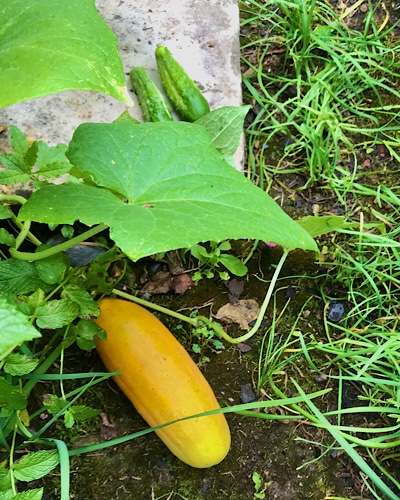
    I don’t know how I missed this pickling cucumber before it grew to such enormous proportions. I’ve scooped the seeds and pulp and added some water to ferment for a couple of days. Then I will dry the seeds that don’t float and save them for next year. This plant has been more successful than prior efforts to grow pickling cucumbers. They may have cross-pollinated with the Persian cucumber, but I’m trying to expand my seed-saving beyond the easy herbs and greens.

    I won’t know how well I’ve done until next year, when I try to grow cucumbers from these seeds. There is a sense of connection to the cycles of life, with such required patience with the changes of season.

    And the cucumber falling from the vine, ripe, and ready to go to seed, is a line in the Maha Mrityunjaya mantra, chanting to release and aid the passage of spirit from this realm of consciousness.

Leave a Reply

Your email address will not be published. Required fields are marked *

This site uses Akismet to reduce spam. Learn how your comment data is processed.