State of the Garden

More ice in the forecast. Will cross post here and on the Rose Garden Yoga Facebook page, if it is too slippery for a safe walk to practice.
Spring is coming. The cherries in Stanton Park are beginning to swell with the promise of buds.
I’ve been baking for holiday potlucks and gatherings. I enjoy the surprise and sense of offering of gatherings where everyone brings something of their own to share. These cookies are easy, attractive, and not as bad for you (if bad means refined flour and sugar, high cholesterol and fat, no nutritional value other than calories) as they could be. I try to use all organic ingredients (except the baking soda and the spirits); the butter and eggs are available locally; I choose fair trade, as well as organic, cocoa.
2 cups whole wheat pastry flour
1/3 cup cocoa powder
1 1/2 tsps baking soda
pinch of salt
3/4 cup butter (at about room temperature — no more than 65F; do not melt or microwave)
1 cup sucanat (evaporated cane juice)
splash of brandy or other spirits
1 egg (beaten)
Mix dry ingredients in a bowl. Cream butter in large bowl; beat in sucanat and then brandy; mix in egg until smooth. Gradually mix dry ingredients into butter mixture. Chill dough well. When dough is chilled enough to shape without it sticking to your hands, roll dough into small balls. Put on cookie sheet and press down slightly. Bake at 325-350F for 8-10 minutes. Makes 4-5 dozen small cookies.
Variations: Replace butter with vegetable shortening and egg with egg replacer for vegan cookies. Add a tablespoon or two of ground cinnamon to the dry mixture and replace the brandy with kahlua for the taste of Abuelita (Mexican hot chocolate). Replace brandy with peppermint schnapps for cocoa-mint cookies. Add a teaspoon or two of dried ginger for cocoa-ginger snaps.
Vinyasa krama is the art of sequencing. How a yoga practice or flow is sequenced can determine whether it is uplifting or inward going, exhilarating or calming. When we are trained and attentive, we start to know the most optimal order to open our bodies and our focus to align with the time of day, the season, the weather, our mood, and our health. This incredible art helps us be positioned and aligned in a way that we feel free in time and space, rather than being constrained by time and space.
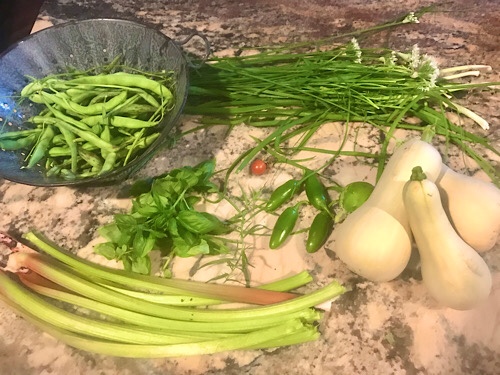
This morning while I was out in the garden, I was thinking a lot about vinyasa krama and the goddess Kali — goddess of, among other things, time and change, and thus, of sequencing. I woke very early, brought to consciousness by the long light of the solstice even through closed curtains. As I went about my morning, rinsing the sprouts while heating the water for my morning coffee; cutting back the greens and herbs before starting breakfast; doing the major pruning and clean-up before doing more decorative garden work; finishing cooking before taking out the recycling; applying a facial mask before starting to vacuum; never walking up or down the stairs empty-handed; waiting to gather the bills until after I was clean and waiting for friends to arrive, etc., I realized how important sequencing is to the richness of my days. By knowing the best way to order tasks for my needs, my day is simultaneously productive, unhurried, and enjoyable.
By the time my friends arrived around noon, I had meditated, taken care of the garden, gathered food for my own breakfast and to share with friends, talked to neighbors, cleaned the house and myself, done a little asana, written in my journal, and sorted the mail. Had I not known from long experience and conscious attention how to sequence all the different elements, knowing which ones went together, which took longest, which ones if done earlier or later would create double clean up, etc, I would have been tired and the tasks unfinished. Instead, after brunch, I came home to a tended garden, a freshly made bed, and time to enjoy a quiet evening.
These sequencing principles also apply for me on major projects at work. If ordered one way, the work is exponentially harder, the deadline a fearsome thing; if ordered another way, everything comes together mostly as it should when it should. When I order my work with attention (this assumes others cooperate with this endeavor), I have time to do a good, careful job and still take breaks, eat well, and leave the office in time to take or teach yoga class.
Whether you are doing your home yoga practice or cooking or working, choose to sequence the elements of your practice, your activities, or your day, with attentiveness, reverence, love, and respect, and Kali will support you and not show you her most fearsome face.

Peace and light, E — Posted with WordPress for BlackBerry.

The white flowers growing with the tomatoes and cucumbers (cages) and the beans (red supports) are coriander that over-wintered, and gave lots of good leaves from late winter through mid-spring. I’m now letting them go to flower and then seed. I like to use the flowers as a garnish. Still green and newly forming coriander seeds minced, along with whatever greens are still tender on the plant, are delicious in lightly cooked young vegetables. Almost flowery, like some Persian cooking. The fig in the right foreground, alas, has no buds this year. It wants to be planted in the ground on a sunny side of someone’s house. Local readers, if you want a healthy fig tree, comment or send an email.


