Art and Culture | Asana, Pranayama, and Yoga Practice | Community and Family | Meditation | Photos | Quaker
Found Exhortation
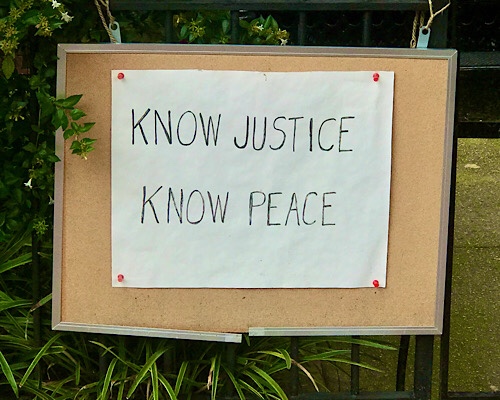
Wouldn’t make a bad epitaph. In the mean time, trying (sadhana).

Peace and light, E — Posted with WordPress for BlackBerry.
 A student and friend sent me a link to an article posted by the Center for Consumer Freedom alerting consumers that excessive levels of heavy metals have been found in the reusable bags being sold by some of the big box retailers and supermarket chains. The analyst reached the conclusion that consumers should be allowed to use disposable plastic or paper bags [environmental consequences ignored] so that they are not forced into the untenable position of having to use bags that are manufactured with unacceptable levels of toxic ingredients.
It is fantastic that the folks at CCF advised people of the potential hazards associated with the manufacture and use of certain types of reusable bags. What I do not follow is the absolutism of the “either or” choice presented: poisonous bags (forced on you by environmentalists) or disposable plastic or paper bags (with all the attendant hazards to the environment). Why does the bag you use have to come from the grocery store? The types of retailers identified might have seized another retail and advertising opportunity to make cheap, hazardous reusable bags in nations with cheap (i.e. inadequately paid and treated) workers in countries with lax environmental and consumer safety standards. But this is just another example of how corporations prosper at the expense of the health of the planet, as if the worth of the stock of corporations — the part that is separate from the world in which the corporation operates — in itself is the highest good (that’s a discussion for another day).
I write about this article because it seems to me to be a perfect example of how staying within paradigms, choices, and societal constructs presented can keep us in the kind of ignorance (avidya) that prevents us from being in alignment, from seeing the good, and from responding in the highest. I am sure you, as can I, can think of far too many other examples of how if we stay with the question as it is framed, can prevent us from finding a peaceful, loving, healthful solution. The choice here is not bad for the environment and your kids (or pets) reusable bags or bad for the environment disposable bags. The choice is between bad for the environment bags and reusable bags that made by you or someone you trust not to use poisonous materials.
I have been carrying my own bags on a progressively more consistent basis since I was inspired to invite people to participate in Earth Day when I was in junior high and high school in the 1970s. The photo shows some of my favorite carry bags. From left to right: (1) the day pack I bought in 1984 to carry my law school books, which were very heavy; it cost maybe $20 and it is still going strong; (2) cute organic cotton bag with “make love, not war, haight-ashbury 1968” silkscreened on it; I get complimented on it whenever I use it, especially when I turn down super cool disposable bags at fashionable stores in NYC (“no thank you; I have my own bag”); freebie canvas bag from Barney’s Coop; cannot be sure that it was made with union labor, but am pretty sure it isn’t one of those toxic bags described in the article.
Next time you are struggling with what seems like an choice between Scylla and Charybdis, invite yourself to soften, to open to the bigger picture, to open your heart and mind as wide as the widest space of meditation, and ask whether you are asking the right question.
I read today a piece in the Washington Post about Hindus needing to “take back” yoga. I read the article and the comments with great interest because it has been a matter of much discussion with those in my meditation and philosophy course as to the extent to which the practices we are learning are “religious” practices and whether they can be practiced consistently with other religions. There is much difference of opinion and strongly heated and held positions.
What I think is missing from the article is the question of distinctions between “spiritual” and “religious” practices. It is a simple fact that practicing yoga with depth and sincerity entails learning practices that are observed by Hindus. Does that make one a Hindu? Does it mean that one is “dissing” Hinduism if one learns and benefits from the practices, but does not self-identify as a Hindu.
What about Jews who have trees at the Christmas holidays (a tradition co-opted from the pagans in any event)? Is it OK that I have a mezuzuh even though my parents (who were born Jews) raised me in the Religious Society of Friends (Quakers), and I continue to be a member of a Quaker meeting, and observe no other Jewish laws or practices.
Is it OK for me to chant “Hindu” chants if I do not identify myself as a Hindu or attend Hindu temple? If it is not OK, for whom is it not OK? Quakers? Hindus? Jews? Me? Who is to decide or judge?
It seems to me that “religion” (as specific sects, identities, and strict rules) tends to highlight difference and disunity, but sincere spiritual practice — whether or not done in a religious context and observance — should be unifying because all religions at their highest and most universal, call upon us to recognize the unity of spirit in ourselves and in all beings.
Who goes past oblivious and uncaring? Who goes past preoccupied? Who takes a brief glance and continues on? Who stops to watch? Who discusses and invites? Who makes a special pilgrimage? Who is inspired to create by the creative offering?
Photos from last week of Doug Aiken’s Song\1 at the Hirshhorn.