Be Here Now (Var.)
I found used a novelization of the Mahabharata a couple of weeks ago, which I am now reading. I’ve read other versions put into English prose, all of which have some stamp of the presenter (author?). The version I am reading brings to the fore that those who are deserving of the love of people and who are blessed by the divine are physically beautiful, wealthy, and possess great military prowess. Righteousness includes unquestionably obeying the orders of rulers and parents and accepting your station in life as the determination of God.
The book jacket proclaims the Mahabharata “the greatest spiritual epic of all time.” I agree that it is a great epic and a rather amazing one. Some of the precepts, like all presented in great writings that have lasted over the centuries are worthy of contemplation for one’s own life (I am all for recognizing guests as divine visitors and treating them with due regard, for example), as well as for understanding the society in which the work was created. But any work that mostly reflects the societal mores of the time in which it was written and is designed to perpetuate the powers that be is perhaps best read as fiction. Saying this does not mean I do not recognize the good of some of the teachings interwoven into the fairy tales, but rather that I think it must also be understood in the confines of its context, lest we perpetuate societal evils that no longer serve. (This, of course, has Western parallels.)
A samskara is generally defined as an impression left in us by a past action or experience. I found myself thinking about the process of samskara yesterday, when I went with long time friends of my family to watch their son taking class at the summer program at the Kirov Academy of Ballet.
I have not watched a ballet class (except on the occasional film) since I was actively studying ballet as a teenager and young adult. I have long been conscious of how ballet imprinted my body image and way of looking at myself, but have not found a space before where I was able to look at this aspect of my history with fresh eyes.
What was different yesterday, was that I was observing with openness. I was sitting with people I have known all my life, sharing their warmth, love, and parental pride for their son, rather than concentrating on my own history. It brought back memories, but not in the same way that sitting by myself or with a girlfriend, watching a documentary has done.
In this open state of reflection, I witnessed something that I knew at some level, but had not given much thought to before: how much having taken thousands of hours of ballet class has informed the way I teach. My tendency in my own practice and in my teaching to see the details of alignment and to try asanas repeatedly until it seems that I or my students have experienced the alignment in the most optimal way for the day is straight out of my experience in ballet class.
Softening and witnessing instead of feeling or judging from past experience gives the possibility of shifting from samskaras, even ones that are very deeply etched into body and mind. Being with my friends yesterday, of course, gave me the joy of seeing the spectacular dancing of these young men and the delight of connection. It also gave me the unexpected gift of a moment of understanding how the Anusara principle of “opening to grace” allows us to shift. When we are open, nonjudging witness consciousness (an aspect of “opening to grace”), that is when we have the possibility with each thing we repeat, to experience it new without being bound by our samskaras.
When I was walking to work this morning, trying not to get enmeshed in anxiety about the stresses of the day to come, I invited myself to practice gratitude (and not just being grateful for having only first world problems).
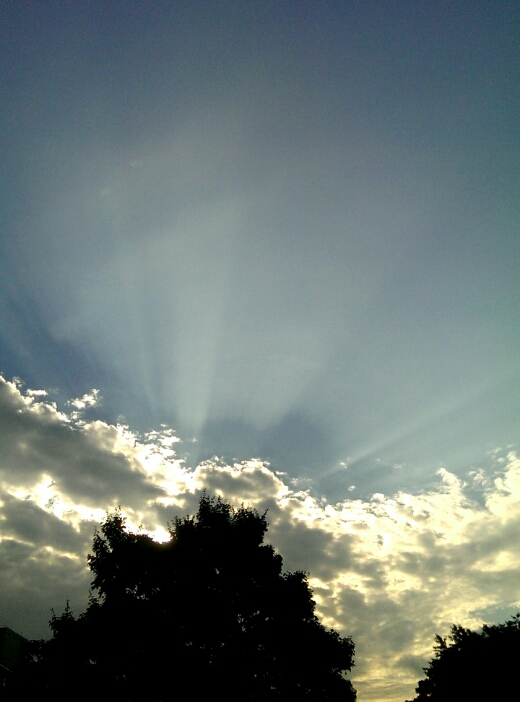
I paused to look all about, at the beauty of this lush summer. When I turned around for a 360 degree appreciation, I saw the view following me was as engaging as the view in the direction I was walking.
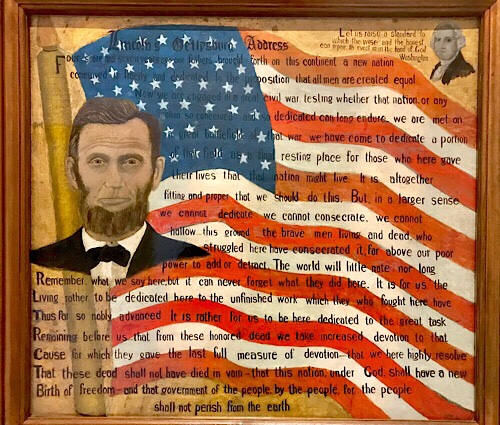
John Kane’s “The Gettysburg Address”
Outlier Art at the National Gallery