Svatantrya or Perhaps Jivanmukti?
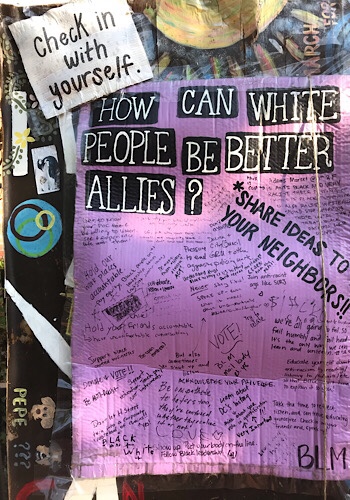
Sign asks, “how can white people be better allies? Share your ideas to your neighbors.”

Rules for conversation at Active Bystander led by J.E. McNeil at Friends Meeting of Washington. May not get to writing about it, but very willing to discuss in person.
Last night as I waited on the metro platform at Takoma Park after yoga class, a large man in a shabby black coat came up to me and said, “happy thanksgiving.”
“Happy thanksgiving,” I replied, thinking I like Thanksgiving better than I like Valentine’s Day, even considering the somewhat unsavory roots of both holidays.
“Oops,” he said, “I meant ‘happy Valentine’s Day; I’ve been getting that wrong all day.”
“That’s OK,” I said. “Every day should be a day of thanks giving.” I had been enjoying the day fully even though I had not engaged in any Hallmark-driven behavior and was feeling fully grateful for my life and not just because of the post-yoga class glow.
“I don’t have anyone to give red roses to any more,” the man lamented. “My mother has passed; my grandma has passed. I don’t have a girl right now.”
“Your mother and grandma are still here in your heart, and they know you love them. They do not need roses,” I offered. “In fact, you have helped the world be a better place not buying any roses today. Most bouquets of roses are laden with pesticides and cut and wrapped by women in poor countries who get sick from the pesticides.” At this, a young woman watching me with commiseration lit up with a big smile. Who would start giving advice on the hazards of Valentine’s Day flowers — I restrained myself from talking fair trade chocolate — in this situation?
“You’re nice,” the man said, “what’s your name?” The metro was still not due for another eight minutes, and, being the introverted, cautious, small, middle-aged woman that I am and thus feeling a little pressured by his longing for someone to talk to, I did the verbal dance to extricate myself from the conversation and get back to the email I had been in the middle of reading. He went away peaceably, so it was alright.
Last night when we walked out of William Penn House from the Tuesday night yoga class onto East Capitol Street, we could see a convocation of police cars in front of the Capitol — presumably in preparation for the President’s speech. Karen asked, “where are the helicopters?” “Maybe, Obama doesn’t need them,” I replied, “maybe he is choosing not to live in fear.” There weren’t any army or police helicopters all night. This was the first Presidential speech in eight years where helicopters did not relentlessly drone overhead, calling people to be afraid and to act from a place of fear.
Patanjali’s yoga sutra II.3, says: avidyha asmita raga dvesa abhinivesah klesah. BKS Iyengar translates this sutra as follows: “The five afflictions which disturb the equilibrium of consciousness are: ignorance or lack of wisdom, ego, pride of the ego or the sense of ‘I’, attachment to pleasure, aversion to pain, fear of death and clinging to life.”
The world is far scarier now than it has been for most of the past eight years. In some ways, though, at least in my neighborhood, it feels less frightening because the signs of being afraid are not being emblazoned everywhere to call all to share in the fear.
We can practice choosing to turn to a place of strength rather than fear on our yoga mats. When we choose to do the difficult poses that are at our edge that bring up fear and aversion, we can notice the fear and aversion, but not become fully engaged in it. By using the Anusara principle of opening to grace, we can accept fear and aversion as part of human being, but then soften and open to the full range of being, and not just cling to the fear. Instead of avoiding the poses or beating ourselves up for being afraid, we can choose to use the yoga principles we know to invite a full experience of the moment and the possible poses. Remaining open to witnessing the full range of our being through the pose, we next engage muscular energy (strengthening by embracing the muscles to the bone, hugging into our center [midline], and drawing from the periphery into our core). Having found our strength, we expand more fully (expanding/inner spiral). We then have space to draw more deeply into our core power (contracting/outer spiral). With this balance of embrace and expansion of ourselves, we then can fully embody strength by reaching outward (organic energy) and making offering. This pulsation of principles in poses has led me to discover physical and energetic abilities in my middle age I had not dreamed possible.
Off the mat, the same principles can lead us to move from love and strength instead of fear and clinging. As I got into bed with the peace of the night uninterrupted, I pondered how these principles can manifest and gave a profound thanks to whomever decided the harbingers of fear — the helicopters — were unnecessary.