What’s Your Dharma?
You make it entertaining and you even now manage to help keep it wise.
In the tradition of our culture’s “new year’s resolution” I like to practice yoga nidra at this time of year to help establish a new sankalpa or intention. A sankalpa is different from a new year’s resolution. It is short, affirming, and is both in the present and forward-looking.
Usually it takes a couple of weeks for me to be certain of what sankalpa is right for me to work with for a period of months. One year, I had been very sick for the entire fall and early winter, so it was easy to choose “I am healthy.” For the past two years, as I struggled with my place this time of war and societal struggle and thought about my own role in creating and avoiding conflict, I chose the sankalpa “I will come from the light in all I do” (“light” for me meaning an inner place of peace, compassion and spaciousness).
In the past several months, mostly due to having thoroughly enjoyed creating meals from the garden and the farmers’ market, I am a little heavier than works with the clothing I own and my sense of comfort with my body image. Instead of having a new year’s resolution to lose five pounds, which would likely fail, I am working with the sankalpa “I love and respect my body.” The former buys into societal expectations of what my body should look like, imposes mental will over my body, and reinforces a mindset of negative judgment and denial. The latter is joyous and affirming. I believe that if I truly love and respect my body, I will eat in a way that is healthy for my body and the earth. I will either lose the few pounds or be more accepting of my body as it is. This sankalpa thus gives me much to contemplate in terms of my relationship to the mirror, my clothes, my asana practice, and my way of eating. How much it gives me to contemplate expands if I think of the body extending beyond just my flesh and bones and physical appearance, but also to my energy body and all that I bring in through the senses.
What sankalpa would be transformative for you this year? What would help you embody your sankalpa (other than, of course, establishing a regular yoga nidra practice — see yoga nidra resources).
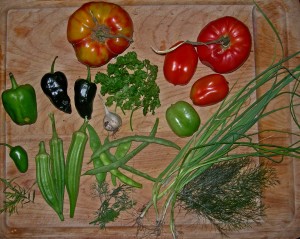 Could not resist the french name. More fun than summer local vegetable stew. An alternative name could be: how to make three okra and six beans into dinner for two. Or maybe four. When I was out in the garden this morning, I simply picked what needed to be picked. Featured here: three okra, six beans, one jalapeno, two ancho chiles (one partly dried on the plant), two large tomatoes (both of which are only partly viable), two ripe and one green (fell off while I was picking the ripe ones) roma tomatoes, one very small garlic clove, baby leeks, garlic chives, tarragon, parsley, dill, and herb fennel. Serve over quinoa, couscous, rice, or pasta, and it is easily a meal for two. Add some red beans or other dried beans, and it could be dinner for four.
One of the things I like about eating from the garden is the necessity of being creative. Cooking from a cook book, who wants an ingredient list this long? I could also be disappointed that no one of my plants is giving me enough to create a dish out of mostly one or two ingredients. If I were getting these ingredients from the store, I would get more okra or beans or peppers. There is a great joy in finding a sense of abundance and sparked creativity and celebrating pleasure, art, fulfillment, delight, offerings with what we have been given, whether it is the food from our garden, our bodies, our talents, our families, or the time and place into which we were born. In finding the highest sense of abundance and creativity within our limitations, we are truly experiencing the yoga concept of jivan mukti, living liberation.
At the Tillai Kali temple in Chidambaram, above the murti of Kali where ritual offerings are made, is a mirror that reflects the viewers, bringing their reflection into the puja. I noticed the mirror and asked Douglas Brooks, who was standing next to me on the trip he was leading, “prakasha and vimarsha”? He affirmed my guess—saying it had taken him many visits to appreciate the presence of the mirror and its purpose to remind of the S/self reflected in the light of consciousness.
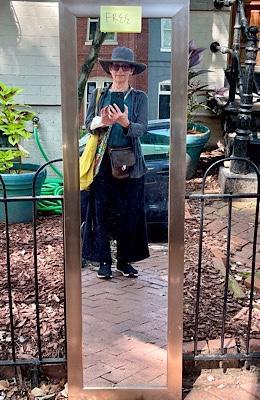
Seeing the “free” sign on this mirror when I was out walking, that place and time came to mind.
A yogi might consider whether wanting to answer “yes” to this question (no matter the circumstances of our dying death) is a major goal of a steady practice.
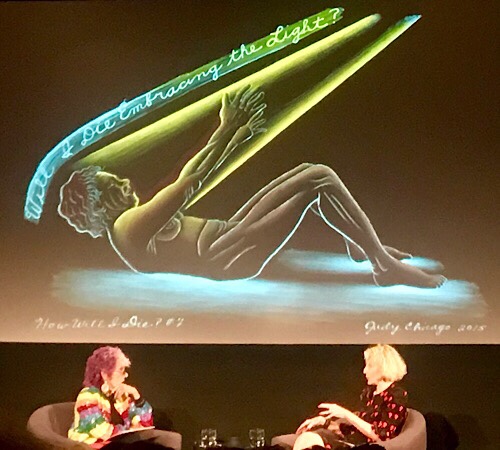
Judy Chicago and Martha Nussbaum, Fresh Talk, at the National Museum of Women in the Arts, 9/22/19