Asana, Pranayama, and Yoga Practice | Food for the Mind (Yoga Philosophy, etc) | Gardening | Meditation | Photos
In a Rose Garden

Earlier this week one of my long-time students emailed me before class to say that even though she had strained a muscle in her mid-back, she still intended to come to practice because she hoped it would make her feel better. “It even hurts when I laugh,” she added. I emailed her back saying that I would offer alignment instructions to help with her back, but I could not promise that we would not laugh (which, of course, she reported made her laugh). In fact, it was a class filled with much laughter, but applying the principles of alignment served to alleviate the pain the student had been experiencing.
Towards the end of the class, as we were getting ready to move into a seated forward bend, I asked my student what alignment principles she should apply to take care of her back in the pose. Demonstrating as she spoke, she said that she should spread her toes to activate “shins in;” take her inner thighs in, back, and apart to inner spiral her legs in order to widen her pelvic floor and enable curve in the lumbar spine, releasing some of the strain on her back; and then work outer spiral to engage and protect her back. “Perfect,” I said, “but what should you do before those actions?”
Another student jumped in, “open to grace.” Quite right, but how, I asked, would you apply “opening to grace” as a physical principle in this instance? That seemed a little like a trick question, so I explained how I use the action of “opening to grace” when I am working with an injury (obviously this applies all the time, but it especially applies both when working with an injury and when moving towards a more advanced pose than you have previously practiced.)
Opening to grace here means being patiently and exquisitely sensitive, moving slowly and mindfully enough to be able to tell from the beginning and throughout the entire cycle of entering into, reaching pinnacle (whatever that may be under the circumstances), and getting out of the pose whether the movements are serving to heal and expand before causing more pain and injury. Does any movement into the pose at all aggravate the injury? Does applying the principles gently make it better? Does applying them with fierce intensity help more? If we start with the strongest, we will have already gone past the place where we discover that resting or just a gentle attempt would have been healing or expanding, but any more would be aggravating. When we start with the gentle and sensitive and then move in deeper and stronger without losing the perfect sensitivity that is when true change can occur.
It never feels good to be injured, but because of the immediate motivation to get out of pain, injuries can be great teachers of just how much practicing with true sensitivity and awareness can enable us to expand heart and mind instead of just moving towards wilder poses for the sake of some idea that we are better yogis if we can do more poses.
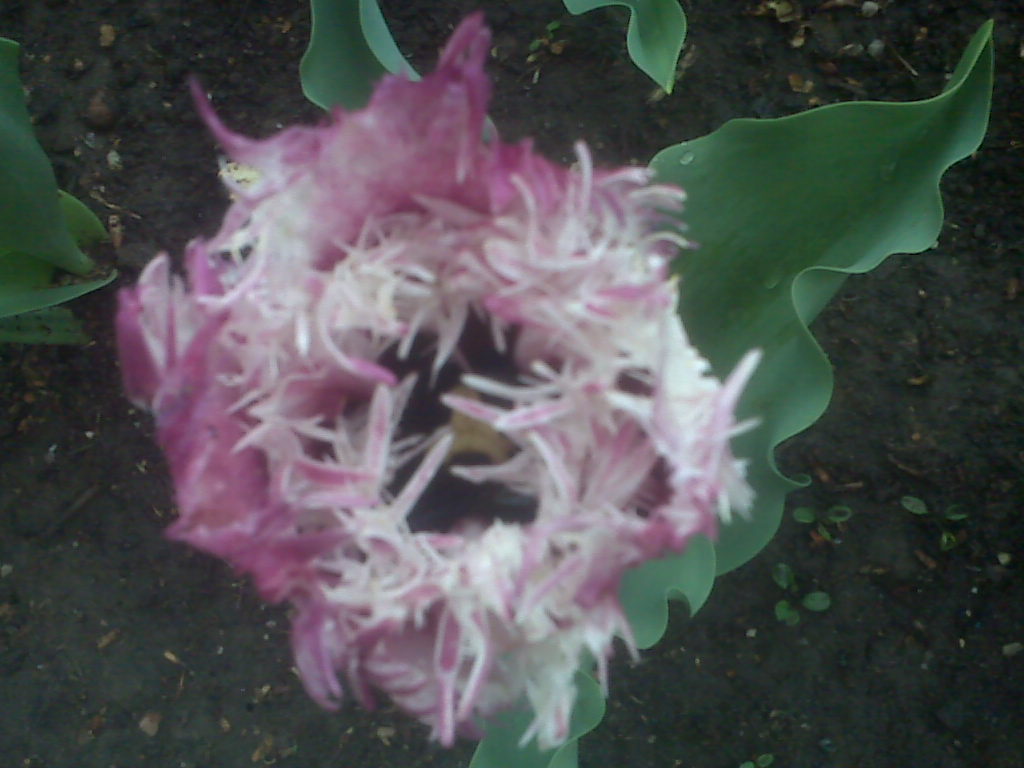
A particularly prickly-looking tulip just north of the Capitol.
Peace and light, E — Posted with WordPress for BlackBerry.

The clouds are thin; we need rain. But not too much.
This murti of Nataraja has been in the window of a store near where I work for at least 20 years. I often walk past is and just as often stop to admire it. I have never really considered taking it home, lovely as it is. The murti is simply too large for any of my rooms. I have mentioned its needing a home to a couple of different friends, who were looking for large murtis of Nataraja, over the past few months, but none have followed through.
Today, when I was walking past it on a lunchtime walk to the bank, I noticed a “commercial property for rent” sign in the window. I will miss having this resplendent image in my work neighborhood, but not enough to buy it and bring it home. I decided, though, to take a photograph. I know the owner only very casually, but well enough to know he is retiring, rather than being driven out by rising rental costs or the recession. The neighborhood has gotten trendier since Nataraja first appeared in the window. Nataraja might be replaced with a delicious restaurant or a fabulous store purveying things that entice me. Or the space could stay vacant or be used for something that holds no interest for me whatsoever.
Nataraja–lord of the dance of concealment and revelation, of dissolution and manifestation–is dancing here. The murti will be sold or transported away when the shop closes and will physically be gone.
I will have my memories of the image, a photograph I took with my BlackBerry, and will have had a sweet opportunity to observe the lord of the dance dancing away his own image.