On the Way to William Penn House for Tuesday Night Yoga Practice
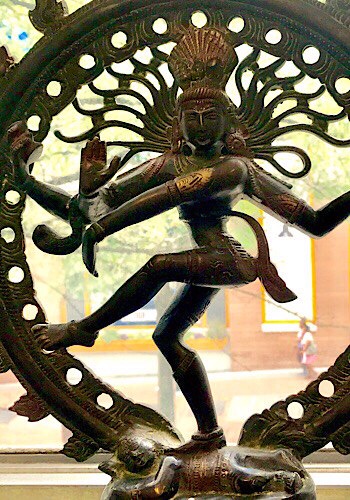
Included in the asana today at Cyndi Lee’s day of workshops at Willow Street Yoga was one of my very favorites: anantasana–the serpent couch of Vishnu. Nataraja, dancing his wild dance, was watching. People outside went about their ordinary and extraordinary lives.
The first of Patanjali’s niyamas (part of the ethical precepts that are precursors to the practice of asana, pranayama, and meditation) is sauca — purity or cleanliness. The practice of sauca includes in it a literal exhortation to be physically clean. I think it also carries with it a sense of order, a cleaning out of physical, mental, and emotional clutter, so that we have more clarity. When we find more clarity, we can be more in the flow with the inexorable sequence of time and space.
Experiencing how we fit into the pulsation of time and space is one of the exquisite joys of gardening. This time of year, avid gardeners are eager to get int the garden, and it is tempting to get started to soon, to start new things without cleaning out the old. When we are more experienced (and know better the optimal sequencing of starting the garden with the shifting of the seasons), we also know that we might have gotten a few days in the 50s F, but it is still winter.
Emphasizing the practice of sauca now will serve the whole gardening season. When it is still cold, but the heart yearns for the garden, is the time to be planning, reorganizing, and cleaning to get ready for the days when it will stay warm enough for growing outside a cold frame or protected area. As I use a lot of containers, now is the time for me to see what containers need repairs, removal of perennials that did not make it through the winter, and new soil. It is the time to prune what is better pruned now than in the fall. This is not just trashing everything, but seeing what should be preserved, what should be repaired, what should be cleaned, and what should be discarded or given away. It is cleaning out what gets in the way of an optimal flow of energy to experience the greatest effulgence of nature. By practicing the cleaning and clearing out phase with intention and enthusiasm, I am present with the garden and also in sequence with the light and the temperature. In this way, just as I am when I practice these principles on the mat, I get the bliss of yoga.
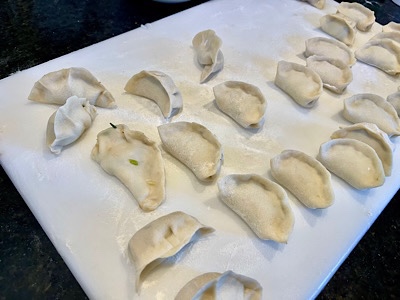
Last Monday I had the honor and delight to be invited to a multigenerational dinner of homemade dumplings at a neighbor’s house.
I was told it was customary for guests to shape a share of the dumplings; the hosts do everything else. As I have not grown up making dumplings as part of group family activity, that meant I needed first to be shown what to do with the already made dough and filling.
Skills used to make homemade noodles, tortillas, and pizza helped make dumpling shaping an accessible activity. It was tricky at first. Two people were showing me two different ways, which was somewhat confusing in an enjoyable way, and helped emphasize that for friendly dumpling making, ultimately, everyone needs to find their own method that works for them. Also, as with many hand skills, because it was the first first time I was being shown, I was simultaneously transposing it from right to left-handed.
It only took two tries to get a dumpling that wouldn’t explode in the pot and lose its filling. It took several more to make one that had nice pleats and blended in with the rest.
We had an interesting discussion about the difference between learning by eating several variations and then reading several recipes and then trying to replicate a version that resembled what I had eaten prepared by someone who learned from childhood as part of a multigenerational group process.
I have long contemplated, and continue to do so, how my comfort in learning anything from a book and then seeing if I can do it or something like it, has shaped my meditation and movement practices.
It’s pretty easy to see which dumplings I made. No difference in taste. I was also happy to contribute garlic chives from the garden.
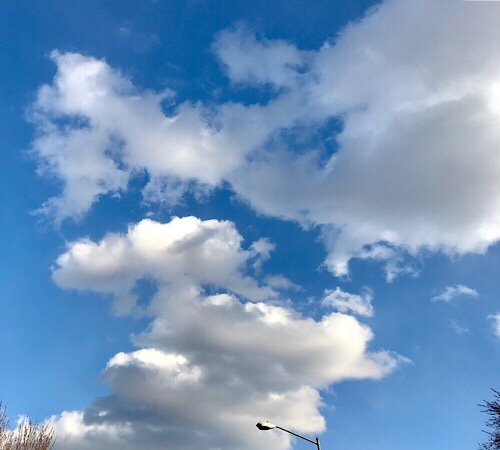
One reason to look up is to avoid the troubled response to a view of highway and homeless shelter. The other is because I am captivated by the never ending exquisite beauty of sky and how much I can learn about my environment from the sky if I pay steady and open attention to it.
Sometimes I practice because I want to move my attention away from something unpleasant. More often it is because to practice is an abiding joy.