Today’s Puja Card
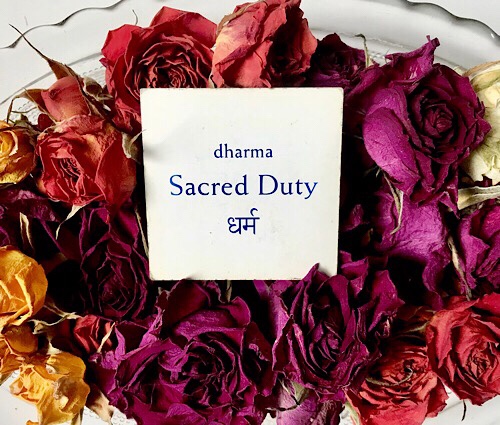
Last night, we were talking about the parameters of cultivating a steady and fruitful meditation practice, and Paul Muller-Ortega suggested that it was about the balance of stability and flexibility. He had learned the principle from a different source, but I have contemplated and explored the principle in depth from teachings I have received from John Friend.
A critical aspect of the Anusara alignment principles is to find the perfect balance of stability and freedom. We need stability to stay fully and safely in each pose. We need freedom to achieve the fullest and most delightful expression of the pose.
We find the stability both by making certain that we have established our foundation (which is an aspect of the first principle of opening to grace). By then using the three aspects of muscular energy–hugging the muscles to the bone, drawing into the midline, and drawing energy from the periphery to the focal point, we make possible an expansion of our edge, whatever that might be. Having a solid, aligned foundation and affirming our very core with these actions, gives us security and balance. We also want to reach out, to be playful, to expand to our fullest, which we do using the expansive, outreaching organic energy — from focal point to the periphery, from the midline to our outer edges, from the very marrow of our bones through bone, muscle, skin, and beyond.
If we over-emphasize (including natural inclination) stability, then we can get stuck. If we just let ourselves be free, then we end up all over the place. When these elements are perfectly balanced, we can safely find our deepest freedom of expression.
When I teach this principle as the focus of a class, I always invite my students to think of how important the balance of stability and freedom is for every aspect of our lives.
The discussion last night put this principle in the context of the regularity and steadiness of our practice, with the recognition that to stick with our practice, we will sometimes need to vary the time or amount of our practice, or what elements are included in the practice.
To get the fullest benefits of a practice (this applies to any practice and not just to meditation), we need to show up consistently and to practice in accordance with how we have been taught. To stay steady, though, we need to give ourselves the permission or freedom not to show up, or within appropriate parameters, to modify the practice when life gets in the way of what we think would be the ideal practice. If we think we have to do things at the exact time and place every day in a perfectly precise way, we become rigid. On the other hand, if we are loosey-goosey about it, then we do not have much of a practice and will not realize the benefits that we could get.
Where in your practice or life would more stability and steadiness give a field for greater freedom and happiness? Where could you give yourself a little more flexibility so that you feel that steadiness brings the possibility of joy, rather than tying you down?
Peace and light, E — Posted with WordPress for BlackBerry.
My gardening friends have been commiserating and worrying about the abnormally dry weather. For the past couple of days, we have all been concerned that this storm has brought so little needed rain, although we are grateful to get whatever rain comes. Other acquaintances were complaining yesterday that it still wasn’t sunny. When I mentioned drought conditions, they had not noticed. If they noticed once it was pointed out, they suggested reasons why for them personally, it would still be a better thing for it to be a sunny day. Part of the reason I garden is to keep me connected with the rhythms of the seasons and the weather. If we do not grow our own food and depend on the fruits of our labors, nor are taught the relationship between the weather and our survival, there is no reason to know it. We become disconnected from nature and from the earth.
For me, connection to the earth deepens my connection to myself and to spirit. How can we know ourselves if we do not know how the earth nourishes us and how we relate to the earth? How can we recognize the light within ourselves, if we are disconnected from nature? At the same time, the practice of yoga, with its inward questing (antar-vimarsha — the quest to touch or reveal the true Self), by revealing to us the subtle energies and knowledge of the relationship of body and mind, can lead us back to yearning for a deeper understanding of the world around us and for a healthier relationship between the give and take between us and the earth. We can thus reach spirit both by being more aware of the outside and seeing where we are disconnected in our practice off the mat and by reaching inward using our spiritual practice (the Anusara principles are designed to be a pulsation of reaching outward and inward for an ever growing expansion and understanding of mind and spirit) and then knowing the outside is not aligned and needs to be shifted. All this is the process of vimarsha, like a little more rain in the drought to nourish and encourage the unfolding of spring.
I am aware that jet fuel and car gasoline from my travels is something I should consider every time I go. I try to travel by train when I can, or by bus, but I also consider my need to get out of my current environment, to connect with people and places and language that are not that to which I’m habituated, especially in these divisive times.
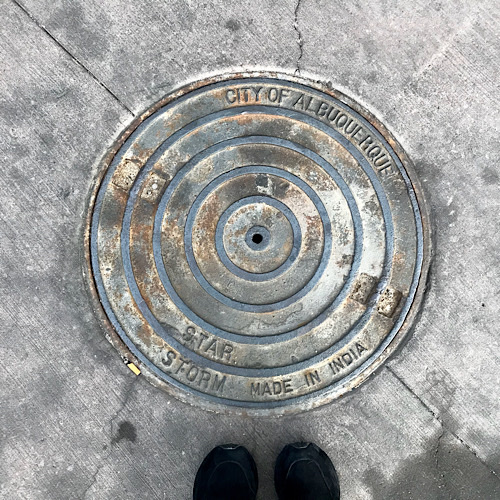
I hired a shared car to take me from the airport to Taos and then from Taos to Santa Fe–having no other choice than but renting a car for myself to get to the location of the retreat, but took the train from Santa Fe to Albuquerque on my way back home. It was convenient and a pleasant ride.
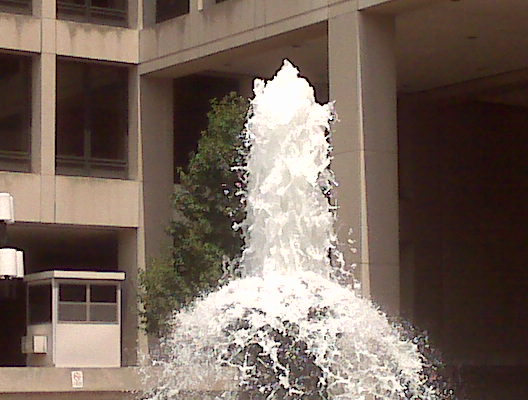
This fountain is at the main entrance (not on the Mall, but around the corner) to the Department of Labor. It is only on every once and a while, and I do not usually use this entrance, so the fountain is not a main part of my relationship to the building.
One day, a couple of years ago, when I was sitting quietly near the fountain to get some soothing energy from the sound of the water and being outside, I thought about how much it resembled a shiva lingam. Was I seeing symbols that were not intended? Was the artist pulling one over on the government by submitting a design that carried symbolism that, in 1974, would not have been acceptable to many in charge? Was the symbolism there and understood when the design was permitted to be implemented? Do the answers to any of those questions matter with the fountain and all its imagery present in all its effusion?