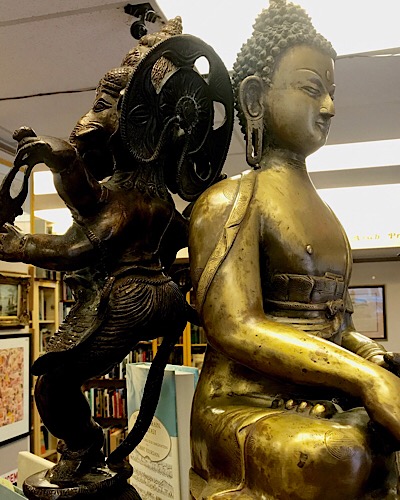
On This Boxing Day
On this Boxing Day, day after another Christmas with no tree on which to perch, the Christmas tree top angel, looking more like a fairy godmother, found a dance with Shiva Nataraja and his cohort.
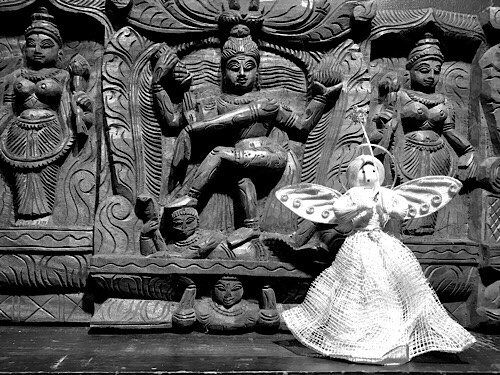
On this Boxing Day, day after another Christmas with no tree on which to perch, the Christmas tree top angel, looking more like a fairy godmother, found a dance with Shiva Nataraja and his cohort.
I have been told more than once that one cannot technically be a true practitioner/believer in the tenets of Kashmir Shaivism without believing in some form of Godhead. As a nontheist who still finds the teachings and practices informative and useful for how best to live, I ask consistently whether that is really true.
I’m sure a purist (religious or academic) would say there’s no anything to the philosophy without being a full believer. But what I think one gets from practices designed to heighten awareness of a divinely connecting universality in the wild diversity of life without a belief that what is universal a priori points to “God” is a recognition that with all that is troubling and difficult and hurtful and evil in this world, the very complexity and outrageousness of being is yet wonderful and inspiring in itself.
In a word, when all else fails, laugh (and create and live) with an ecstatic fatalism.

Painting by Sandra Dooley. Cuba 2014
This week I have been working on twists both in my own practice and in my classes. In so doing, I have been thinking about the difference between turning around or doing an about-face and staying steady and true to oneself, while truly being open to another perspective.
In order to get into twisted and bound asanas, it is critical to be steady in your place and to use the three self-affirming elements of muscular energy — hugging into the midline, embracing the muscles to the bone, and drawing from the periphery into the focal point — to be able to revolve on the midline and open the heart to a new direction.
The same is true off the mat. If we just flip our position or turn an about-face, we are not grounded or reliable. Inside the beltway, for example, I’ve heard people saying they think McCain and Specter should be voted out of office because it is not clear where they stand. Their positions seem more about expediency than about a steadiness of conviction, coupled with an openness to listen to and work with others with differing views.
Ideally, we want to embrace ourselves, our history, and our nature, and be sufficiently comfortable and secure with ourselves that we can hear others. Even if it feels convoluted or binding to open to true listening, by reaching while staying steady, we can better have compassion and recognize the light and humanity in those with whom we disagree. By doing so, ultimately, just as we create greater strength and flexibility by practicing twists, we experience a greater openness of spirit with respect to ourselves and all around us.
This is a big part of my current practice, and perhaps one of the very hardest. Steadfast commitment to a balance of steadiness and openness makes possible, I think and hope at this point in my practice, radical affirmation of the good in everything.
In classical yoga, maya is the illusion that the tangible world is what is real. Only atman is real; the world we experience through our senses (and our senses them selves) as reality is an illusion. We renounce the world to escape the temptation of being drawn into it as reality. In so doing, though, we ineluctably must come to the conclusion that all that is ill with the world is as much an illusion as that which is tempting. In turning away from the world we would be also turning away from the pain of seeing inequity and suffering and the desire to seek change in the tangible, sense-experienced world.
As I was walking around New York City, ankle-deep in slush and being hyper-stimulated by the lights and the noise and the smells and the bustle and the choices, I found myself thinking about maya and that in its classical sense has two surface temptations for me. The first is the temptation to turn away from the stimulation, to reject consumption of more than needed to exist. In the face of such excessive stimulation, the idea of nothing, of utter simplicity, of quiet seems desirable. If the turning away is another form of seeking pleasure or escaping pain, though, it is still in the trap of maya — the worldly illusion that binds us in the pair of opposites–pleasure and pain. The second temptation, the temptation to withdraw from everything except seeking the light within, is more subtle. If we truly are to turn away from the world of the senses, we turn away from notions of justice and equality and freedom that are based how we live in the material world as much as we turn away from consumption.
The true path of renunciation, of pure meditation, is a rare and beautiful path, but to stay in the world and to withdraw ineffectually in such a way might earn the hackneyed epithet “navel gazing.” My path is not that of the renunciate yogin, nor do I have the fortitude to live a life of Christian poverty, which would reject riches and live for service. Where can we find the support in the yoga path to stay engaged and yet still live mindfully, fostering the expression and recognition of spirit in ourselves and others?
In tantric philosophy, maya is understood somewhat differently than in classical yoga. The maya is not the world itself. When we think that getting and having and avoiding is all that there is and that it is separate from spirit, then our lives are cloaked by maya, and we are ignorant (avidya) of the true bliss of spirit (satcitananda). To know spirit, we must see through maya. To do that requires discrimination (viveka) in what we take into our senses and ethically responsible action in the tangible world to align our lives in a way that expands the opportunity to recognize spirit, which in my mind includes having less material disparity in society, which disparity most assuredly makes the essential truth of blissful consciousness more opaque (due to the play of maya) for both the haves and the have nots. While we make our attempt to live with more discrimination and grace and with less cause of conflict or suffering (doing better some times than others), we still try to recognize and savor the exquisite divine in each sight and taste and sound and creation. How extraordinary always is New York in all its wild manifestation!


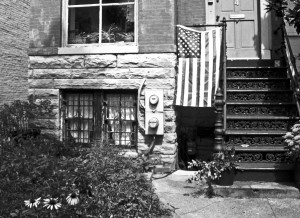

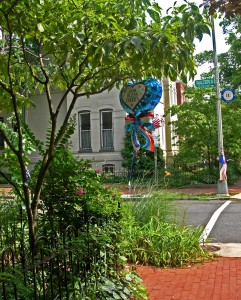
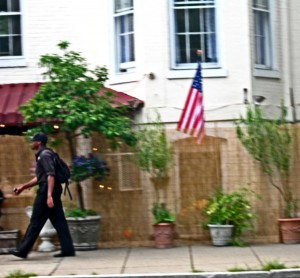

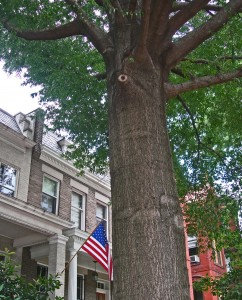
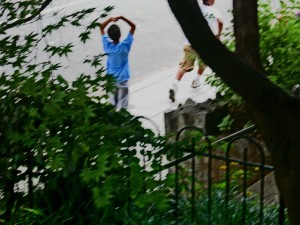
The boy in the blue shirt and his friend stopped me as I was going into my yard, “happy 4th of July,” they said. “Happy holiday to you,” I responded.
“Do you like fireworks?” the boy in blue asked. “I like the pretty ones on the Mall,” I replied, “but I don’t like the loud, smoky ones on the street. I find them too noisy, and too much of a fire hazard.” “Oh,” he said, and ran off down the street.
Tonight, if previous years are a reliable indicator, he and his friends and family will light dozens upon dozens of illegal fireworks on my street, pausing only to let the bus go by. They will scream with delight every time they startle themselves with a big one. I will water the front to help prevent fire, marvel at human inventiveness, and ponder the nature of freedom.
Peace and light, E — Posted with WordPress for BlackBerry.