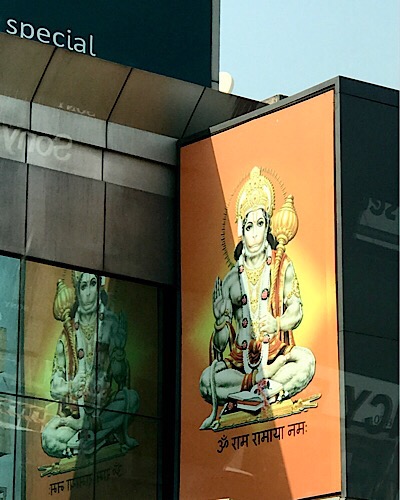
Jai Hanuman
I’ve just arrived in Vrindavan. I have been advised to hold on to my glasses. The monkeys like to grab them and hurl them to the ground.
I’ve just arrived in Vrindavan. I have been advised to hold on to my glasses. The monkeys like to grab them and hurl them to the ground.
Last week, I used as a theme sukha — ease, comfort, happiness. I was inspired by Lorin Roche’s discussion of translating in his “version” of the Vijnana Bhairava, which he entitles “The Radiance Sutras.” In it he notes that “[e]ven more literally, sukha is (according to some etymologies) composed of su, good + kha, space. A good space.” At first blush, teaching about sukha might seem to be off-topic from my session theme of sequencing principles. The whole purpose, though, of seeking to understand, practice, and optimize our sequencing in time and space on and off the mat is to find just that. It is to be in a “good space,” to feel at ease, whether we are being challenged or delighted.
I found myself contemplating sukha yet further this week (it is a recurring practice and contemplation theme for me — I love Patanjali’s sutra “sthiram sukham asanam”), as I have been observing and helping the foster cats make mine their new home. When we are uprooted or out of alignment, we are not in a good space. It is a struggle to feel happy or at ease. When we find our rhythm again, then ease unfolds.
There is a set of principles that generally works for taking uprooted animals (or people) and helping them feel at home. Part of making them at home is their new person holding him/herself in a “good space” for the newcomers, which indeed helps them find their own, which is its own yoga.
The blessing of yoga for us, and why we take ourselves to challenging difficult places on the mat, is so that we can, by use of intelligent sequencing of practices, techniques, and mindsets, discover how to feel connected to our own spirit wherever we are in time and space — the essence of ease in this body and mind. The more we can do this for ourselves, the more we can do it for others.
When I selected Oxfam to be the donee of the proceeds from my first Thanksgiving Day Yoga Fundraiser ten years ago, I took into account that its mission is to “create[] lasting solutions to poverty, hunger, and injustice,” which seemed to me deeply related to what I believe is the best aspect of the history and tradition of making a holiday of thanks giving (leaving aside the shadow side of the history). Last night, when I was writing the newsletter inviting all to come and join me for the fundraising class, I thought about whether some readers would wonder why the donee of the proceeds wasn’t being changed to the Red Cross or Doctors Without Borders or other reputable organizations that are out in the field helping those known to us who are closer to home and are still suffering from the ravages of Hurricane Sandy.
Over the past few months, in ever increasing quantity as the elections approached, I received several emails a day and sometimes in an hour (and if I had been willing to answer the phone, calls) pleading for me to donate money and time. For some, it was asking again and again, even though or perhaps especially because I had given generously already. In the face of an unexpectedly large disaster, we cannot help but wish we could do something to help. Not surprisingly, I am feeling a little of what they call in the business “donor fatigue,” and I expect that many others feel the same. It is important, when faced with urgent cries for help, to remember that the preexisting calls on our resources have not gone away (newspaper reporting and the absence thereof notwithstanding). I do not question for a minute that those who are able to do so should share some resources with those whose homes and lives have been turned upside down by Hurricane Sandy, but it is also important to remember and continue to support the causes that are not today’s news.
“Practical Sanskrit” just did a post on its Facebook page that discusses the nyaya (maxim) of watering the mango tree. When we water a tree with the intention to honor our ancestors and the earth for its gracious offering, we are simultaneously taking care of the tree and honoring our ancestors, the earth, and the tree. The post continues by inviting us to be more conscious of trees, especially in the city, and to be more engaged in caring for them.
Practical Sanskrit’s post reminded me of a comment on this blog a couple of weeks ago. A commenter on stated that most of the things that I write about doing to live more lightly on the planet require substantial financial means and education. That is true in certain cases–obviously, if I wasn’t blogging, I would not have any need to try and go “carbon neutral” with the blog (although it is no more expensive to have a carbon-neutral web host than one that is not). And as I explained yesterday when chatting with a cabinet-maker who was at the Amicus Green stand at the Green Festival yesterday, with the grant programs, tax credits, and loans available, we can now put solar on our houses with virtually no cash outlay in Maryland and the District (other states may not make it so easy). In that case, one still needs to be a homeowner, but can still do it without significant money to burn.
But most of the things I do to try and live more lightly, while still being comfortable, I learned in the years when I was truly poor (and I didn’t much like having always to worry about how I was going to pay the bills): not having a car; not having cable tv; turning off the water while I soap the dishes and brush my teeth; taking short showers and turning the water off while lathering; keeping the thermostat between 59-63 in the winter and dressing warmly; keeping the thermostat between 78-82 in the summer and dressing and eating lightly; shopping for clothes at the consignment shop; furnishing my house from flea markets, auctions, and neighborhood sales; doing my own sprouts on the kitchen counter; having much of my diet be dried grains and pulses bought in bulk; turning off all the lights in the house except for the one I am using at the moment; bringing my own lunch to work as a regular activity and saving eating out for special occasions; avoiding buying and wearing clothes that require regular dry cleaning.
What is nice about being financially comfortable is I now can do all those things with loving intention, rather than feeling constrained by my lack of material well-being. I am not forced to do them. Tantric yoga, with its emphasis on being in the world, invites us always to act with intention, to make all of living an offering and a recognition of spirit. It is easier to do when we are educated, aware, and yearning for spirit, than when we are forced to do something out of material poverty. It is also easier to do when we do it for love rather than a sense of guilt or obligation. Being able to live with intention, picking and choosing how we live and what we consume, can truly enhance grace in our lives. I am sure there are those who grumble about having to go out and water the mango tree to make sure it fruits when they would rather be watching tv. How much more life-enhancing to water with love for the tree.