Found Objects Around Town

In the middle of another
11-hour work day, not
Counting the time to
commute, the commute
Being the round trip walk
From home during which I
have been practicing japa–
Maha mrtyunjaya mantra–
For dear spirits recently
No longer in this body.
In between the work,
Between those walks,
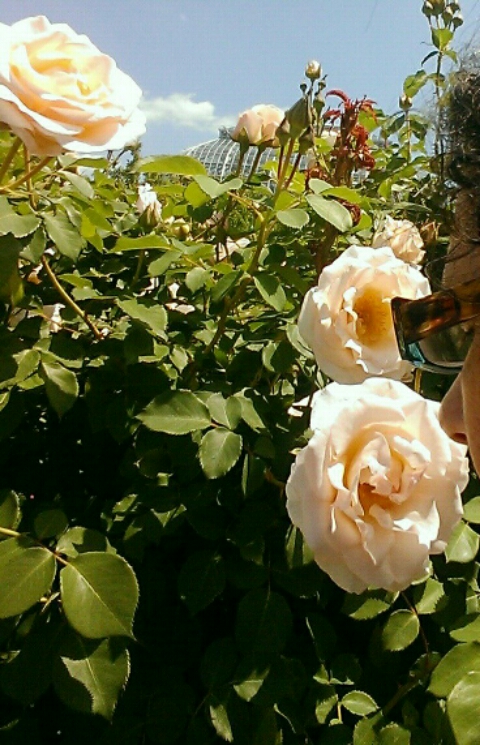
I stopped. I stopped
and smelled the roses.
Thus refreshed by visual
Beauty and warm sun
And intoxicating scent,
I had the energy to begin
Again–to continue,
To work well.
It is a constant dialogue that arises for me with others in my various communities about the place of political discussion in a spiritual community. Is there a place for examining the state of the world, calling for action, and trying to change things when we believe (or are seeking to understand) everything as being at its essence infused with the light? I just happened to read this parable today, after being advised that spiritual and political dialogue have no place being conjoined (today, it was about the budget and the war; it could just as easily have been about how to address from a place of spirit the complexities of how to shift and respond to the Gulf oil spill):
“RAMAKRISHNA: … [W]ater remains water, whether it stands still or breaks into waves. Divine Reality remains exactly the same when one is silent and one speaks. Relax your mind a moment and consider this parable. A guru teaches his disciple that every being and event is simply God. The ardent disciple, while walking home meditating on this truth, encounters a mad elephant. The elephant-driver, who has completely lost control of the animal, shouts to all who are in the way, warning them to run. But the stubborn disciple refuses to deviate from his path. He continues his contemplative exercise, regarding himself as God and the elephant as God. The crazed beast picks up this foolish man with its trunk and dashes him to the earth. The guru, famous for his healing powers, is called to revive the unconscious victim. After certain prayers are recited and holy water is sprinkled, the young man regains consciousness. He is surprised to find his guru gazing at him. When asked why he did not run from such evident danger, he replies: ‘Why should I run? My guru, you teach that all beings and events are God. I have implicit faith in your inspired words.’ The venerable master then addresses his immature disciple: ‘But my child, why did you fail to heed the inspired words of the elephant-driver, who is also God?'”
Lex Hixon, Great Swan: Meetings with Ramakrishna (Shambala Publications 1992)
It was beautiful today at the Arboretum, and I was glad to be there. I also noticed, along with other signs of impending drought, how low are the water levels for this time of year. I have been working on making my garden more water efficient.
My boss with whom I’ve worked for over 20 years and who has an unfortunate tendency to get agitated (gentle understatement here) at the workplace has just discovered Thich Nhat Hanh. My boss was intrigued by Thich Nhat Hanh’s suggestion that when you find yourself getting angry, “don’t.” Knowing that he is still going to have to take action in response to the things that tick him off (and, as I would add, that not getting angry is distinct from disengaging, failing to act, or being apathetic), my boss still invited us to say to him when we see him getting worked up, “remember Thich Nhat Hanh.” I liked that. I like that he recognizes a need to change and grow and is starting to take steps after years of appearing not to be aware of the impact of his tendencies on himself and his co-workers.
One of the best ways I know to shift our reactiveness is to develop a steady meditation practice. If you don’t already have one, I invite you to begin to develop a daily meditation practice, which could include conscious breathing or visualizations. If your practice is only sporadic, notice how much better it is when your meditation is part of your daily routine.
When I was eight or nine, a teacher asked everyone in my class to say what they wanted to be when they grew up. The other children named the various jobs or professions that appealed to them at the time. I responded that I wanted to be independently wealthy. At that age, I was expressing something I already knew from family issues. Though I did not have the words for it or a clear understanding, what I was saying was not just false precocity. I knew at a basic level what is taught in yoga: I would need enough material support (ardha) to follow my heart in love (kama) and work (dharma); then my life could be free (moksha).
When I was 22 and visiting my friend Dan, he asked me what I really wanted to do with my life. We had just graduated from college. Dan was working for a sculptor who was a professor in the art department; I had just moved back to New York, had just gotten over a failed attempt to serve as an office manager for an off-off Broadway theater, was in a place of deep emotional and financial struggle, and was trying to determine what work and corresponding further education I wanted. “I want to be content,” I said. “That’s too passive,” he replied. “No, that’s not what I mean,” I tried to explain. “For me being content being satisfied and engaged with my work and life, but still working hard and having goals. It’s not just hanging out.” I had all sorts of things that I found interesting and possibilities for a life path, but I didn’t have one specific career or life plan that I was certain would be more fulfilling than any of the others. They just would have satisfied me in different ways. Because of the dilemma of too many choices, I wanted to be able happy with whatever choice I made, even if it seemed like a compromise. I was conscious that once I picked, because of the inherent limitations of time and space, that I would either have to be content with my choice or be unhappy. I have since learned to think of contentment (samtosha), which is one of the niyamas of the path of yoga expounded by Patanjali, as a practice rather than a goal (and it is a very important and continuing practice for me). Contentment is not an end, as I had thought when I was 22; it is just one part of the path to a goal of living liberated (jivanmukti), experiencing self as spirit in all that one does.
On a recent telephone seminar, Paul Muller-Ortega, my meditation and philosophy teacher, in the midst of a broad dialogue regarding various studies and practices, spoke a little of ecstatic serenity. Memories of the discussions I had had long ago about what I wanted welled up in the forefront of my thoughts. In thinking about what is my intention now, especially with regard to my practice (sadhana), I witnessed my previously stated intentions as just stages on the path to this discovery. As soon as I heard Paul say the phrase, I thought, “that’s what I want; I want to be ecstatically serene.” I seek to be always in some part of my conscious being still and peaceful, while simultaneously being passionately engaged in what life brings to me and I bring to life.