On My Walk Home From Work After Having Been the Lead Speaker for a Webinar With 1008 Listeners
Plus or minus.


Plus or minus.

The first day of the advanced intensive this week, John Friend invited us to write in our journals about what we wanted to get out of the three days from both an energetic perspective and from the perspective of a particular asana that has challenged us. This was not long into the first session of the first day, but it was after he spent some time speaking about what he believes it takes to be a good student–of yoga and of life. Though he did not specifically relate the qualities to the Anusara principles or the mahabhutas (elements), based on what I have heard him teach before about studentship, which is a significant aspect of a committed yoga practice, the qualities of studentship he outlined are parallel to the principles of alignment.
The first quality of studentship, he explained, is having a simultaneous sense of wonder and of humbleness (openness to the teaching and the teacher). This is about being spacious (akasha) and an application of the first and highest principle–opening to grace.
The second is steadiness, which includes showing up, paying attention, being consistent, being diligent. This is being like the earth, being muscular and strong (muscular energy) in how one studies.
The student also needs to be accommodating, to be able to be fluid (like water), to go with the flow of the teacher, the studies, and the class as a whole. This is similar to how the expanding action of inner spiral helps us make more space to grow in a pose.
Third, the student should always do his or her best, to be on fire to learn and grow. Doing one’s best in this way is like the action of tucking the tail bone to engage fully outer (or contracting) spiral to draw into the inner power to shine.
Finally, just as air reaches out in all directions and the Anusara yogi, in asana practice, uses organic energy to extend outward, a good student makes offering of all he or she is learning, to make studying an act of loving service (seva).
When John asked us to take out our journals this week, I took mine out and wrote on what he asked. As I did so, I found myself remembering the first time he asked me to write in my journal, which was at an Inner Harmony retreat in 2003, when I was in the middle of my Anusara teacher training. I have been keeping a journal steadily since I was 11, and though I was on fire for studying yoga, being told what to write in my journal felt a little like an invasion of sacred and intimate personal space. I think others probably expected this; they had “yoga” notebooks with them and did not need to write in a personal journal when the received this instruction, but all I had was my regular journal.
I am still in Miami; tomorrow I will be visiting a friend and then joining with others for the Mahashivaratri celebration, or I would pull out my journal entry from the week at Inner Harmony to see what I wrote. I know that I wrote as much about why it was hard for me to be told what to write in my journal as I wrote on whatever was the topic on which I had been directed to write. I know also that was the week I really decided how important it was to study with John. Finding the balance between knowing what was my own space and truly understanding where I would best learn by following completely the teacher, was a critical part of my yoga studies. Being a good student is not always easy, but it is an evolving part of the sadhana (practice) of relationship, which is the true yoga. This is why how to be a good student initiated the week’s teachings for a group of advanced students, most of whom were teachers themselves.
This afternoon, at the end of the last session, John asked us to get out our journals (I am still using my regular journal as I am not much for taking notes and separate notebooks for yoga just get left behind mostly empty) and look at what we had written on the first day. Did we get out of the training what we had written that we wanted, he asked. For me, the answer was mostly yes, and in some profound and unexpected ways. Would I have gotten so much in that regard if I had not done what my teacher directed and thereby focused my intention for the training? I think probably not. And part of what I wanted, though I did not write it down that way, was to be yet still a better student of my teacher, the teachings, and the spirit.
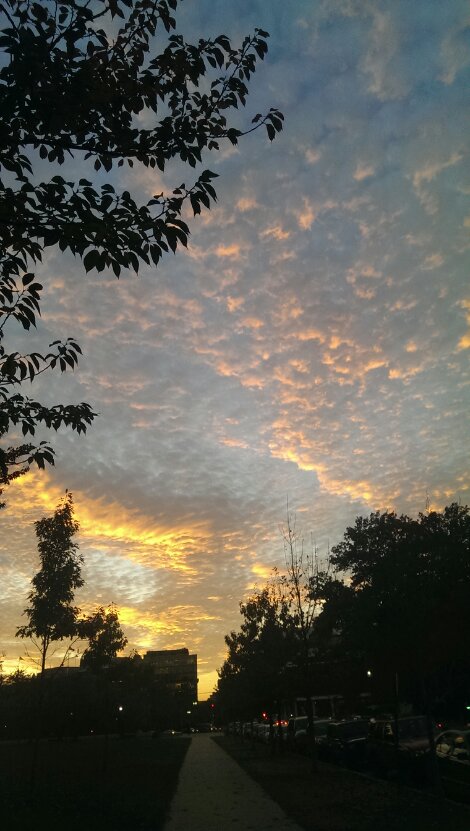
I have been advised this full moon is in Virgo, and that it is a good time for healing practices. I stood absorbed and delighted by the dance between the full moon and the clouds.

I am reading Philip Goldberg’s American Veda–From Emerson and the Beatles to Yoga and Meditation; How Indian Spirituality Changed the West. It is another of the recently published works on the interplay and inter-influence of east and west. What distinguishes American Veda is that it is more about how Indian spirituality influenced western/American society overall, than an analysis of the yoga that we practice in the west. Much that one might expect to be in the book is there: Emerson, Thoreau, Swami Vivekananda (and the Parliament of the World’s Religions), Ramakrishna, Paramahamsa Yogananda, Osho, Muktananda, the Beatles, Maharishi Mahesh Yogi, but there are other connections that are less well-known.
As one generally familiar with the history of Indian philosophy and yoga practices coming to the West, it reads more like a survey or overview than an analysis to the extent that it tries not to leave out any one who could have been an influence and goes into little depth regarding any particular influence. (Note: the author himself says that the book is limited to Vedic/Hindu influences; he refers the reader to other sources, in particular, How the Swans Came to the Lake, for the transmission of Buddhism to the west).
What is most interesting to me about reading American Veda is that it reads like old home week. I recognize the names and the philosophies and the way people speak about spirituality and religion, and the author lovingly and thoroughly shows how profound and widespread is the influence of Vedic thought in America, even where no attribution is given. I recognized even when I first discovered Indian philosophy texts in high school the interplay between how me and my fellow unprogrammed. liberal Quaker friends were talking about mystical experience and understanding of God/Spirit and the Indian philosophy, and it is lovely to have a book where someone went out and did all the research and gathered the sources. By the time I was thinking about anything at all really, Indian philosophy was already something in my consciousness thanks to the Beatles and the Beats. The Beatles discovered Maharishi Mahesh Yogi when I was six, which was the year that Sgt Pepper’s Lonely Hearts Club Band and Magical Mystery Tour came out and my parents for some now unfathomable reason gave them to me for my Christmas present. My older sister and I played those albums over and over again on our portable record player, whirling ourselves into states of dizzy ecstasy with the sitar grooving in the background on our favorite songs.
I was moved to read the Bhagavad Gita by reading J.D. Salinger’s Franny and Zooey. I do not remember whether this was in 9th or 10th grade, but I read Salinger because was what cool, smart kids read. What I remember is that I read both Franny and Zooey and Catcher in the Rye (probably read the latter first) before Catcher in the Rye was assigned reading in 10th or 11th grade and that while I was not particularly impressed with Holden Caulfield, I really wanted to be as brilliant and educated and extraordinary and talented and philosophical as the children in the Glass family, and so I tried to read what they read (though alas, I read it in translation, where they were able to read the Greek and Latin and Sanskrit, etc.) By 11th grade, a teacher had given me J. Krishnamurti to read, and his anti-guru guruness appealed to my Quaker sensibilities.
I must have been completely in tune with Kali, the goddess of sequencing.