| | | | |

What a Difference an Article Makes

Leaving aside whether there is such a state as enlightenment and whether nirvana is enlightenment or its equivalent, I believe one should always question one who promises “the” path and doesn’t just offer “a” path that has served the one offering teaching or access.

Of course, other than potential issues in any community that makes such exclusive promises, one is always free to taste and explore and reinterpret the “the” as “a.”

Similar Posts

  • | |

    Kvelling and Kvetching

    It started before yesterday’s Tuesday night class.  There was a piece of fuzz next to one of the students mats–a schmutz.  We then decided that the yoga outfit, especially the old raggedy one, was a schmata. Tonight, I was in an uncharacteristically silly mood.  With birds falling out of the sky, fish washing up on the shore, and the Republicans taking back “control” of the house, I could weep or I could find the laughter in small things.  Tonight, with a practice theme of the Anusara’s “first principle” — opening to grace — I spontaneously and giddily came to the latter.

    I mentioned the idea of yiddish for yogis, and the class took off.  We were all women tonight, so it was “yoga for yentas.”  The word one utters when going into the first forward bend of the practice, is of course, oy, which can be lengthened to oy vey is mir. When we are truly opening to grace, we are kvelling; when we are noticing our aches and pains and forgetting to move towards the good, we are then kvetching.

    Just FYI, I learned after doing a cautious internet search before posting this blog entry, that it turns out that the phrase “Yiddish Yoga” has been trademarked.  I am pretty certain we can still have fun talking about using yiddish vocabulary words in yoga class without violating any laws, though it has been over 20 years since I took class in copyright and trademark law.  So feel free to think of your favorite yiddish word and how it should be used in yoga class.  You never know how it will enhance your practice, for whom it will bring a smile or a laugh, and what other thoughts might arise.  I’m pretty sure that there isn’t a yiddish equivalent for satcitananda, any more than there is an English equivalent for weltanschauung or schadenfreude, or a French word for sandwich, but at least one student wants to give it a try.

  • | |

    Rudra (and fierce indignation)

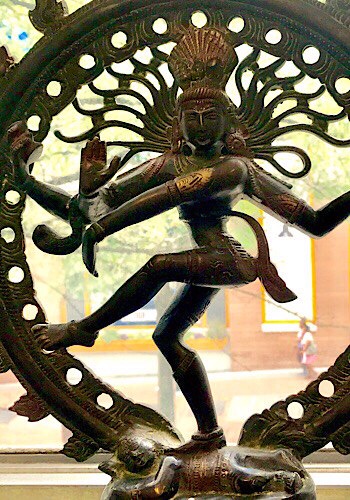
    Ruda, who is both the ancestor of Shiva and another name for Shiva, is known as the howler.  Rudra is wild and fierce.  Rudra rages.  I heard Paul Muller-Ortega recently describe Rudra.  He said Rudra rages, but offered that there are lots of things against which to rage, such as injustice and inflicted suffering.

    The idea of Shiva/Rudra raging has filled my contemplations for the last week.  The questions that arise for me is “what is divinely inspired rage?” “When is fierceness or rage serving to expand love and compassion rather than just destroying the self or others?”

    When are rage and destruction necessary to optimize the flow of energy?  I think of Rosa Parks, Nelson Mandela, Gandhi.  I think of a surgeon removing a tumor.  When I think of the ongoing war in Iraq; the newest reports of torture; the potential that corporate interests, ignorance, and bigotry may completely undermine this country’s coming to agreement on providing basic health care for all, I think that living a quiet life is not fully engaging a life of the spirit.  How do I find a place of non-attached, but fierce action?  How do I find Rudra and not get distracted by personal desires for outcome (and personal desires for simple peace and quiet)?  When should I howl, to whom should I howl, and what?

    This rage, this fierceness, must come from a grounding in the heart with the discrimination of study and practice.  If I cannot find it myself, can I at least support those with the courage and wisdom to be directly engaged?

Leave a Reply

Your email address will not be published. Required fields are marked *

This site uses Akismet to reduce spam. Learn how your comment data is processed.