Sadhana?

I slept restlessly last night and woke early with concern for those who were in the metro crash. Being already a bit agitated, worries about getting things done at work also were arising. Despite my restlessness, I made sure to sit for meditation. Thoughts kept arising, but by the time I was into my sit, I was able to find a space, where I was not tangled or unsteadied by the thoughts. I felt more peaceful and able to meet the challenges of the day.
In times of agitation, I often find myself drawn to contemplate again Patanjali’s sutra 1.2: Yoga citta vrtti nirodaha. In classical yoga, it means to still the thought waves. This is meant to be the ultimate purpose of yoga: to still thought so that what is beyond mind and body can be revealed.
Practicing and studying from a tantric perspective, I think not so much of stilling my thoughts when I practice and meditate, but rather, finding a sense of alignment, an allowing of and making allowance within my being for the rhythm of the thoughts like a sailor getting sea legs on a boat, so that I can be steady (sthira) and have a greater sense of peace (shantaya) and light (tejase), no matter how wild are the thoughts arising and sensations entering in the field of my consciousness.
The philosophy and religion professors with whom I have studied yoga philosophy have emphasized that we need both theoretical study and experiential practice to develop understanding. In that light, here’s the reading line-up (though currently I am slowly making my way through Harry Potter y el cáliz de fuego.

Anyone who wants to or has read anything in this list and is interested in discussing, please let me know.
A friend once said that when he heard sirens while he was meditating, he used it as a reminder to share the light of meditation. It is easy to think of roads blocked by emergency vehicles and blaring sirens as disruptions, inconveniences, and annoyances when they are coming for someone other than ourselves. I had a moment of thankfulness this morning that the minor problems are the kind of problems that I have. I was thankful, too, to live where if something bad happens, strangers come to the rescue. I offered healing light to the emergency workers and the person or persons to whom these workers were rushing.

When I was in eighth grade, my history teacher, Mr. B, assigned to the class engaging in a debate as to whether Rockefeller, Carnegie, and Mellon were philanthropists or robber barons. We were put in teams and told which side we had to argue. When we were given the assignment, I went to Mr. B privately and said it was not possible to argue one side or the other. These men were only able to be philanthropists at their level of giving because of the money they had made as robber barons. My teacher said that was an unacceptable position. I was to argue the position I was assigned, I was wrong that it was not an either or debate. I should understand that what was critical to this debate was which aspect was the elemental identifying characteristic.
Where I think was our real difference of opinion was that Mr. B thought that one could/should not recognize both enormous evil and enormous good in the same person. If one was evil, then the good was essentially irrelevant. If one had done tremendous good, then it should not matter if there was bad along the way. I tend to see the whole. I take the good where I find it (for example, I have found great truth and utility in the writings of Swamis Muktananda and Chidvilasananda although I would not recognize either as my “guru”), but do not expect the “bad” to be absent or non-coexistent with the “good” and tend to be outspoken in my recognition of both. I still sometimes get in trouble for this.
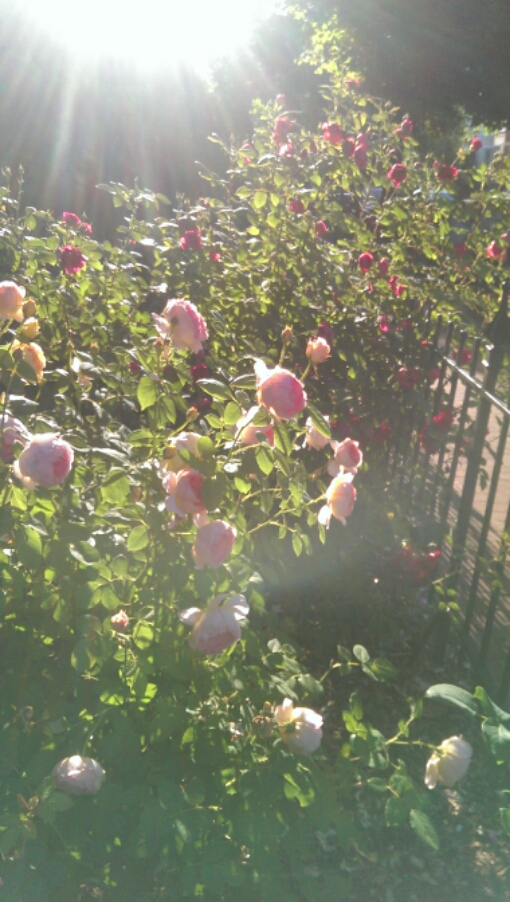
How is it possible to feel lonely when the morning sun shines bright on lush gardens? What do we do, if we know we’re one of the lucky ones compared to most, and yet still feel some absence?
I find doing something for someone else (where both needed and welcomed or else it is not seva) helps remind me of my own presence.