Morning Walk to Work (and Neelakantha)

As I was preparing my week’s classes, I was led to contemplate the off-the-mat import of the words — “in, back, and apart” — used to describe the actions that activate the Anusara alignment principle “inner spiral,” which is also referred to as “expanding spiral.”
The meaning and point of “yoga,” we are told is union. In the Anusara system, inner or expanding spiral is a critical element of the “universal principles of alignment,” which are designed to get us physically and energetically into our optimal blue-print.
How can going in, back, and apart be what would create an expansion that would enable us to better experience our whole selves and all beings as spirit and in unity? Doesn’t that sound entirely backwards?
Going “in” is one of the key aspects of yoga practice. If we only look out, we can get caught up is grasping and longing, which causes great suffering. Although we need also to appreciate the outside, going in, especially by means of meditation. Going in is what enables us to discover our only true freedom, which is the freedom to choose how we react internally to whatever is going on outside of ourselves.
Moving back in yoga is not the same as backing off or away or turning one’s back on things, which would move us away from connection. Rather, when we move our awareness to the back body or open to what is all around us and not just what is forward-looking, we can soften and open to the unknown and to the unseen, allowing the subtle energies to move and guide us to deeper insight as to what connects and unifies.
Moving apart in inner spiral literally is the expansive component of the action. Moving apart is not becoming more separate, but making space (spaciousness) where there was binding, allowing for more freedom to experience all that is possible. It is also about breaking apart from our preconceived notions of being limited and different.
Moving in, back, and apart does not just realign the legs so that we can heal our pelvis and low backs and radically expand our flexibility even as our bodies age (as if that weren’t good enough). Energetically, it can revolve our whole way of connecting to ourselves and the world.

Peace and light, E — Posted with WordPress for BlackBerry.
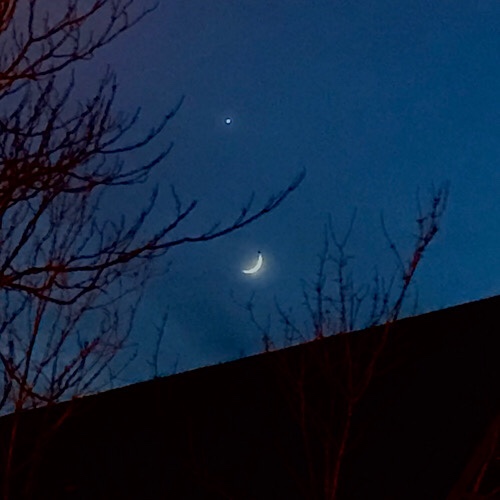
Venus and crescent moon
Geeta Iyengar, in Yoga, A Gem for Women, sums up the proper diet according to Ayurveda as follows:
“A balanced diet, in moderation, is the best. Ayurveda says that the stomach should be filled with two parts of solid food and one part of water, and that one part of the stomach should be kept free for the movement of air. Food which is not congenial to the system should be avoided. Too oily, dry, spicy, and sour foodstuff are not good for the system. A diet which is balanced, light, varied, and well cooked is ideal for health.”
In other words, to be healthy, we should eat fresh, varied, well-prepared, tasty food. We should eat with sufficient awareness to know enough the effects of what we eat on our energy level, sleep, digestion, and ability to move and think that we know what is good for our system in small, large, or any quantities (and eat mindfully in accordance with that knowledge). We should not eat to the point of fullness and beyond (this is a common suggestion in the West for losing weight, i.e., stop eating when you are full or right before — think getting away from the unrealistic American portion size). Any other dietary practices should serve to find this place of moderation and enjoyment, the two real keys to health and happiness with and in eating. Diets that take us away from balance will be hard to follow, unhealthy, and cause all sorts of other shifts in our mind-body. What is best for you depends on your own knowledge of yourself and your environment.
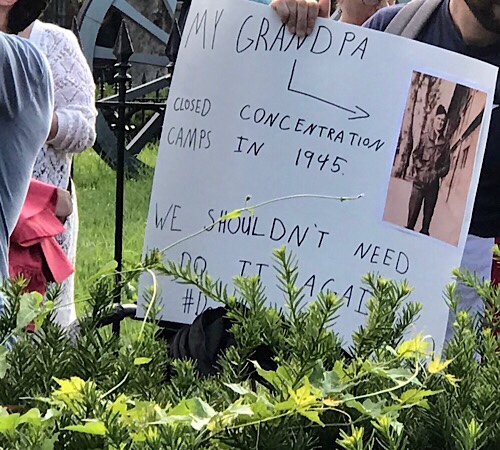

Lights for Liberty, Lafayette Park, July 12, 2019
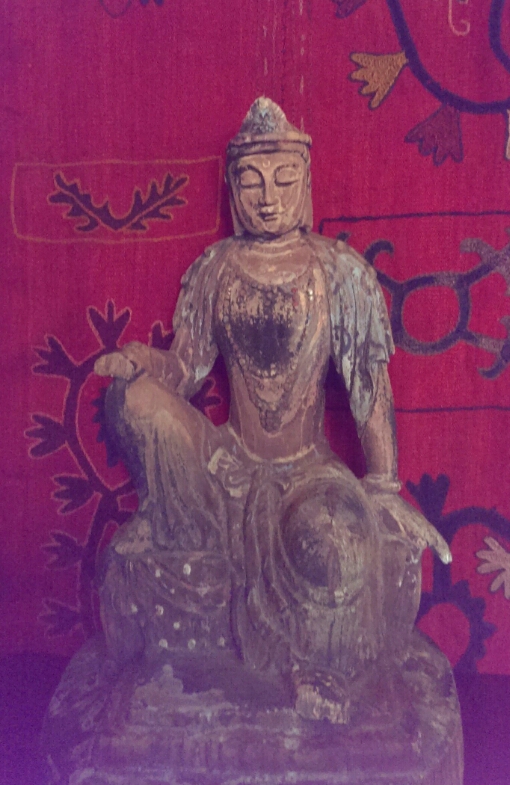
Last Sunday, when I was at Eastern Market to get apples and pears, I saw a small, painted wood statue of Kuan Yin. I have been attracted to this one of the 330 million gods and goddesses for some time. Her primary attribute is compassion. She is said to be a female Chinese metamorphosis of the Buddhist bodhisattva Avalotikeshvara, who, according to some, is an emanation of the Hindu deity Shiva.
She had a price tag of $70 around her neck. It was too much, especially since her hand and foot looked like they had just broken off in transit.
Still, I was attracted to her. The vendor, who is from Pakistan, came over to talk to me, asking me if I was interested.
“Too high,” I said.
“What would you pay?”
Knowing it is holiday season, and the vendors really need to do well to survive the winter, I suggested $45, thinking it was really too much, but I very much liked the impeccably serene expression on her face.
“You have bought things from me before,” he said. I’d bought a couple of older rugs from him last Spring, at which time he had chatted with me for a while and showed me a picture of his chosen guru. “You are a divine being; I will give her to you for free.”
“I bet you say that to all your customers,” I replied.
“Everyone is divine, yes,” he said, ” but you are different. You know it.”
Somewhat overwhelmed by this, I thanked him for the honor and took out my wallet. I had $42 and change. “I will pay $40.”
I paid him and walked her home unwrapped in my arms, thinking it will be hard to live up to his expectations. Who better, though, to remind me to relate to others, always recognizing their inherent divinity (whatever that might mean to me or anyone else), than the goddess of compassion?
Where the wood was raw from having been broken, I rubbed the edges with ash from Chidambaram temple (that I happened to have in the studio), so that the breaks would not visually distract, and one would only notice the sweet face.