Similar Posts
Coming Snowstorm (and Heyam Dukham Anagatam)
As I think about whether I will be able to get up to Willow Street to teach my last classes of the session, how much shoveling I will need to do , whether the next forecast storm (middle of next week) might create challenges for my planned trip to NY, etc, etc, my favorite (well, in the top 10) sutra of Patanjali, sprang to mind: heyam dukham anagatam, 2.16, which means roughly: the pain that has yet to come can be avoided.
I have several translations/commentaries of the Patanjali’s Yoga Sutras in my library. All have a different spin on what this means in practice. What I know is that it is at least partly about being in the present and taking things as they come. One should still practice and plan. By practicing and planning, we are better prepared for inevitable pains and challenges. (For those of you who are giddy with excitement with the thought of a “white Christmas,” this Sutra still helps. Part of the pain that can be avoided is disappointment when expectations are not realized the way we hoped they would be realized.) Once we have prepared in a healthy way, though, there is no point in agonizing about what might come, in being in pain in the present because of the possibility (or even inevitability) of a future pain.
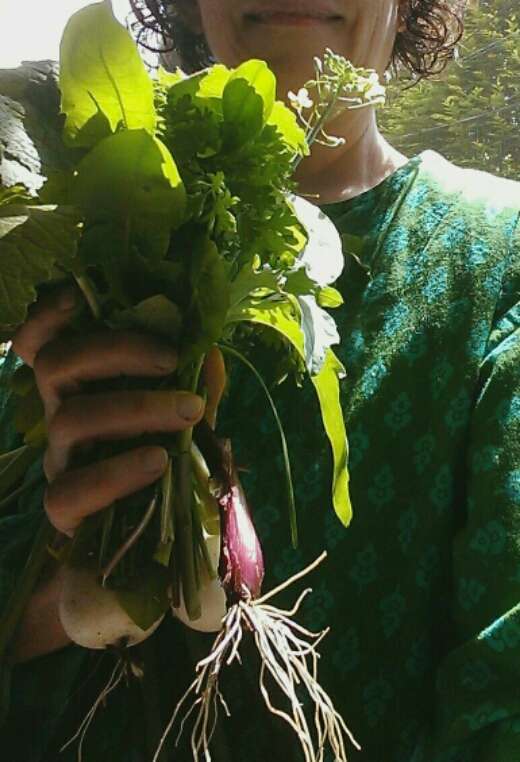
The snow seems inevitable. I am charging my camera battery. I’m picking what is probably the last of the chard and the baby leeks from the garden, and I am getting ready for Serenity Saturday restoratives. As long as I can walk to the studio — eight inches is just plain fun, not impassable — I’ll be there with a warm and full offering. In the meantime, I am enjoying my day instead of worrying about the potential barriers to enjoyment.
- Art and Culture | Asana, Pranayama, and Yoga Practice | Community and Family | Food for the Mind (Yoga Philosophy, etc) | Meditation | Photos
After the Exhileration, Work
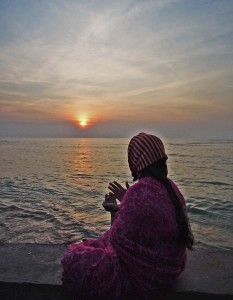
We all (or at least most of those who would be reading this blog) have heard the Buddhist-inspired saying: before enlightenment, the laundry. After enlightenment, the laundry. The question is whether after the moments of enlightenment can we infuse doing the laundry with more joy, acceptance, and peace. A young adult acquaintance asked me the other day whether I was readjusting ok. I did not know to what he was referring, and he had to explain that he was asking how I was doing on my return from my India trip. “It was just a vacation–albeit an extraordinary one,” I replied. “Life continues.”
“The good experiences just slip away like dry sand through my fingers,” he made a motion of letting something slip away.
“When you practice and when you get older, it will be easier to bring the temporary, good experiences into your life without feeling they are lost when you have moved onto the next thing,” I said with hope that would actually be true for him, he seemed so bereft.
The yoga teaches us neither to be out searching for the highs nor actively avoiding the lows; the dance of grasping and avoiding is what makes us suffer. That does not mean that the highs, the times of wild abandoned joy, the experiences of utter fulfillment, of exquisite understanding are of no value. What brings joy is a thing of wonder and an opportunity to deepen our ability to love and be generous. They are only a problem if we ruin our time by vainly clinging to or trying to repeat the sensation. As our practice (and our understanding of a life well-lived and loved) matures, we understand that there is no readjusting in the return to the day to day. We welcome what we have had, try to remember what we have learned, including how much joy and delight we are able to drink in, and approach each day as another opportunity to seek and share connection.