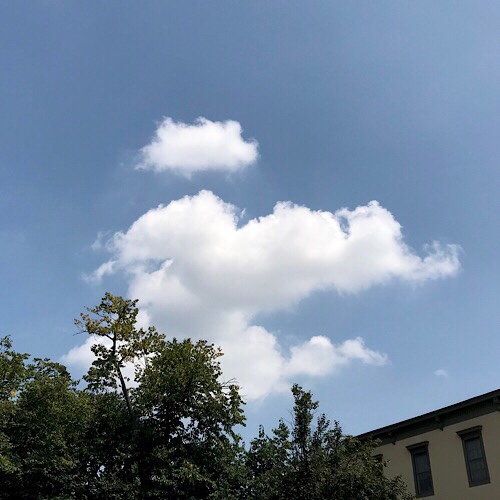
Signs Around Town (Excerpt; and Santosha?)

Samtosha (contentment or satisfaction) is, according to Patanjali, a practice.
Samtosha (contentment or satisfaction) is, according to Patanjali, a practice.
 I returned home last night from eight days away, five of which were truly on retreat — just meditating, bathing in hot springs, hiking, eating well, practicing yoga, and celebrating with dance and music. To see pictures, click here.
The focus of the week was honoring the past and engaging in the present so as best to serve the future.
We left Breitenbush Hot Springs mid-afternoon on Thursday. Rather than take a red eye, I stayed Thursday night at an airport hotel and took an early morning flight home on Friday. I woke early Friday morning and rested in meditation to ease the shock of going from an off-the-grid community in the forest to an airport hotel. This rainbow glowed over the airport while I was waiting for the hotel shuttle to take me there for my flight.
The rainbow reminded me to carry the deep joy of the retreat home with me.
When I was in eighth grade, my history teacher, Mr. B, assigned to the class engaging in a debate as to whether Rockefeller, Carnegie, and Mellon were philanthropists or robber barons. We were put in teams and told which side we had to argue. When we were given the assignment, I went to Mr. B privately and said it was not possible to argue one side or the other. These men were only able to be philanthropists at their level of giving because of the money they had made as robber barons. My teacher said that was an unacceptable position. I was to argue the position I was assigned, I was wrong that it was not an either or debate. I should understand that what was critical to this debate was which aspect was the elemental identifying characteristic.
Where I think was our real difference of opinion was that Mr. B thought that one could/should not recognize both enormous evil and enormous good in the same person. If one was evil, then the good was essentially irrelevant. If one had done tremendous good, then it should not matter if there was bad along the way. I tend to see the whole. I take the good where I find it (for example, I have found great truth and utility in the writings of Swamis Muktananda and Chidvilasananda although I would not recognize either as my “guru”), but do not expect the “bad” to be absent or non-coexistent with the “good” and tend to be outspoken in my recognition of both. I still sometimes get in trouble for this.
The young woman sitting next to me on the train north from New York, who is impossibly tall and has lovely, strong features (i.e., is perfectly cast), is memorizing Lady Macbeth’s lines.
I had on my own lap print-outs of mantras that Paul Muller-Ortega has invited us to memorize as part of our continuing studies.
To enter the character of Lady Macbeth, one of the first steps is to memorize the lines, to know completely what she says and not just to hear it and appreciate it. Memorizing the lines is an essential part of the route to becoming Lady Macbeth.
Paul Muller-Ortega has suggested that the reason to memorize various mantras is not to acquire them, not to be able to demonstrate a superficial knowledge or skill, but to aid in the profound practice of
bhavana–deep contemplation at the heart level. It is not the fact of memorization, but the activity of memorizing. It is no accident that we call memorizing, “knowing by heart.” We seek to learn by heart to invite ourselves into the space of concentration that requires. It is a slow and difficult process for me. I persist, though, because of the deepening and expanding understanding it facilitates.
I note for those yogis (and other readers) who might find the idea of learning mantras alien or uncomfortable or apparently at odds with your own religious beliefs or practices, that studying the mantras does not require or make one a Hindu. I think of it as an invitation to understand and embody the highest archetypes and principles they invoke and represent and compatible with my other observances.

Peace and light, E — Posted with WordPress for BlackBerry.

Earlier this week, I took a wonderful class with my friend J, who is an Anusara teacher based in NYC. She started class telling a story of a fisherman. The fisherman had worked hard and long during the spring, summer, and fall and was looking forward to a rest during the winter months. He left his boat and went ashore, looking for shelter. He came upon a brightly lit house and was invited in by a friendly host. He was given a delicious meal and then brought to a beautiful bedroom with a fabulously made, soft bed with exquisitely scented linens. He got into the bed, but tossed and turned and could not sleep. Agitated by his inability to sleep, he left the house, went back to his boat, wrapped himself in his fishy-smelling nets and promptly fell sound asleep.
J interpreted the story as saying that our familiar patterns bind us and keep us from discovering and receiving true beauty and bliss. This interpretation resonated with the students; one called out in a conversation about the quantity of nets we have, that she could alphabetize hers, and we all laughed. I heard something different in the story, though perhaps it was because I had seen part of The Wizard of Oz when channel-surfing in my hotel room the night before. What I heard was that when we accept our work and our place, we find a place of true rest. When the fisherman realized that his place was on his boat — at home with his work, instead of seeking ethereal bliss — then he found peace and true rest (“there’s no place like home, there’s no place like home…”)
What is missing from the movie version of The Wizard of Oz, though, is that in later books, Dorothy goes back to the land of Oz, bringing her family and work (albeit that of a child) with her. She, in effect, integrates the importance of prosaic home and work life with being in a land of enchantment. In that, both interpretations of the story of the fisherman are partly true. We need not to let our old habits bind us, but we also need not to cast off work, home, and community as things that interfere with our discovering bliss. Instead, we need to find enchantment in our very being, as we live and work and relate in this world.

Lovely as long as one first has enough to eat and shelter from the storm.