Dear Friends,
I hope this email finds you as well as possible under your personal circumstances. Here, up front, are the details for the Thanksgiving Day fundraiser. A longer story follows, if you want to scroll down and read it. I hope many of you who will be in town can make it, and I wish all the healthiest, most joyous, delicious, and abundant holiday you can have:
Thanksgiving Day, Thursday, November 28, 2013. 11th Annual Thanksgiving Day Fundraiser for Oxfam.
Location: William Penn House, 515 East Capitol Street, SE, Washington, DC 20003.
Time: 10:00 a.m.-11:15 a.m.
Yoga Details:
- All levels class. Just how we will align and flow to get the energy moving and supporting us will depend on who comes and how many, but be sure that it will be designed to be simultaneously soothing and energizing to help you bring your best self to the formal start of the winter holidays. Alternatives will be provided for those working with challenges of embodiment. Advanced variations may also be offered to expand the experience of the abundance of the day.
- For Most Ages–Children old enough to pretty much stay on their own yoga mat and enjoy trying the grown up poses–depends on the child–are welcome, and then it’s all ages up from there.
- Props. We have plenty of blocks, straps, and chairs; a modest supply of blankets; and a limited number of loaner mats. Please bring your own mat if you have one and any other props you may need (such as multiple blankets). Donations of your no longer used props are welcome.
Benefit for Oxfam: Suggested donation $20. As in most of the previous years I have offered this class, I will collect checks made out directly to Oxfam, America (preferred over cash); even better, you could make an on-line donation before the class. I will then forward 100 percent of the proceeds to Oxfam, America. I also will match any individual donations over $20 up to $200. As always, the amount is suggested; what is within your means is a sufficient amount.
No Advance Registration. Just show up at the door. Though I enjoy the spontaneity of teaching whoever appears, the more the advance knowledge of who and how many plan to attend, the better I can design the class to suit more of your needs and desires, so I welcome your letting me know by replying to this email, sending me a private message, or by liking and then commenting on the Rose Garden Yoga page on Facebook.
This is the 11th year for this yoga practice. The first time I offered this practice, I was mostly through the year-long teacher training then at Willow Street Yoga and teaching at a studio on the Hill that has long since moved and reconfigured itself. My initial intention was to remind myself (and anyone else who wanted to share and listen) that one of the most effective ways to kindle appreciate for the abundance in one’s own life is to commit an act of generosity (even if one that is relatively modest and also provides benefits to the giver).
These are, for so many I know and for countless more I only read about in the news, challenging and unrestful or even unimaginably painful times. I am thankful that my resources are sufficiently abundant that I can draw on the practices and work and community and creative pursuits of various sorts (including here cooking and gardening, though perhaps those would go under practices, too) to find my soul, to reconnect with my inner strength, and remember how much good I have in my life.
Being able to share the yoga with friends old and new with a shared intention to be generous to ourselves and others and make our thanks giving that much more nurturing and powerful a holy day certainly is on my gratitude list for this holiday season. Come join us at William Penn House on Thanksgiving morning or for the regular Tuesday night practice (100% of student donations go to benefit the work camp program run by William Penn House). If the current limits of time, space, or circumstance make not possible sharing the yoga face to face, do please still be in touch.
Peace and light,
Elizabeth


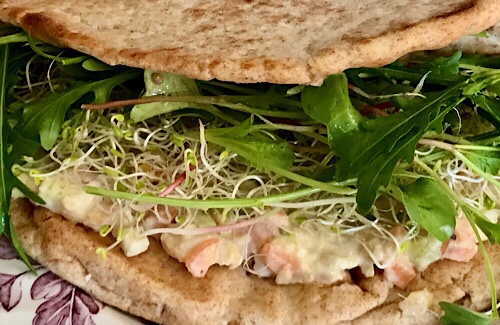
Two ideas keep me in a place of mindful eating. I am a very firm believer in “all things in moderation, including moderation”. It does me no good to completely deny myself the things I want, just as it does me harm to overindulge. The other idea is taking time to enjoy what I am eating. Rushing through my meal dishonors the people who took the time and energy to grow, harvest, and prepare my food (even if it was me).
Dear Elizabeth and everyone,
You may know the verse chanted by Hindu monks before meals:
Brahman is the ritual,
Brahman is the offering,
Brahman is he who offers
To the fire that is Brahman.
If a man sees Brahman
In every action,
He will find Brahman.
(from the Gita translation by Christopher Isherwood and Swami Prabhavandana)
“The fire” is hunger. When I say this silently before meals, I substitute:
“Brahmin is *she* who offers…
*She* will find Brahmin.”
…and so on.
Isn’t this lovely?
All the best,
Sandie