| |

On Reading Patanjali (to help get ready for work)

This morning my sit was full of lots of random thought waves.  This was no doubt, in part, due to my having four meetings,  a call, and a lunch scheduled.  When I was finished, I went into the library, picked up the Christopher Isherwood/Swami Prabhavandananda version How to Know God and opened it randomly to see if it could help guide my thinking today.  I opened to  sutra I.40:   “The mind of a yogi can concentrate upon any object of any size, from the atomic to the infinitely great.”  My first thought was, “how nice.”  My second thought was, “I need to look at another translation; that does not sound quite how I’ve read it elsewhere.”

I opened my trusted B.K.S. Iyengar, Light on the Yoga Sutra’s of Patanjali.  The translation there is “Mastery of contemplation brings the power to extend from the finest particle to the greatest.”

These translations are not so different from each other.  It was also most timely for me to read this classical sutra in connection with what I have been contemplating in the Pratyabijna Hrdyam.

I read the Isherwood translation as saying that as long as one concentrates as a yogi with full and loving attention, then all actions are in union (yoga).  I understand the Iyengar translation to say that mastering yoga allows one to perceive in the most individual, differentiated being or object, the infinite universal.  With that knowing, just as the Kashmir Shaivist teachings say, one is living liberated (jivanmukti).

However I read this thread of teaching, it is most relevant for how I live and what I must do today with the worldly commitments I have made.  With the intention to stay present with yoga concentration and aims, I now head to my day of meetings.

The sanskrit is: “paramanu parammahattvantah asya vasikarah”
Similar Posts

  • |

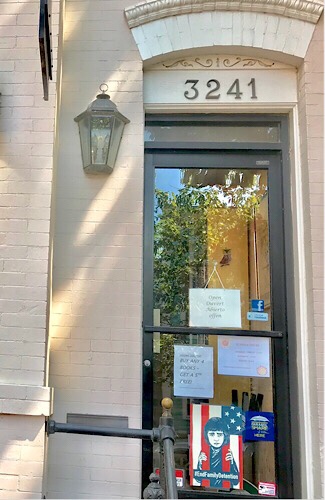
    I had previously committed to volunteering at the Lantern at the same time as the demonstration at the White House against the separation, incarceration, and deportation of those seeking asylum. I left the house an hour early and got off the bus at Farragut Square instead of taking it all the way to Georgetown. Volunteers were actively coordinating and people were starting to gather.

    I talked to people who were heading over as I walked on to the Lantern, and I brought the demonstration with me.

  • |

    Indian “Pony” Ride

    The Indian equivalent of the pony ride, is, not surprisingly, the elephant ride.

    This elephant, who is now 37 years old, became the giver of rides for tourists and birthday parties after having been rescued from malnourishment and the back-breaking labor of years of hauling lumber.  I was lucky enough to be able to get lots of hugging from her before people gathered for their rides.  She especially liked to be scratched behind her ears.

    Though the ride was rather tame–or perhaps because tame (i.e. gentle)–I rather enjoyed moving with this gracious being. A horse might now seem small (though likely feistier).

    Indian pony ride


  • | | |

    Found Exhortation

    One of the most profound and essential teachings of the great yogis is to “watch the gap.” We are given the practice of watching the gap, the space, the pause, the turning point between the in breath and the out breath, the out breath and the in breath. In the gap, we are able to witness perfect fullness (purna) and perfect emptiness (sunyata). In minding the gap, we can experience perfect stillness and serenity. It is an extraordinary practice in its simplicity and in its gift of peace and repose.

    Whether you have never heard of this practice, learned it at some point but have mostly forgotten about it, or just did it with your own practice, I invite you to take a few minutes on reading this: make your seat steady and as comfortable as possible, close your eyes, invite an intention of finding a still spaciousness in your heart. Draw your attention to the breath and start to notice the space (maybe almost instantaneous and unobservable, maybe a real pause) between the in and out breaths.

    If you are moved, comment on your experience to share with each other. There is no one right reaction nor a wrong one. If it was challenging to sit still and focus, just be gentle and soften to how enjoyable it can be to do nothing other than watch the breath, like the sweet and easy restfulness of watching the movement of waves at the beach.

    Peace and light, E — Posted with WordPress for BlackBerry.

  • | |

    Robber Barons v. Philanthropists (a memory triggered by reading the 1994 New Yorker article on SYDA Yoga)

    When I was in eighth grade, my history teacher, Mr. B,  assigned to the class engaging in a debate as to whether Rockefeller, Carnegie, and Mellon were philanthropists or robber barons.  We were put in teams and told which side we had to argue.  When we were given the assignment, I went to Mr. B privately and said it was not possible to argue one side or the other.  These men were only able to be philanthropists at their level of giving because of the money they had made as robber barons.  My teacher said that was an unacceptable position.  I was to argue the position I was assigned, I was wrong that it was not an either or debate.  I should understand that what was critical to this debate was which aspect was the elemental identifying characteristic.

    Where I think was our real difference of opinion was that Mr. B thought that one could/should not recognize both enormous evil and enormous good in the same person.  If one was evil, then the good was essentially irrelevant.  If one had done tremendous good, then it should not matter if there was bad along the way.  I tend to see the whole.  I take the good where I find it (for example, I have found great truth and utility in the writings of Swamis Muktananda and Chidvilasananda although I would not recognize either as my “guru”), but do not expect the “bad” to be absent or non-coexistent with the “good” and tend to be outspoken in my recognition of both.  I still sometimes get in trouble for this.

  • |

    Join Me for Free On-Line Practice Today (X-Mas Eve) and Next Thursday (New Year’s Eve)

    Invitation to Gratitude and Inspiration

    Free Streaming Yoga Christmas Eve (TODAY!) and New Year’s Eve

    Nurture Your Gifts and Release What No Longer Serves

    Time:  4:00-5:30pm

    Date:  Thursdays–December 24 and 31

    Register at: https://www.suzannelynchwellness.com/holiday-yoga-classes

    We’ll be signing on early if you just want to say hello.

    Please feel free both to forward and to ask any questions.


    —

Leave a Reply

Your email address will not be published. Required fields are marked *

This site uses Akismet to reduce spam. Learn how your comment data is processed.