Art and Culture | Asana, Pranayama, and Yoga Practice | Community and Family | Food for the Mind (Yoga Philosophy, etc) | Meditation
How Appropo to My Current Situation
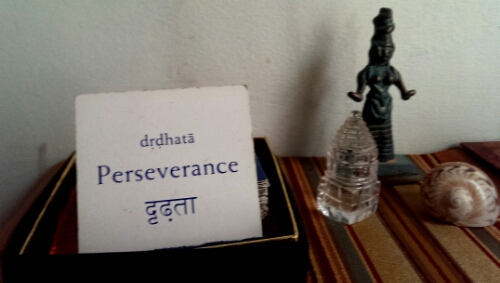
Today’s puja card.
Today’s puja card.
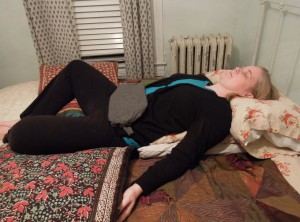
Let’s face it. When we are on travel and staying at someone else’s house or in a hotel and doing all the running around that comes with visiting or working or sightseeing out of town, we can get out of balance. This disruption of routine can upset our sleep and our digestion. You don’t need the exact collection of pillow shown in these photos. The point is that you can use whatever pillows and blankets (or even towels or your own coat or sweater to make the shapes of yoga bolsters and blankets) to do a nourishing and balancing restorative practice. I like to travel with a hot water bottle in the colder months; there is little more comforting than yoga restoratives with a hot water bottle.
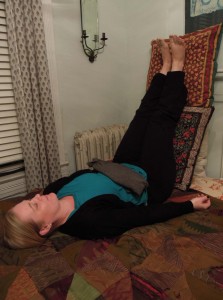
1. Legs up the headboard (sometimes there isn’t enough room on the floor to do any yoga even to do vipariti karani (legs up the wall pose)). Here, pillows are stacked against the head of the bed because it otherwise would be uncomfortable (and risky for the art over the bed). I suggest this pose first to surrender to being turned upside down, to undo the effects of gravity and too much walking around and carrying things, to relieve the legs and feet and to allow more energy to recenter itself in the heart. Stay for 10 minutes, or even longer.
2. Supported twist. Start with your left thigh against the pillow stack, so that the energy follows the natural direction of the large colon, thereby helping relieve the impact of travel disruption to the digestion. The gentle twist also wrings the adrenals, allowing them to release the toxicity of travel and disrupted diet. After 7-10 minutes, switch to the other side with the right thigh perfectly parallel to the pillows before bowing forward.
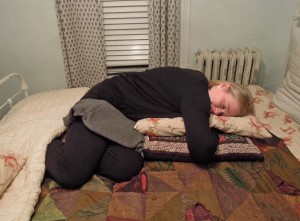
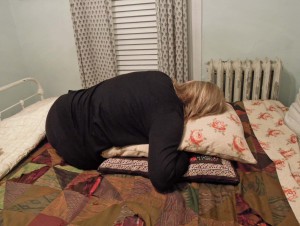
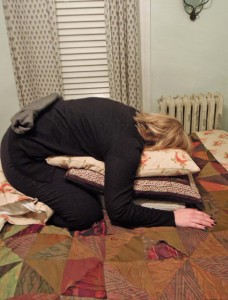
3. Balasana. Place a pillow or two between your heels and your seat. With your toes touching and knees wide apart, bring a couple of pillows, or folded blankets between your knees back to mid-thigh and then bow forward over the support, adjusting your makeshift props as needed to feel at ease in the pose. The pose invites a fullness in the back body, letting the adrenals rejuvenate after the cleansing action of the twists. This is good. Stay for 10-12 minutes or so, remembering to turn your head to the other side half way through.
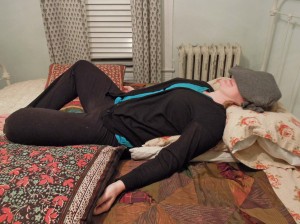
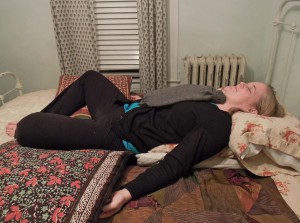
4. Supported supta badha konasana (bound angle pose). After you’ve relieved the feet and legs, nurtured the digestion and the adrenals, now is the moment to surrender to bliss (ananda) and open the heart to being right where you are–wherever that might be. Key for this pose is to make sure that the support under your back is right up against your sacrum. Shown by the fabulous yogini model are three possible ways to use the hot water bottle. I wouldn’t have thought to put it on my face, but she delighted in that idea, and I can see how it would be good for sinuses stressed by travel.
As with any physical practice, you should approach even gentle poses such as these with appropriate awareness, honoring your own body’s limits. If you want to learn how to practice yoga asana safely and optimally, it is best to take classes to supplement a personal practice.
I woke up sad this morning. I gave a political contribution, sat for meditation, and went out into the garden before going upstairs to work. I’m still sad, but engaged myself in what I was doing for the full day–trying to take care of community and self and be absorbed in what I was doing so that it could be done most fully. My consciousness thus engaged elsewhere, I did not absorb time and energy with my sadness.

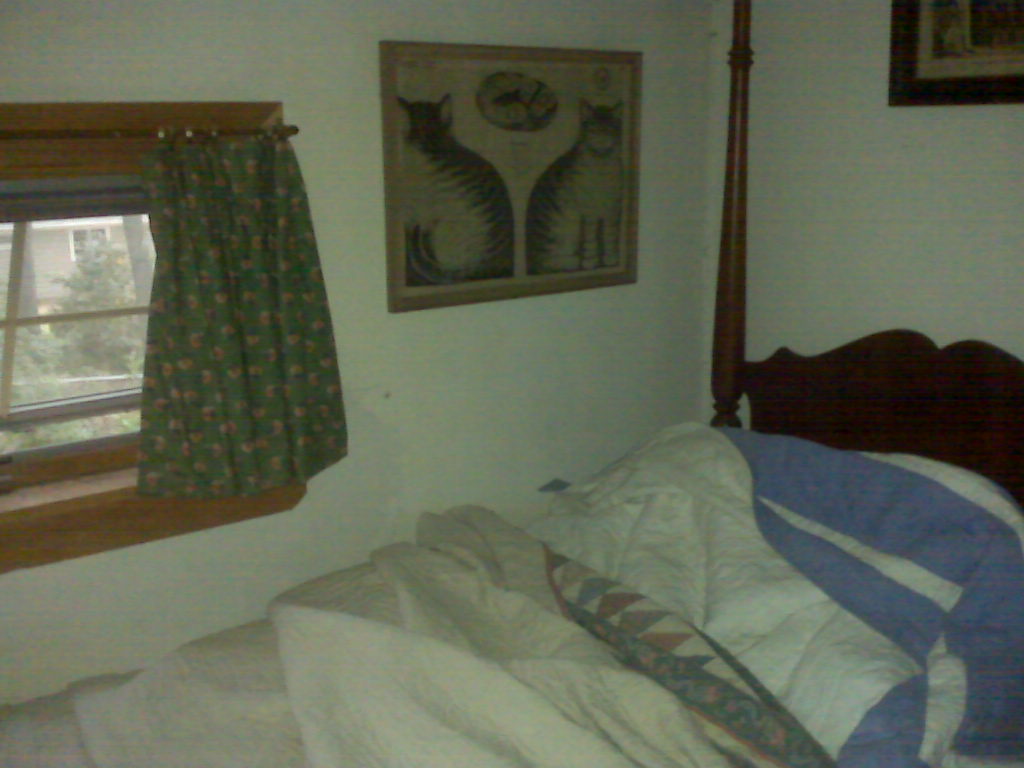
I slept last night in the room that I slept in as a child. My mother now uses the room to store some of the vestiges of her old antiquing business. The carpet, wallpaper, and curtains from the 1960’s are gone, but the bed is the same one in which I had slept. The picture on the wall is a kit for making a stuffed animal that my Grandma Rose had bought me (probably when I was about 8) at the Brooklyn Museum of Art that my mother decided would be better as framed art than a sewing project for me.
The neighborhood looks different–it is far more developed as is everywhere near a big city–but the bones are the same.
It is a challenge not to feel the weight of my history and ancestry when I return. Taking the time to meditate when I woke helped me stay fully in my adult self.
When we meditate, we ideally dissolve our individual consciousness into the luminous spaciouness of universal consciousness. In that space, where we are temporarily not experiencing ourselves as an individual, we are also not experiencing our individual self in the sequence (krama) of time. The luminous spaciousness of meditative consciousness is sequenceless (akrama) and, as universal consciousness, is the place in which the sequences of being in time and space arise.
What I experienced this morning when I meditated was that I did not have to be flooded with the emotions of my, to try to graciously describe, emotionally challenging childhood. In the space of meditation I could bring to my day an acceptance of all of my life and be where I am at present, coming to a place of recognition that although I lived all of my history, it neither defines me nor binds me from expanding into a space of growing love and light.
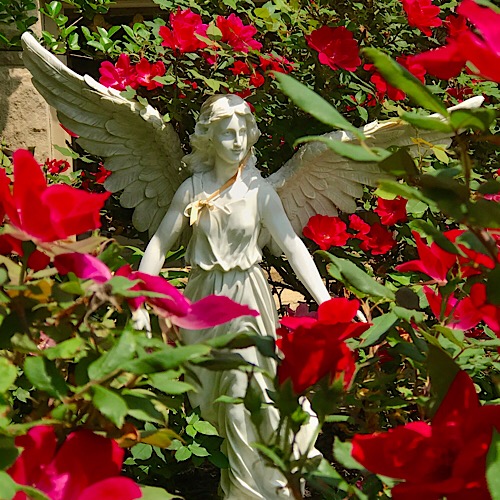
Pausing to smell the
Roses, I met an angel
Dancing wings outstretched.
With the cat and doing my taxes.