Similar Posts
Tantric Yoga Selfie (With “I Voted Early” Sticker)
The true tantric practitioner is fully engaged in the life of a householder. In my book, that means being educated about the issues, participating in social change, and fulfilling the citizen’s responsibility to speak by voting.
I hope all of you will not only be voting, but also will be encouraging others to vote–especially those who actually can elect representatives to Congress and the Senate (unlike those of us in DC who continue to be disenfranchised).
- Art and Culture | Asana, Pranayama, and Yoga Practice | Food for the Mind (Yoga Philosophy, etc) | Meditation | Photos
Airport Delay (and “Unreasonable Happiness”)
I am sitting in Phoenix’s Sky Harbor International airport waiting for the plane that should already be carrying me home to finish being repaired. After having done a full hour of practice this morning in my room, having a last delicious breakfast at the retreat center, and enjoyed the two-hour ride with friends to the airport, I find myself perfectly happy to sit in the airport. I am warm and well-fed. I have bought a novel to read on the plane — Lev Grossman’s “The Magicians” — and put aside a philosophy handout to write. The handout, a translation of the beginning of Abhinavagupta’s “Tantrasara” that was given to us by Paul Muller-Ortega to support our meditation practices, teaches us to seek the power of bliss through the practices, this bliss being true knowledge and true freedom. The more we practice, the more we can draw on this power and abide in a state of true happiness. Paul Muller-Ortega sometimes says that we want to be “unreasonably happy.” As I sit here feeling perfectly content after my weekend of practice and community and watching others in the airport get progressively grumpier with the delay, I feel unreasonably happy. I also feel fully motivated to practice and study ever more deeply so that I can abide ever more steadily and this glorious unreason.
Untitled

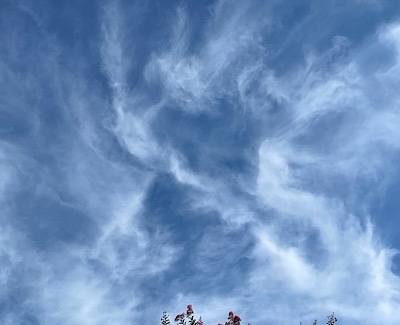
In the late afternoon, after it did not really rain again in this pocket of the DMV, I went out in the garden to get fresh herbs and greens to go with tomatoes picked earlier in the day. This was what the clouds were doing. I was called to pause and, with awe and appreciation, observe.
Winter Reading on the Tattvas (the elements)
I am returning to a contemplation of teachings about the tattvas (the 36 elements in Kashir Shaivism; in Vedanta only 25). Each time I go back to study, practice, and contemplate the tattvas, a new understanding arises about how I am in the world and how I might want to shift my alignment to be better able to serve, for want of a better word, the good. The tattvas provide a way of understanding the structure of consciousness [Consciousness], from the most metaphysical, universal elements to the most diverse, individual, physical elements and the relationship between the two. Practicing asana with the Anusara principles of alignment at the same time as reading these teachings has, for me, helped bridge the space between the intuitive and concrete understandings of being in the world. The point of trying to understand these extraordinary philosophical ideas is not for the sake of acquiring academic learning, but rather is an invitation to use the joyous experience of wrestling intellectually, intuitively, and physically to illuminate understanding, as a way to dwell more consistently in the heart.
Reading Sources:
Kashmir Shaivism, The Secret Supreme, Swami Lakshmanjoo, ed. John Huges, Universal Shaiva Fellowship (2003)
Kashmir Shaivism, J.C. Chatterji (SUNY Press, 1986)
The Triadic Heart of Siva, Paul Eduardo Muller-Ortega (SUNY Press 1989)
Artha, Kama, Dharma, Moksha (and Politics)
Last night, Paul Muller-Ortega, as part of the introductory talk for the meditation intensive, spoke at some length about the principles of ardha, kama, dharma, moksha.
As I have written about before, in the classical yoga view, it is the renunciation of the first three–material well-being, love and relationship, and right work or path, that leads us to the fourth–liberation. From a tantric yoga perspective, it is living and having the first three from the perspective of illuminated wisdom and discerning (viveka) insight (pratibha) that makes us free (jivanmukti) in this life.
One of the most exquisite things about a steady practice and study, is that each time we revisit a core concept, we hear and understand new aspects to bring into our lives.
When speaking of approaching these elemental aspects of human being, Paul noted that ardha includes not only material well-being, even wealth, but also the power that wealth brings and how we use it. Although he only mentioned that briefly amidst several other concepts, it really resonated with the current state of my being in relationship to the world and our country.
I have been contemplating deeply about wealth and power in this time of budget debate, and how they can and should be used to bring nurture, peace, and health to the maximum degree possible. (You might guess that I don’t think increasing spending for war and decreasing spending for education and health is going to bring us freedom).
Thinking about the power of money as part of our contemplation of our material well-being is something of critical importance at this time. If we shun or disdain in our minds wealth and power while still yearning for our own comforts, than we have lost an opportunity to bring the yoga principles into our lives as optimally as possible. (Of course, grasping and coveting money and power is completely destructive of the possibility of happiness, but most of us think about that, and it is why some say they are bad — money being the root of all evil, etc.).
If we are really in the world and want to be happy and to share and spread happiness, while living in accordance with the principles of the yamas and niyamas, especially the yamas: ahimsa, satya, aparigraha, brahmacharya, asteya (non-harming, truthfulness, non-greediness, aligning with spirit, and non-stealing), that is when we will start opening up the possibility of true living liberation.
Imagine, instead of thinking about material well-being as a “guilty pleasure” thinking of ways in which you can use your own well-being (and work through your practice to discover greater health and strength) to be a voice and power for good in your own individual way.
Peace and light, E — Posted with WordPress for BlackBerry.