Similar Posts

  • | | |

    The News

    The photos of the aftermath of the earthquake are horrific. I cannot really imagine what it must be like. I found myself today thinking about how it is that I trust that the images are real even though those who offer us “entertainment” give us similar pictures through the same media. How do we stay keenly open to truth and sympathy when our receipt of truth and fiction comes through the same channels? My heart goes out to all those suffering.

    Peace and light, E — Posted with WordPress for BlackBerry.
  • | | | | | |

    The “Highest First” and Knowing What Is a Weed

    Webster’s On-Line Dictionary defines a “weed” as”any plant growing in cultivated ground to the injury of the crop or desired vegetation, or to the disfigurement of the place; an unsightly, useless, or injurious plant.”  At first blush, this might seem like an easy concept, but if we start breaking down the definition, we can see how much our education, assumptions, and prejudices come into play in deciding what is a weed and what is not.  We need to recognize individual plants (when they first come out of the earth and when they are in full leaf or flower) and what they offer.  We need to know how to foster growth of what we choose to plant, including knowing what will thrive in our location and bring more health and beauty to ourselves and the planet, and we need to have a sense of aesthetics that will cultivate not only our connection to spirit, but optimize the shining through of spirit in all that surrounds us.

    Several years ago, I bought a sprig of epazote in a two inch grower’s pot.  It went to seed and came back all over my little garden.  It grows wild beside highways where it is a native plant.  I really like the taste, and it is hard to find here, so I give seedlings away to friends who want it for their own gardens (locals just ask, and I’ll give you some).  It is one plant I know I do not have to replace; it will come back every year if I let it go to seed.  If I had not controlled it by taking it out of prime planting spaces and either using it right away or replanting it someplace nothing else will grow, though, it would be crowding out other plants in a way that is less than optimal.  It is thus both a desired plant and a potentially invasive weed depending on how it fits in with the whole.

    I have seen neighbors using Roundup to kill purslane and dandelions that have grown up between the bricks on the sidewalk in front of their houses.  Although I think both purslane and dandelions are pretty plants and perfect for spots where nothing else will grow, I can appreciate wanting the front of the house to look tidy.  Why not pick the free edible plants instead of spraying toxic chemicals?  I let edible wild plants come up between the crevices and then either relocate them or treat weeding as harvesting, getting incredible flavor and nutrition from something that most are taught to try and eradicate.

    There are other plants that are sufficiently invasive or poisonous, though, that I do my best to eliminate them from my space (though I do not use pesticides).  The other day, I was walking down East Capitol Street after teaching the William Penn House class and saw some English Ivy climbing up a beautiful tree in one of the sidewalk tree boxes.  I stopped to pull it all off because English Ivy left unchecked will kill a tree.  While engaged in this activity an older couple who lived in the house next to the tree walked up to me and my fellow yogi who was helping me with the ivy removal.  The woman thanked me, saying that she had been meaning to pull the ivy.  Ivy is an example of a plant people think is pretty and appropriate to plant, but it does not belong in our climate and is incredibly destructive.  By my lights, it is a weed, even though I can buy it in most nurseries in the area.  I am blessed not to have poison ivy where I live, but it should be removed.  It is too hard to live with it.

    What does determining whether a plant is truly a weed, whether it causes injury or interferes with what is desired or is unsightly, useless or injurious have to do with the “first principle” in Anusara yoga of “opening to grace?”  The first principle invites us to be ready in the first instance to recognize the auspiciousness of both what we seek out and what we encounter.  In teaching meditation and related practices of Blue Throat Yoga, Paul Muller-Ortega speaks of this as “the highest first.”  As we study and practice (jnana/vijnana), we approach the same and new things with ever more refined technique, knowledge and understanding.  The progressive refinement from our efforts helps us then to open up to a deeper perception of the best of our nature.  We keep repeating the cycle of studying and practicing, always remembering the first principle, and we, despite and because of ourselves, shift our relationship with the world around and inside us.  To be open is a softness, a spaciousness, a willingness to see that is without effort.  We temper what gets in the way of effortless opening with the fire to study and to practice with the intention learn how to be more effortless in understanding how things are part of the whole.

    How do we apply first principle in knowing what to weed from our garden (or, for that matter, how to address in ourselves a physical, mental or emotional characteristic or pattern of behavior that may or may not serve us or both–our individual “weeds”)?

    Is the “desired” vegetation a desire that would help align the gardener and the garden with nature or is it something that was taught that comes from an unsustainable aesthetic and social paradigm (for example, a perfectly green lawn with no plants other than grass)?  If the crop is one that truly nourishes (so worth preserving from injury or interference), does it just mean that the “weed” needs to be relocated so that both the crop and the “weed” can flourish simultaneously?  In other words, is the “weed” beneficial in its own way, but just needs to be shifted so that its inherent good can truly be appreciated and honored?

    Is a determination of injuriousness, uselessness, or unsightliness based on ignorance or true discriminative wisdom?  We cannnot know unless we both sweetly open to recognize the potential for discovering the good in what seems most harmful (perhaps one day scientists will find an extraordinary benefit from poison ivy, just as the deadly poisonous plant digitalis is also a powerful heart medicine) and continue to study and practice with an intention to open ever more deeply.


    From left to right: volunteer epazote, lemon balm, purslane and dill.  Dinner:  black beans flavored with epazote; greens, including purslane.  Lemon balm (aka melissa) makes a delicious and quieting evening tea.

  • | | | | |

    Late Spring Greetings–Making Time and Space (Web Version of E-Newsletter)

    Dear Friends,
    I hope you are thriving to the greatest extent possible under your current circumstances in this outrageous Spring and weathering (pun intended) the wild fluctuations between apparent late winter and seemingly already mid-summer.  My garden has been uncertain at several moments, but partly due to careful attention at strategic points and partly out of love and luck, it is thriving–providing lots of herbs and greens and promising lots of tomatoes and peppers and beans.

    I write this letter a bit later than might have been desirable, as the summer session at Willow Street has already started, and my partial sabbatical from yoga teaching evidently has begun.  In practical terms of time and space this is the first time in almost eight years that I am not working weekends (first Saturdays and then Friday evenings) and commuting out to Takoma Park from Capitol Hill to teach.

    It took much contemplation to come to this partial sabbatical. Being a part of the Willow Street Community has been and continues to be important to me, and I have learned an incredible amount from the opportunity Suzie Hurley, and Joe and Natalie Miller, gave me to share my enthusiasm for the practices and the teachings with the fabulous variety of people who come to Willow Street as students.  It was an honor and a continuing source of inspiration and focus to be able to study with so many fine fellow teachers over the years.  And change can be hard for me.  It also is hard to let go of something that has been profoundly important.

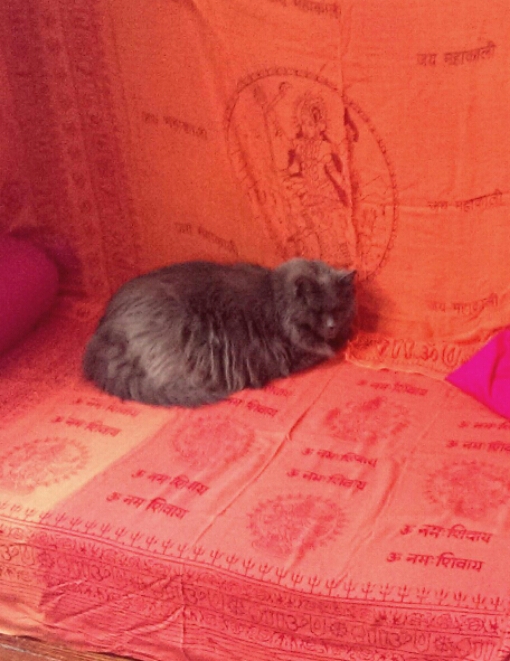
    For my optimal health and well being, though, there just was not enough time for me to work full time and go where my heart is currently leading and also continue to teach on Friday nights or Saturday mornings.  I had to make a shift or start fraying around the edges, becoming less happy with everything.  Better to make some space to breath and feel and think without pressure.  Freeing my weekends fully will give me some of the space and time that I need at this crossroad in my life.  I am moving, I hope, towards a phase where there is more emphasis on nurturing self and relationship more deeply and exploring other creative pursuits with more seriousness.   To be able to work intelligently and with good will as a civil servant at this time and to continue to engage in our society that is in so much upheaval, leads me, for my abiding health and expansion, to the garden and the cat and my own practice and the growing and very special relationship that began on the trip to India (no value judgment implied by the order).  It also will be lots easier for me to study; going to a weekend workshop will no longer require my getting a substitute to cover my absence–expect to see me as a fellow student at the Friday nights of weekend workshops at Willow Street.  New ideas and opportunities for teaching will likely come, but not for the moment.

    I continue to lead the all levels yoga practice at William Penn House on Tuesday nights where you will be warmly welcomed by the regulars whatever your age or ability level and will be sure to enjoy the fruits of my new and varied explorations in yoga and other practices, while still keeping to the fundamental structure of class influenced by Anusara methodology.  Please join us.  A portion of each student’s payment supports the work of William Penn House.  While there is a suggested amount, if funds are a challenge, just pay what you can.

    Feel free to e-mail me if you are a more experienced practitioner who is interested in the Wednesday night practice or if you are interested in arranging private sessions or semi-private practices with your own small group.

    I look forward to seeing those of you who are local on a Tuesday night or at a workshop around town or in the neighborhood and also continuing to share photos and contemplations on this latest phase of my yogic (yes, I know that isn’t a real word) on the blog.

    Peace and light,

    Elizabeth

    clouds

Leave a Reply

Your email address will not be published. Required fields are marked *

This site uses Akismet to reduce spam. Learn how your comment data is processed.