Last Night’s Moon


Last night, at his workshop at Willow Street Yoga, Todd Norian discussed the niyama samtosha — contentment. “Perfect,” I thought, because I had been contemplating the practice of samtosha all day. When I had sat to meditate in the morning yesterday, it was hard for me to stay with my mantra or any sense of peacefulness, light, or delight. Thoughts of the horrendous repercussions of the Supreme Court’s decision on campaign finance kept arising. Time to get back to the foundations of practicing! As I began walking to work (past the Capitol), I brought myself back to the practice of samtosha, which I find one of the most useful practices for me.
Samtosha is the second of the niyamas set forth in Patanjali’s Yoga Sutras. The yamas and niyamas are ethical precepts for living and for practicing. In Patanjali’s eight-limbed, dualistic path of raja yoga, they precede the practices of asana (the physical postures), pranayama (breathing), and the various stages of meditation, which culminate in samadhi (equinimity or bliss). When I am struggling with what I witness in the outside world, I always come back to the practice of samtosha. Some people may be naturally lighter-hearted than others, but contentment is indeed a practice, and it is a foundational practice.
When I practice contentment, I remember to be grateful for all that I have. When I fully practice contentment, instead of becoming bleak and cynical (it is easy enough for me), I not only feel more naturally cheerful, but find I have have more strength to continue acting in accordance with my beliefs, even when I am confused, alarmed, outraged, and disgusted by what is going on outside. When practicing contentment, I try to find my own light, I seek the love and company of friends, I join with like-minded persons to be moved to work for change, even if I do not trust it will make any visible change to anyone other than me.
FYI, Todd Norian will be at Willow Street Yoga Center all weekend. If you are local and reading this in time, try to come for some of the weekend. He is wonderful.
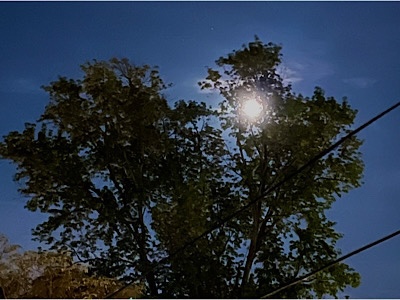
It felt good to sleep in and still wake up at my usual 6am. I did my morning practice, went to meeting for worship, joined in at a fundraising lunch for Pakistan flood relief, looked at the Truth Beauty exhibit at the Phillips, took a walk in the neighborhood, and then took a short nap. Then I took one of my favorite walks in the neighborhood — from my house to House of Hands, the home of my neighbor, friend, and wonderful massage therapist Patrick. As you can see, the sun was setting as I walked to a 5pm appointment. In honor of the change of seasons, the heat was on the massage table. Nice. It was dark when my massage was finished, but I had hot soup for dinner and am looking forward to my evening meditation and practice. I do not have many days that are this luxurious and free of commitments. I enjoy them to the fullest when they come.
When a student asks a question and I do not know the answer, I do not try to answer it then and there. I do go home and take the time to try and find an answer. If I find enough information to be useful, I follow up. Last night, before the William Penn House class, a student asked whether I had received a recent mass e-mailing from John Friend in which he mentioned teaching about biotensegrity. I knew the answer to whether I had received the email–yes, a friend had forwarded it. I did not know, though, how John was using the term biotensegrity. I went and did a little research.
Buckminster Fuller coined the word “tensegrity”as the conjunction of tension and integration. The idea of tensegrity is being actively taught by anatomy teacher Tom Myers, a student of both Buckminster Fuller and Ida Rolf and a teacher of certain of my yoga teachers. It also bears a trademark when called “Carlos Castenada tensegrity.” I never got into the “magical passes” of Castenada’s students turned teachers, but at some point relatively recently found a used copy of “Magical Passes.” As I had delved fairly deeply into Carlos Castenada in my youth, I picked up the book and made it part of my library, though did not read it at the time.
I am not surprised that John is talking about biotensegrity. From my few hours of reading, it seems resonant with the “universal principles of alignment” that were the foundation of his Anusara teachings and also consistent with his movement towards the exploration and teaching of “sacred geometry” near the end of his Anusara days.
Yes, I know I haven’t actually said what is tensegrity or biotensegrity in the yoga/body awareness and movement context. But I do not teach unless I have learned something well enough to integrate it fully into mind and body such that I can articulate it in my own words, and I have not thought enough about the term tensegrity as it relates to yoga practice, though the concept makes initial intuitive sense. If the links inspire interest, I invite you to look more deeply. And I’m going to put “Magical Passes” on my stack of reading, though not necessarily at the top.