Meditate Anywhere
When I emerged from the DC Covid Center after getting the Omnicron booster and meditating for the post-vax waiting period, I emerged and saw this person meditating outside.
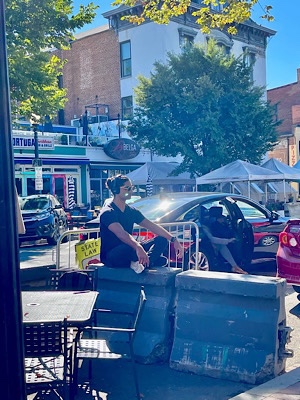
When I emerged from the DC Covid Center after getting the Omnicron booster and meditating for the post-vax waiting period, I emerged and saw this person meditating outside.
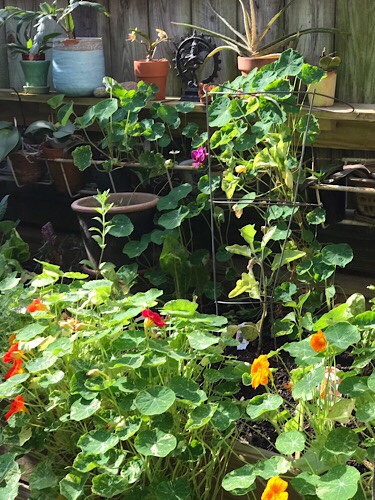
This rose in a friend’s garden had the most exquisite scent.

Today I have some hope. I keep on, though, regardless of hope. That is the practice.
How do you react when you see signs of neglect, disinterest, disregard for the health and well-being of the earth and other beings? Do you get stuck in a sense of helplessness or rage? Do you think we’re all screwed anyway and decide no effort to make things better is worth it? Are you moved to political action? Are you moved to take better care of self, family, and friends, even if you think you cannot make much of a greater impact beyond your intimate circle? Can you remain engaged and still find joy, whatever the apparent immediate results and how hard the battle seems to be?
The Bhagavad Gita, says that to live a life of yoga, we must do the last of these. The first teaching from the Bhagavad Gita on this point is that we must live in accordance with our dharma (duty). The second teaching, and more important for having peace of mind in a life of duty, is that of “actionless action.” The true yoga is to live a life of action in accordance with dharma, but without attachment to the outcome (i.e., live in an orderly way, accepting the tendency of the universe to be chaotic).
Dharma in the Bhagavad Gita, of course, contemplated rigid roles in terms of livelihood and place in society. In the paradigm of citizenship in a democracy that does not so narrowly circumscribe one’s livelihood or place in society, I wcould argue that it is all of our dharma to participate as a citizen, voting, speaking out for our beliefs, and otherwise using the freedom we have to live a life that best supports the twins of individual and common good, including not just human good, but the whole ecology in which we exist. The actionless action part is to keep seeking (without despairing) to make things more in alignment even if the forces against healing, nurture, and alignment seem to conspire against positive results that we will see or actualize ourselves.
Are you registered to vote? Have you watered your trees? Casey Trees reminds us that this week in DC is dry; trees need about 25 gallons of water or 1 1/2 inches.
I spend a lot of words on this blog extolling the benefits I have perceived in myself and in my students from the various yoga practices. I also candidly admit (when asked) that not all practices are for every one and certainly not all of the time.
It probably seems obvious that challenging asana would not be right in the presence of certain injuries or illnesses, even if asana practice, which is good for our strength, balance, and flexibility, among other things, is generally beneficial overall. Being an advanced practitioner entails in good measure being sufficiently sensitive and aware of our edge day by day and even moment by moment in our practice so that we expand our capacity to live life to the fullest without blowing past our edge out of ignorance, carelessness, or ego and needlessly injure ourselves.
What is more subtle is finding the same edge in meditation. I am not talking about physical discomfort sitting for meditation. That can be easily remedied with appropriate props, for example a cushion or chair. There can be such a thing as too much meditation or not the right type of meditative practice for certain practitioners or under certain circumstances. Going deeply into the self beyond the surface level of thought can release things that had been buried. We may not be surprised if we have nightmares or anxiety dreams when life is presenting us with lots of challenges and difficulties. It may be more shocking, though, if negative thoughts or emotions come up when we sit for meditation. Meditation is supposed to be benign and health-optimizing.
One way to deal with the shock is to stop, but then we lose the wonderful benefits of meditation. What is more optimal is to learn where is our edge in meditation, just as we do for asana. As we get more proficient and experienced with meditation, if things are coming up that are difficult to handle, we learn when to shorten our time sitting, when to add in more physically comforting and boundary-enhancing asana, and how to release the negative stuff that is arising without it impacting our lives or relationships.
The challenge is that it is precisely the steady, intense practice over time that gives us the insight to know when the practice is too much at a particular time. For me, finding the edge where I can expand perfectly can be a challenge, but is ultimately and completely worth my while.
For some of the alleged dark sides of practice, try entering into your favorite search engine “meditation side effects.” Then read with appropriate skepticism; it is the internet after all, and you should be as skeptical about the claims of the negative aspects as you might be or once have been of the potential benefits of the practices.