Seva
Today I joined others at Kingman Island to help with invasive plant removal. Licensed destruction can be very satisfying. It was a beautiful to be outside.

Today I joined others at Kingman Island to help with invasive plant removal. Licensed destruction can be very satisfying. It was a beautiful to be outside.
I am on Amtrak heading to the Anusara teachers’ gathering in
Morrisville, NC. The train is surprisingly crowded and not surprisingly a whole different vibe than the train to NY.
By day we will be practing and gathering in a hall at a Hindu temple. The grounds are reported to be beautiful and welcoming. By night, those of us who don’t have local friends will be staying at hotels off the highway with cable TV that usually serve the visitors to the big university ball games and events. We’ll then all be driving back and forth to the venue and out to eat.
I find it of mild interest that I spend more time in cars and more time in a place with TV when I travel to study yoga than at any other time during the year.
This morning, when I was reviewing in my head some of the meetings and other work matters upcoming this week, I thought, “what a good time to practice all the things I have been studying.”
It felt like progress to think that and then notice my first thought was not, “this week is going to be awful,” or even, “this week is going to be challenging,” instead of thinking the latter and reminding myself of the former.
And having a homemade popsicle after a long day certainly helps make this heat wave more enjoyable.

Lime, cucumber, mint popsicle (cucumber and mint from the garden)
When I read Kate Swift’s obituary yesterday, it lead me to think more deeply about a recent conversation I had about the Bhagavad Gita. The Bhagavad Gita, not surprisingly, is required reading for most yoga teachers. It is an integral part of the history and philosophy of yoga thought and practice. It is, though, about a battle in the middle of war, in a time and place where a woman’s highest and best (and arguably only role in life) is to be obedient first to parents and then to husband. Purity, obedience, and beauty (as decided by society) are the great virtues of women. As a dialogue between a male warrior (Arjuna) and a male incarnation of the deity (Krishna), all of the spiritual and social teachings are presented in terms of men and males, right down to the pronouns. The translation that was being discussed was that by Juan Mascaro. As a mid-twentieth century translation by a Spaniard at Cambridge University who has lectured on “Literary and Spiritual Values in the Authorized Version of the Bible,” the translation no doubt perpetuates (without any specific or willful intention to do so) the inherent sexism that is also found in the English language and in the Bible and its notion of God.
The question raised was how a book that perpetuates sexist stereotypes could be required reading to be a yoga teacher. (See my previous blog entry on how we, as yoga teachers, can rely on a book that is primarily about war.) How would it read, it was suggested, if all the pronouns in the Gita were changed from he to she? The person raising the question said that making this change made the spiritual guidance more accessible to her. For me, shifting the pronouns from male to female does not address the challenge because I do not believe in spirit that can be given gender. I read the Gita and other yoga texts in two ways: (1) as historical and literary/philosophical documents that are products of the author’s time and place in history; and (2) as a source of universal human truths. The Gita, as a dialogue between a warrior and a male avatar of “God,” does not have much place in the ideals I hold dear. Neither the caste system nor the roles for women espoused in the text support my own beliefs about equality, justice, fairness, or love. The extraordinary teachings of yoga, though, transcend the history out of which they arose. To do justice to the yoga texts — and not just the yoga texts, but the great teachings and texts that are an integral part of our social fabric — we must both recognize their historical context and be open to learning what has transcended history and cultural boundaries to make them living words.
In attempting to make the shift to a modern interpretation that allows for “feminism,” I know many who try to address some of the challenge for modern readers by saying that we all have characteristics of the masculine and the feminine, and so we can read the guidance in the texts as being valid for both sexes. The problem I have with that is Kate Swift’s point. If we label various personality traits and characteristics as being elementally male or female, we are still perpetuating sexism through linguistic bias. It is not enough for me to make the warrior female and allow her “male” characteristics. What I think is that all human characteristics are gender neutral. If the teachings are not to be biased when we as teachers transmit our reflections on the texts to our students (after recognizing how history has done it), then we need to say that all people can be assertive or passive, strong or sweet, rigorous or soft, etc, but not just say that some are masculine and some are feminine and that in having all of these traits to some degree, we are showing that we are both god and goddess, masculine and feminine.
Or we could just not do any labeling at all, instead concentrating on the truly universal yoga teachings of right action, selfless service, and deep abiding love–none of which have anything to do with gender.
I have been told more than once that one cannot technically be a true practitioner/believer in the tenets of Kashmir Shaivism without believing in some form of Godhead. As a nontheist who still finds the teachings and practices informative and useful for how best to live, I ask consistently whether that is really true.
I’m sure a purist (religious or academic) would say there’s no anything to the philosophy without being a full believer. But what I think one gets from practices designed to heighten awareness of a divinely connecting universality in the wild diversity of life without a belief that what is universal a priori points to “God” is a recognition that with all that is troubling and difficult and hurtful and evil in this world, the very complexity and outrageousness of being is yet wonderful and inspiring in itself.
In a word, when all else fails, laugh (and create and live) with an ecstatic fatalism.

Painting by Sandra Dooley. Cuba 2014
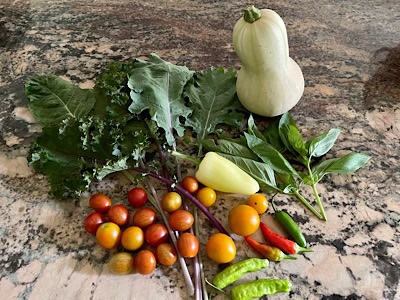
Even though not documented much recently, the garden has moved into summer effulgence. It is a place of curiosity, wonder, and delight. What brings you joy and nourishment in these troubled times that are calling for ever more engagement?