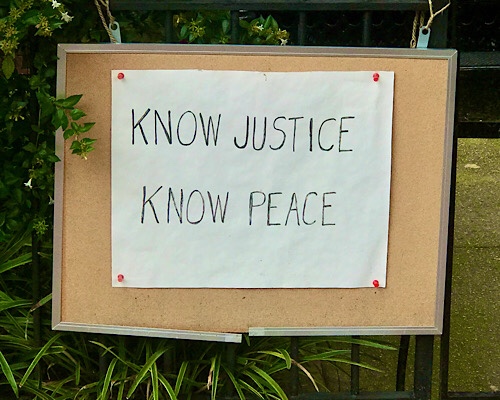
Shadow and Light
What we do matters even if it does not (or apparently does not) change the big picture.
I find contributing in some way helps me feel less despondent, even if that is because I have occupied my mind with positive action for as long as I am doing it.
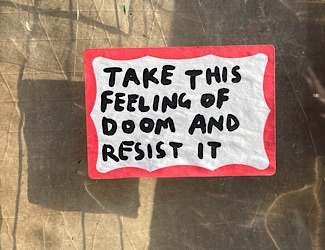

Stated another way: act only at speeds in which you can be fully mindful.
Last weekend, I went with a friend to see The Steins Collect at the Metropolitan Museum. I made a special effort to see the exhibit because of the incredible impact on art and culture that the Steins had by virtue of their collecting. Many of the paintings in the exhibit were familiar; I’d seen them before either at the Met for those from its own collection, at other museums, or in books. Some, which have ended up in other private collections or in the collections of museums that I have not visited, were completely new to me.
Among the paintings in the exhibit is Picasso’s Boy Leading a Horse (which, as you can see from the link, the MOMA website currently indicates as “not on view”). I’ve seen the painting many times before at MOMA. The shift of location and context shook up my perceptions of the painting, and I indicated that to my friend. Another woman who was looking at the painting too engaged in the conversation. “It seems wrong here,” she said. “It’s a different view,” I replied. “It is disconcerting, but seeing it in different light, context, and company is enabling me to see new things in the painting and to find a more enhanced appreciation.”
I have been thinking this week, and talking about it in my classes, how a change of context can bring us new vision. How often, when things just keep going in a set pattern, do they collect dust and cobwebs (literally or figuratively)? I asked my therapeutic students whether they had preconceived notions about various challenges of embodiment, especially the chonic ones. Do you see them as part of your identity, something that causes you pain instead of giving you the joy of movement? What if you embraced being ever more conscious of alignment instead of being conscious of pain and limitation (and learning better and sooner when you cannot get out of injury without outside help)?
What of it? What of the change of perspective? After all, things get rearranged for us and the dissolution can be gradual or violent or something of both and be something of greater or lesser magnitude. Times of flux and dissoluti9on are the perpect time for questioning, for new vision, for discovering new ways to experience what had become too familiar, for seeing how one might wish to shift one’s own perspective for the good, to know and take responsibility for one’s own place and piece of this relationship to whatever it is that is shifting, dispersing, or dissolving., to seek to become unbound from the habitual binds of whatever invisible clothing we might be wearing.
The shiva-shakti tattvas, the two highest tattvas, are completely subjective. The shiva tattva is, according to the philosophy, the ultimate reality, the pure “I,” undiminished and undifferentiated consciousness. As something purely subjective, it is both everywhere and nowhere, in every being and simultaneously beyond them. It is not dissimilar to Hegel’s Absolute (though I believe Douglas Brooks, who knows far more than I in this area, might disagree with me on this one), which “is and is not,” or Kant’s “unmoved mover.”
Shakti tattva is power — the power to tranform, create, manifest, diversify, cloak. Shakti is the power to become embodied in objective form. Shiva and shakti tattvas are thus inseparable. Ultimate unbounded consciousness and freedom (shiva) only has meaning to the extent the power to move, create, and diversify (shakti) pulses and transforms the subjective into the objective, the unimaginable to the observable.
In our yoga practice and meditation, we seek to use the practices to reveal to ourselves the ultimate pulsation (spanda) between the objective and subjective, the observable and the unknowable, the individual and the completely universal. One way I experience the first principle of Anusara yoga (open to grace), is taking the mat or my seat with an openness to sense and experience this ultimate pulsation (spanda) and play (lila), so that by using my body, mind, and will, I can better recognize the spirit that shines in all of us and use that recognition to inform how I relate to myself, society, and all beings.