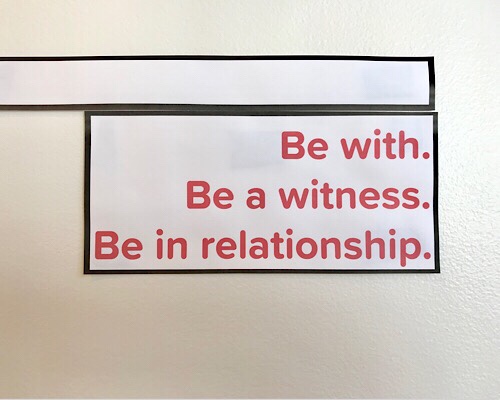
Found Quotation
Received as a thank you note from an organization I have supported over the past year.
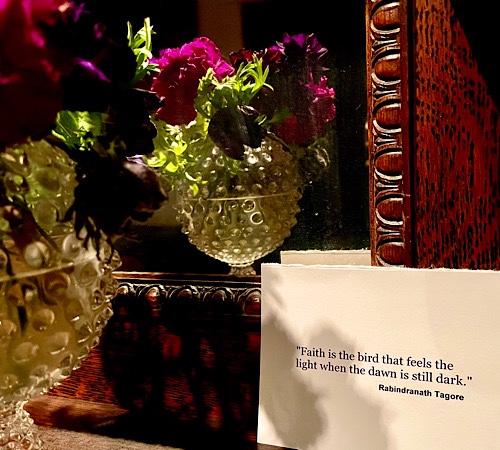
Received as a thank you note from an organization I have supported over the past year.
Last night, we were talking about the parameters of cultivating a steady and fruitful meditation practice, and Paul Muller-Ortega suggested that it was about the balance of stability and flexibility. He had learned the principle from a different source, but I have contemplated and explored the principle in depth from teachings I have received from John Friend.
A critical aspect of the Anusara alignment principles is to find the perfect balance of stability and freedom. We need stability to stay fully and safely in each pose. We need freedom to achieve the fullest and most delightful expression of the pose.
We find the stability both by making certain that we have established our foundation (which is an aspect of the first principle of opening to grace). By then using the three aspects of muscular energy–hugging the muscles to the bone, drawing into the midline, and drawing energy from the periphery to the focal point, we make possible an expansion of our edge, whatever that might be. Having a solid, aligned foundation and affirming our very core with these actions, gives us security and balance. We also want to reach out, to be playful, to expand to our fullest, which we do using the expansive, outreaching organic energy — from focal point to the periphery, from the midline to our outer edges, from the very marrow of our bones through bone, muscle, skin, and beyond.
If we over-emphasize (including natural inclination) stability, then we can get stuck. If we just let ourselves be free, then we end up all over the place. When these elements are perfectly balanced, we can safely find our deepest freedom of expression.
When I teach this principle as the focus of a class, I always invite my students to think of how important the balance of stability and freedom is for every aspect of our lives.
The discussion last night put this principle in the context of the regularity and steadiness of our practice, with the recognition that to stick with our practice, we will sometimes need to vary the time or amount of our practice, or what elements are included in the practice.
To get the fullest benefits of a practice (this applies to any practice and not just to meditation), we need to show up consistently and to practice in accordance with how we have been taught. To stay steady, though, we need to give ourselves the permission or freedom not to show up, or within appropriate parameters, to modify the practice when life gets in the way of what we think would be the ideal practice. If we think we have to do things at the exact time and place every day in a perfectly precise way, we become rigid. On the other hand, if we are loosey-goosey about it, then we do not have much of a practice and will not realize the benefits that we could get.
Where in your practice or life would more stability and steadiness give a field for greater freedom and happiness? Where could you give yourself a little more flexibility so that you feel that steadiness brings the possibility of joy, rather than tying you down?
Peace and light, E — Posted with WordPress for BlackBerry.

Peace and light, E — Posted with WordPress for BlackBerry.
Last night in group practice a student asked what she could do to keep her standing leg upper thigh/outer groin from cramping in ardha chandra chapasana (sugar cane pose). I responded that she probably was not using her inner thighs enough; she need to hug more to the midline. Another student pointed out that it is very challenging to hug to the midline in an asymmetrical pose.
Anyone who studies Anusara yoga has heard the teacher say “hug to the midline.” The physical instructions most often given to help the student do so, are “shins in” (coupled with “thighs back and apart”) or “isometrically draw your heels/feet together” (or hands in an arm balance or elbows/forearms in pincha mayurasana or sirsasana). “Hugging to the midline” is one of the three aspects of “muscular energy,” the second of the five “Universal Principles of Alignment” in Anusara yoga.
To help find the midline in an asymmetrical pose, I invited the students to do a partner exercise in ardha chandrasana (balancing half moon pose). One student went into the pose. The other student stood behind the one in the pose and place a hand or forearm underneath the lifted ankle of the student in the pose. The student in the pose then pressed down energetically into her friend’s support. The student was then able to find how to do “shins in” with the lifted leg. What all the students discovered was that by working with far more enthusiasm and power to the midline, it was much easier to open the heart into a deep back bend in the pose. As it was a backbending practice, we also explored the principle in various one-legged backbends, including eka pada ustrasana (one-legged camel pose) and eka pada urdva danurasana (one -legged wheel pose). The students who might not otherwise have been able to find these poses, discovered that if they hugged with heartfelt enthusiasm to the midline, they found an ability to do a pose that they might otherwise have thought beyond their reach.
This alignment principle was a perfect way to illustrate the theme of the practice, which was discipline as discipleship to the light (see yesterday’s blog post). All of the alignment principles in Anusara yoga are designed to get us deeper into our hearts; it is an added benefit that they make us stronger, more flexible, more secure in our bodies, healthier, and more energetic. Hugging to the midline will definitely help us engage our core muscles, thus giving us more strength and tone. As an energetic matter, hugging to the midline draws us into the central channel, the sushumna nadi — the place of grace where the kundalini energy rises.
When we are practicing sincerely, we are not just seeking to achieve a pose or get stronger or even to have kundalini experiences. We do not discipline ourselves for some external goal. Rather, out of the deepest longing to connect, we engage the principles to align our energetic and physical bodies so that we can be more in the flow and find more capacity to soften and expand our hearts and carry that into our lives, lifestyles, and relationships. The physical practice can show us how this works, and then, when we are aware, pulses us back to our true desire. More than the physical act of hugging to the midline makes it easier to do a heart-opener (backbend) and the energetic act of drawing to the midline may stimulate the flow of the kundalini energy, the discipline of drawing in to find the light will help us soften and expand the heart center so that we can reside more deeply there, and thus experience and share more joy, love, and compassion.
For the past hour or so, one of my neighbors has been shoveling the sidewalk. He is a young teenager; for a while a younger girl was out with him, too. They both had shovels and were working pretty vigorously. I always wave and say hi to these neighbors, but have an uneasy relationship with them. In the 19 years I have lived on the block, various members of the household (though not these particular kids) have broken into my house and threatened me and my neighbors. People who live in the house and their visitors regularly throw litter into my yard, and other neighbors have reported that they have caught kids currently living in the house throwing stones at houses and cars.
The shoveling was going on for a long time and the sounds were getting closer. Sure enough, this young man, perhaps because he was feeling trapped by being stuck in the house all day and was feeling full of energy, was shoveling the entire sidewalk, including the space in front of my house. I am delighted and grateful. I was not looking forward to going out and doing it myself. I will make certain to thank him. He has reminded me that I need always to be open to receiving the good from whatever source, however unexpected.

Peace and light, E — Posted with WordPress for BlackBerry.