Moonlit Clouds, Saturn, Jupiter

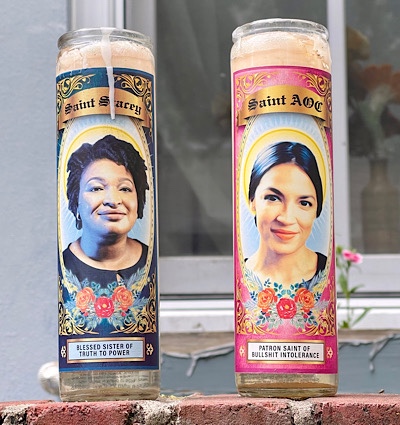
These devotional candles were on the fence enclosing a neighbor’s garden. I appreciate the sentiment, and am grateful and have financially supported both.
I am also moved to ask why it is we put people on pedestals. Could it also be in part a way of letting oneself off the hook for doing what is in our capabilities because only the contributions of those who are more than human have real meaning?
Dear Friends,
My apologies for being so long in sending a proper newsletter. 2014 was a challenging year for me. I started the year sick, ended the year sick, and was limited by injuries for several months out of the year. Work was intensely challenging on just about every level, day after day, week after week, and it continues to be so. And then there’s concern about the state of society and the planet and trying to figure out what I, honoring my capacity and limits, can do to do more good and less harm (I’ll never get this sent if I get side-tracked in that direction).
I also had some great adventures, including a major home renovation and an extraordinary trip to Cuba, but then was working too hard in between to appreciate and integrate fully my experiences (which is a yoga lesson in itself–addressing whether we need more stimulation when we haven’t had time to address/process previous experiences whether delights or challenges to mind, body, emotions, creativity).
Yes, I’m still teaching, even though working as much as I am these days. You can find me leading an all levels group practice with a wonderful group of people on Tuesday nights from 6:30pm -7:45pm at William Penn House in Capitol Hill. 100% of the proceeds (pay what you can; suggested donation $12-15) support the work camp program at William Penn House. There’s also a weekly group practice for more advanced students on Wednesday nights. Email if you are interested in the Wednesday night practice. More info on classes on my rose garden yoga website.
Yes, for those of you who don’t subscribe, I’m still blogging. With the help of wonderful web designer, friend, neighbor, and fellow yogi, Jess C, I just updated the look of the website. I hope to find time to blog about the many layers of meaning that went into the new design, which has the colors of Kali (goddess of sequencing); the murtis are Dakshinamurti (Siva as teacher) and Saraswati (goddess of learning, the arts, etc.); the books are a small, but important to me as yogini, portion of my library.
If you’re in town, join me for practice one of these weeks or perhaps we’ll run into each other another class or workshop. Please let me know how you are. Best way to be in regular touch are to subscribe to the blog. When there isn’t an interval between working and living and loving, and all the rest, to share more detailed written contemplations about living yoga,I’ll share the signs and exhortations I see around town and remind myself and anyone else who wants the reminder that no matter what is going on, there’s always a moment to appreciate a little beauty–perhaps to notice a heart-shaped cloud in the sky.
Feel free also to friend me or like “Rose Garden Yoga” on Facebook. Instagram possibly coming soon in my copious free time. Ha.
Peace, love, and light,
Elizabeth
On Capitol Hill.

Peace and light, E — Posted with WordPress for BlackBerry.
Paul Muller-Ortega, who teaches philosophy and meditation from similar roots to those that inform Anusara yoga, spoke yesterday of the differences between the path of the renunciate and the path of the householder. He strongly stated that neither path was better. What he suggested, though, was that a householder will better flourish practicing yoga designed for the householder rather than attempting to practice renunciate techniques, while still staying in the householder path.
What does this mean? I think it means that we become unhappy and conflicted if we try attempt the practices of the path of complete non-attachment and transcendence of body and mind while we are still very much staying in society and responsible for family, work, and citizenship. The tantric, householder path, including that of the Shaivite tradition of Kashmir and Abhinavagupta, offers practices that enable one to live liberated in society, instead of suggesting that the only way to true liberation is to reject and transcend work, family, and community. In yoga terms, the householder path is one that realizes moksha (liberation), through ardha (physical and material well-being), kama (love/relationship), and dharma (right work/path) rather than by transcending them.
Taking the householder path does not mean just indulging. It still requires sensitivity, dedication, discrimination, and alignment. I think it may be even harder than renunciation. I know it is easier for me to just stay alone and practice, for example, than to bring yoga off my mat to how I work, consume, relate to others, and participate in society. The householder path, though, is the one for me.
I stopped to take a photo of the question. This delightful dog would not move and insisted on attention. He finally moved far enough off of it to have it legible after he insisted I rub his belly. I guess I could have gone without a photo, but it was nice getting the canine love. His human was patiently bemused.