Offering (Night Blooming Jasmine)

There were lots of images of Hanuman around where we were in the hills. I come home after this long break–far enough away and for a long enough time to be able to gain perspective–and think, given that I have dedicated most of my career to public service, about how the myth of Hanuman may inform my ongoing contemplation at this time in my life and in this socio-political climate of how I can best contribute and participate.
Hanuman is the faithful servant; I think that one aspect of his story is that in being true to Rama, he is being true to dharma, to law and culture. In loving and protecting Sita, he is recognizing nature. Only when he is acting in service to them and others can he access his true powers (siddhis).
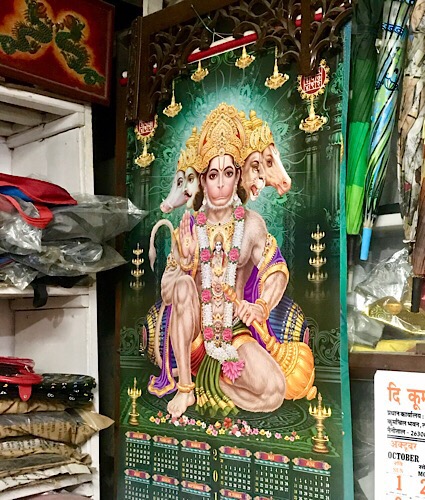
Inside the Durga store, Nainital, India, October 2017
What do you dream of creating?
Do your dreams include influencing the dreams of others individually?
What about influencing our collective dreams?
Is it possible to seek change while simultaneously letting go of control? (An aspect of the “actionless action” that the Bhagavad Gita teaches as a primary goal of the yoga.)

Peace and light, E — Posted with WordPress for BlackBerry.
I found used a novelization of the Mahabharata a couple of weeks ago, which I am now reading. I’ve read other versions put into English prose, all of which have some stamp of the presenter (author?). The version I am reading brings to the fore that those who are deserving of the love of people and who are blessed by the divine are physically beautiful, wealthy, and possess great military prowess. Righteousness includes unquestionably obeying the orders of rulers and parents and accepting your station in life as the determination of God.
The book jacket proclaims the Mahabharata “the greatest spiritual epic of all time.” I agree that it is a great epic and a rather amazing one. Some of the precepts, like all presented in great writings that have lasted over the centuries are worthy of contemplation for one’s own life (I am all for recognizing guests as divine visitors and treating them with due regard, for example), as well as for understanding the society in which the work was created. But any work that mostly reflects the societal mores of the time in which it was written and is designed to perpetuate the powers that be is perhaps best read as fiction. Saying this does not mean I do not recognize the good of some of the teachings interwoven into the fairy tales, but rather that I think it must also be understood in the confines of its context, lest we perpetuate societal evils that no longer serve. (This, of course, has Western parallels.)
The seasons change no matter how humans are behaving. Grieving for all the nameless suffering and for a couple of friends who have died very recently. Please be kind with your tender hearts.
Here’s a bit of beauty.

My friend Olga has written a series of blog posts reflecting on the Certified Teachers’ Gathering and what it means to her to to be a part of the Anusara community. I found most interesting the reflections on how Anusara is growing as a community, even as an “institution.”
One of the things that I ponder in connection with being a member of any group is how deeply to be involved, whether I can pick and choose from among the teachings and practices offered and still be regarded as a true participant? Whether I can be uncomfortable with some of the organizational structure, but still be true to the ultimate goal or teachings? What does it mean at the workplace — for me the giant bureaucracy of the Department of Labor? What does it mean if we are a member of an organized religion (I’m a member of the Friends Meeting of Washington)? A group of like-minded practitioners? A neighborhood? A society?