Cat Stretches (Humans Can Do Them, Too)
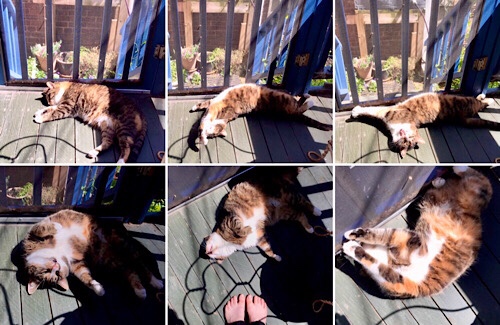

Even in times of war and crisis. Perhaps even more so in such times.

The problem with trying to run away to make things better is that we still bring ourselves with us. We don’t have the luxury of hitting the “reset” button after we’ve done things that we wish we had not done.
Yoga and meditation practice can help give us a sense, though, of being reset by giving us more and radical acceptance and compassion and the ability to simply marvel at the very intricacies of the dance. From there, we can release what binds from our history and continue on, knowing that it is a choice to respond in the same way as we have in the past when the old patterns confront us again (which they inevitably will).
Last week I took a lovely all-levels yoga class where the emphasis was on fully engaging in the practice rather than striving to achieve a particular outward notion of what the poses should look like.
Near the beginning of the class, but after the emphasis on not striving had already been discussed, the teacher said that the ideal form in uttanasana — standing forward fold — for classical hatha yoga is with the feet together. But, he said, however, he said, but not, the teacher explained, if your back is curved like a “c” in the pose, and your lumbar vertebrae are higher than your sacrum. In that case, you want to take your feet wider apart or you will strain or injure your low back.
As I was fully into the pose, I could see the rows of students behind me. At least two fellow students in my immediate line of sight, promptly put their feet together, even though they had tight hamstrings and bulging lumbar spines and were clearly pushing themselves hard to get their fingertips to the floor. As soon as the word “ideal” was uttered, they could not hear the caution or could or would not apply it to themselves.
The evident intent of the teacher in his exposition of the pose was to give an example where the “ideal” form is most certainly not ideal and will not further the reasons we practice asana. But for so many in this society, striving is such an ingrained way of being, that yoga class can become just another way to achieve.
It was useful for me to witness how carefully one must teach to high achievers this principle of the “ideal” being what suits and not what will win accolades. How do we teach (and learn) the practice of goalless goals, of enjoying working for fitness (of the mind, body, and emotions) without pushing and striving? I’m pretty sure that invoking the principle of actionless action from the Bhagavad Gita would not have made a difference here. It seems a shame to think that the only way to protect all the students’ backs is never to mention the classical form of the pose, and to have to tell all the students (especially in a big class) to have their feet apart (or some similar alignment rule)for protection of the few who do not (or are not yet ready) to hear the whole lesson.
Peace and light, E — Posted with WordPress for BlackBerry.
Webster’s On-Line Dictionary defines a “weed” as”any plant growing in cultivated ground to the injury of the crop or desired vegetation, or to the disfigurement of the place; an unsightly, useless, or injurious plant.” At first blush, this might seem like an easy concept, but if we start breaking down the definition, we can see how much our education, assumptions, and prejudices come into play in deciding what is a weed and what is not. We need to recognize individual plants (when they first come out of the earth and when they are in full leaf or flower) and what they offer. We need to know how to foster growth of what we choose to plant, including knowing what will thrive in our location and bring more health and beauty to ourselves and the planet, and we need to have a sense of aesthetics that will cultivate not only our connection to spirit, but optimize the shining through of spirit in all that surrounds us.
Several years ago, I bought a sprig of epazote in a two inch grower’s pot. It went to seed and came back all over my little garden. It grows wild beside highways where it is a native plant. I really like the taste, and it is hard to find here, so I give seedlings away to friends who want it for their own gardens (locals just ask, and I’ll give you some). It is one plant I know I do not have to replace; it will come back every year if I let it go to seed. If I had not controlled it by taking it out of prime planting spaces and either using it right away or replanting it someplace nothing else will grow, though, it would be crowding out other plants in a way that is less than optimal. It is thus both a desired plant and a potentially invasive weed depending on how it fits in with the whole.
I have seen neighbors using Roundup to kill purslane and dandelions that have grown up between the bricks on the sidewalk in front of their houses. Although I think both purslane and dandelions are pretty plants and perfect for spots where nothing else will grow, I can appreciate wanting the front of the house to look tidy. Why not pick the free edible plants instead of spraying toxic chemicals? I let edible wild plants come up between the crevices and then either relocate them or treat weeding as harvesting, getting incredible flavor and nutrition from something that most are taught to try and eradicate.
There are other plants that are sufficiently invasive or poisonous, though, that I do my best to eliminate them from my space (though I do not use pesticides). The other day, I was walking down East Capitol Street after teaching the William Penn House class and saw some English Ivy climbing up a beautiful tree in one of the sidewalk tree boxes. I stopped to pull it all off because English Ivy left unchecked will kill a tree. While engaged in this activity an older couple who lived in the house next to the tree walked up to me and my fellow yogi who was helping me with the ivy removal. The woman thanked me, saying that she had been meaning to pull the ivy. Ivy is an example of a plant people think is pretty and appropriate to plant, but it does not belong in our climate and is incredibly destructive. By my lights, it is a weed, even though I can buy it in most nurseries in the area. I am blessed not to have poison ivy where I live, but it should be removed. It is too hard to live with it.
What does determining whether a plant is truly a weed, whether it causes injury or interferes with what is desired or is unsightly, useless or injurious have to do with the “first principle” in Anusara yoga of “opening to grace?” The first principle invites us to be ready in the first instance to recognize the auspiciousness of both what we seek out and what we encounter. In teaching meditation and related practices of Blue Throat Yoga, Paul Muller-Ortega speaks of this as “the highest first.” As we study and practice (jnana/vijnana), we approach the same and new things with ever more refined technique, knowledge and understanding. The progressive refinement from our efforts helps us then to open up to a deeper perception of the best of our nature. We keep repeating the cycle of studying and practicing, always remembering the first principle, and we, despite and because of ourselves, shift our relationship with the world around and inside us. To be open is a softness, a spaciousness, a willingness to see that is without effort. We temper what gets in the way of effortless opening with the fire to study and to practice with the intention learn how to be more effortless in understanding how things are part of the whole.
How do we apply first principle in knowing what to weed from our garden (or, for that matter, how to address in ourselves a physical, mental or emotional characteristic or pattern of behavior that may or may not serve us or both–our individual “weeds”)?
Is the “desired” vegetation a desire that would help align the gardener and the garden with nature or is it something that was taught that comes from an unsustainable aesthetic and social paradigm (for example, a perfectly green lawn with no plants other than grass)? If the crop is one that truly nourishes (so worth preserving from injury or interference), does it just mean that the “weed” needs to be relocated so that both the crop and the “weed” can flourish simultaneously? In other words, is the “weed” beneficial in its own way, but just needs to be shifted so that its inherent good can truly be appreciated and honored?
Is a determination of injuriousness, uselessness, or unsightliness based on ignorance or true discriminative wisdom? We cannnot know unless we both sweetly open to recognize the potential for discovering the good in what seems most harmful (perhaps one day scientists will find an extraordinary benefit from poison ivy, just as the deadly poisonous plant digitalis is also a powerful heart medicine) and continue to study and practice with an intention to open ever more deeply.
From left to right: volunteer epazote, lemon balm, purslane and dill. Dinner: black beans flavored with epazote; greens, including purslane. Lemon balm (aka melissa) makes a delicious and quieting evening tea.
When these trucks first came into sight, they were driving side-by-side just below the speed limit, with a number of cars tailing close behind in both lanes. The voice of the monkey mind started down the “what the f**k?” path. But soon after, Johnny law parked in the median came into view. Another half mile down the road a second police car was lurking. As soon as the trucks passed the second police car, the truck in the left lane pulled over in front of his companion, and the passenger cars were able to move a little faster.
The trucks weren’t creating an annoying obstacle. They were graciously saving the cars following closely behind from getting speeding tickets.
One never can tell, either at first glance or in retrospective review of life choices, how what might have appeared as obstruction, failure, or missed opportunity in fact either opened new pathways or saved one from harm. Best then, neither to come to conclusions too quickly or to hold onto regrets.
Peace and light, E — Posted with WordPress for BlackBerry.