| | |

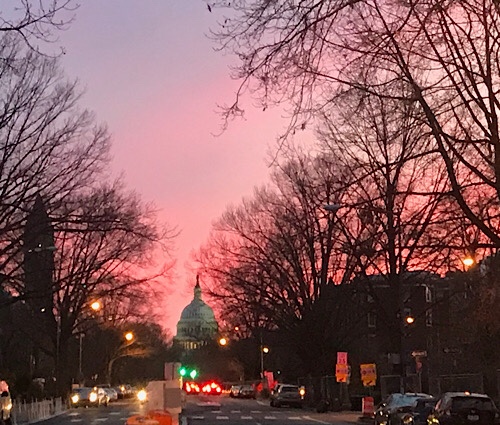
On My Way Home

I was grateful to be able to walk to my comfortable home with plenty of food and to notice the beauty, but still engage in discussion and action to address the current situation. I choose as my role models those who inspire me to think and work and engage more fully. What are the responsibilities that come with privilege–as much as one has (at this point I have more than most,whatever it took to be where I am)?

Similar Posts

  • | | | |

    “They’re Still Here”

    “They’re still here,” said the evidently conservative (by other things he said and his dress) and cynical young man sitting on the seat in front of me on the bus, as we drove past the “Occupy DC” group. The bus moved forward, and the running commentary on what was outside the window moved to derogatory statements about the homeless. I thought about the discussion a group of us had after meeting for worship this morning about seeking to live witnessing and honoring the sacred in every being. This includes, of course, recognizing the universal spirit worthy of love in those who proudly do not do so nor feel the need to try. Easier said than done, but that is true of most of the profoundly deep practices.

    Peace and light, E — Posted with WordPress for BlackBerry.

  • |

    Tying Oneself Into Knots

    Some think of yoga as folding or knotting oneself into pretzel-like shapes. No one wants to feel that they are tied into a knot in life, and those who make fun of yoga may do so because it seems silly to them intentionally to make knots with the body.
    But carefully learning how to stretch and fold and bend and mold oneself into the shapes of the various asanas paradoxically can free one from feeling bound up or constricted by the knottiness of existence.

    Peace and light, E — Posted with WordPress for BlackBerry.

  • |

    Sukha (the why of sequencing and the foster cats)

    Last week, I used as a theme sukha — ease, comfort, happiness.  I was inspired by Lorin Roche’s discussion of translating in his “version” of the Vijnana Bhairava, which he entitles “The Radiance Sutras.”  In it he notes that “[e]ven more literally, sukha is (according to some etymologies) composed of su, good + kha, space.  A good space.”  At first blush, teaching about sukha might seem to be off-topic from my session theme of sequencing principles.  The whole purpose, though, of seeking to understand, practice, and optimize our sequencing in time and space on and off the mat is to find just that.  It is to be in a “good space,” to feel at ease, whether we are being challenged or delighted.

    I found myself contemplating sukha yet further this week (it is a recurring practice and contemplation theme for me — I love Patanjali’s sutra “sthiram sukham asanam”), as I have been observing and helping the foster cats make mine their new home.  When we are uprooted or out of alignment, we are not in a good space.  It is a struggle to feel happy or at ease.  When we find our rhythm again, then ease unfolds.

    There is a set of principles that generally works for taking uprooted animals (or people) and helping them feel at home.  Part of making them at home is their new person holding him/herself in a “good space” for the newcomers, which indeed helps them find their own, which is its own yoga.

    The blessing of yoga for us, and why we take ourselves to challenging difficult places on the mat, is so that we can, by use of intelligent sequencing of practices, techniques, and mindsets, discover how to feel connected to our own spirit wherever we are in time and space — the essence of ease in this body and mind.  The more we can do this for ourselves, the more we can do it for others.

  • |

    Amy Ippoliti’s 30-Day Yoga Challenge

    Anusara yogini and teacher extraordinaire, Amy Ippoliti, started a “30-Day Yoga Challenge,” which she updates monthly, for students and friends who are her Facebook friends.  For the past several months, the challenge has been to work towards some very challenging poses (how appropriate for a challenge).  This month Amy invited students to practice without air conditioning, or for hot yoga practitioners, without extra heat.  Granted, she is based in Boulder, Colorado, where it is not 101F today, but she speaks my mind.  Whenever people have asked me what I think about hot yoga, I have answered that it serves some people very well, but I always find myself asking the question, whence is the heat coming and will it enhance my yoga to change the room temperature if I need to burn fossil fuels to practice?

    Why is practicing without a technologically altered environment a yoga challenge?  Have you ever found that if conditions aren’t right, you think you cannot do your practice?  If we are truly practicing with commitment, then what we want to do is to find the practice that will fit the environment (including not just the outer environment, but the state of our mind and physical well-being) on any given day, even if it means that the practice will not meet our expectation of what our practice should be.

    When we practice steadily and listen to the teachings, one of the things yoga teaches us is how to be more sensitive to our environment and to what we put into our minds and bodies.  A friend complained of being terribly sleepy the other day.  I said it was the heat; look at your pets; don’t you notice that they are sleeping more in the heat?  What practicing in accordance with the ambient temperature means (or eating or sleeping or dressing or engaging in leisure activity) learning better how to align with the energies around us, including being sensitive to how we would optimally practice in the heat.  As yogis, I believe that what we want, ever more deeply and more profoundly, is to live aligned with nature and our own being in it so that we can find better recognize the fullness and the light of being whatever challenges arise.

    I’m doing a modified version of Amy’s challenge here in DC this week:  at the William Penn House, I’ll take whatever air conditioning is on (which, for those of you who are wondering, can be pretty nice and cool since it is the ground floor).  At the house practice, I’ll keep the house at the same 80-82F I typically keep the house when it is over 90F outside; I won’t lower it because I am practicing, but we won’t be having it over 90F.  At Willow Street, I’ll go with the flow.
Leave a Reply

Your email address will not be published. Required fields are marked *

This site uses Akismet to reduce spam. Learn how your comment data is processed.