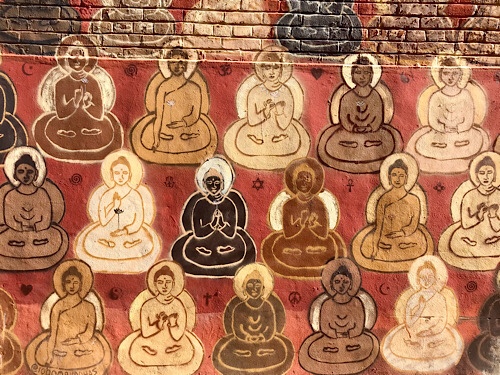
Buddhas Around Town
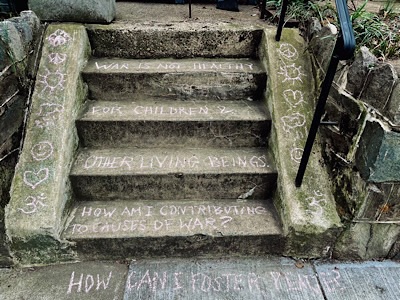
I found myself thinking this morning of the poster from when I was a child that said, “war is not healthy for children and other living things.” I wrote it on the front stairs and then asked myself the question, how do I contribute to the causes of war?” And so that I am not only asking what I must change or stop doing, I also ask myself, how can I foster peace?
As I was leaving my massage therapists house, his wife said, “it’s open,” walk up 15th Street and check it out.” I turned from my usual track and headed up 15th Street Between C and D Streets, SE, a young guy was standing in a freshly painted doorway calling out to see if anyone wanted free samples. Having already been given a thumbs up, I stopped and joined two others who were enjoying the offer.
I was handed a freshly baked Philadelphia style pretzel and a squeeze container of mustard. The pretzel had been baked within the half hour, there was just the right amount of salt, and it was definitely a treat after a Saturday afternoon massage.
“It’s a simple concept–just the pretzels, and I am still working out hours and prices. Have to work around having a two-year old at home.”
The neighbors, who definitely were enjoying their pretzels and the neighborhood setting, said they would be happy to be in a picture for my blog.
The pretzels will certainly appeal after the Little League games across the street, but it’s a treat for those in post massage bliss and people taking a casual walk around the neighborhood, too.
I am happy to support this new venture. What changes and integrates our neighborhood includes the willingness to open a small business off the beaten track (340 15th St., SE) that will appeal to a broad section of the community.
To find out information on prices (he does special orders for parties) and hours of operation, check out “The Pretzel Bakery”s Facebook page.
.

Peace and light, E — Posted with WordPress for BlackBerry.
Almost none of the services provided by Planned Parenthood are abortions. Rather, they provide much needed health care to women in underserved communities. Please stand with Planned Parenthood today:
 |
Dear Elizabeth, Minutes ago, the U.S. House of Representatives voted to bar Planned Parenthood from all federal funding for any purpose whatsoever. That means no funding to Planned Parenthood health centers for birth control, lifesaving cancer screenings, HIV testing, and other essential care. By far, this is the most dangerous legislative assault on women’s health in our history, and it cannot go unanswered. We need you to stand united with us now. We need you to stand with Planned Parenthood and with the three million women, men, and teens we serve, who are now at risk of losing access to basic care. We’ve drafted an open letter to every single representative in the House who voted for this cruel, unconscionable, unthinkable bill, and to every senator who still has a chance to stop it. Will you sign it — and share it right now? |
|||
|
|
|
|
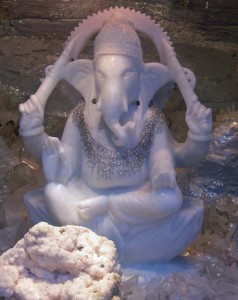 Today is a good day for me to contemplate on the Ganesha archetype — the one who places obstacles in our way and gives us the wisdom to know how to remove them or avoid them. The obstacle I can see; I’m at the needing wisdom stage.
Svadharma, from sva (self) and dharma (duty) means our personal path, duty, calling, or place. The principle of svadharma is a significant teaching in various yoga texts, such as the Bhagavad Gita, especially emphasizing the importance in acting in accordance with one’s caste (for example, Arjuna needing to act in accordance with his dharma as a warrior) or one’s sex (consider Sita’s role in the Ramayana).
Extrapolating this teaching and taking it onto the mat, during one of the practice sessions the previous week at the Certified Teachers’ Gathering, John Friend said that “every part of the the body has its own svadharma to increase the pranic flow.” He then said that if you just took a photo of the feet of an Anusara yoga practitioner in any pose, you should be able to see that the whole body was fully engaged and active. John Friend’s teaching here was not just using the yoga philosophy as a catalyst to better understand the body. By using the principle to illuminate the practice, the practice reflectively illuminated the principle itself, without denying or denigrating its original context or getting bogged down in its historical baggage of perpetuating the caste system and demarcated, subservient roles for women.
Thinking about the svadharma of the pinky toe has no such baggage. The pinky toes are homely looking things, they do not fit well into most women’s shoes, they rather painfully bump into things, and they are hard to move independently. They are not essential for living and do not have the emotional charge of the heart and brain, the exquisite connection to the world of the sense organs, or the connection to life itself of the lungs. Despite this, the call to lift and spread the toes, to draw the pinky toe toward the heel, or the hip happens just about every time I go to the mat in my practice or teach a class. Activating the pinky toe by opening it and spreading it apart from the other toes is a conscious act of opening that helps hug the shins to the midline. In hugging the shins in by means of activating the pinky toe, the yogi on the mat can then safely move the thighs back and apart, creating an expansion of the pelvic floor that provides room for more strongly tucking under the tailbone to access core power. The pinky toe thus is an important part of our practice, even if we could manage to get by without it.
But the svadharma of the pinky toe on the mat is not just to be able to help us access the movement of “shins in” so that we can better do “thighs out,” although that is an important physical part of its essence. The toe does not move on its own. We have to start by bringing our awareness and consciousness to the toe. Part of the pinky toe’s svadharma, then, is to invite the infusion of consciousness to show how full participation of even an apparently insignificant part of the body can lead us to a better understanding and personal experience of the pulsation between reaching out and hugging in and affirming ourselves. By intentionally bringing our awareness to the power we can unleash in the pose by the movement of the pinky toe, we bring the opportunity for greater strength, expansion, and flow of energies. This is why, I think, John Friend suggested that by just seeing the toes we should be able to know the engagement of the whole body and mind in a particular pose.
As a practical and therapeutic matter, recognizing and bringing into play the svadharma of each and every part of the body serves to help us increase the flow of energy and expand our range of movement. In addition, activating the parts of the body that are inclined to slack (for example, the pinky toe or the adductor and abdominal muscles) will bring ease to the muscles that tend to overwork to compensate, such as the neck and low back muscles. We are not just stronger and more flexible when every part of the body does fulfills its svadharma, but we eliminate much pain and suffering. (More to come on this particular concept in other posts.)
Off the mat, when all parts of the whole are fully conscious of and know their svadharma, the whole will itself have more consciousness, more light, and better experience the bliss of being. It is easy to see, without judgment or question, that the pinky toe cannot do the work of the heart, although when the pinky toe is working it can help contribute to an integration of mind and body that will further the opening of the heart and thus the whole person. Finding our svadharma as a whole person within society does not have to be about conforming to preconceived social norms that no longer serve. The better we are able to understand where we are in time, space, and the interconnected web of being, though, the more fully we can participate in leading society itself to a more conscious and light-filled place, just as bringing our conscious awareness to the actions of the pinky toe can do the same for us as individual yogis on the mat. When we recognize and live out our true svadharma as such, we radically affirm ourselves, the community, and the very essence of all being.