Signs Around Town
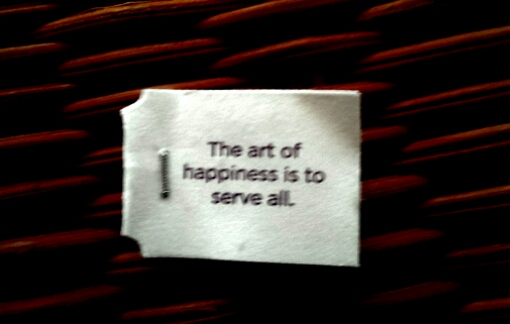
This morning, a friend suggested that if he took into account the needs of others when making plans, all he would be doing is serving others, and he would never get to do what he wants. “Why would I want to do that?” he asked.
I think that’s a common enough question in this society. By uncanny coincidence, the teabag I selected right after the question was posed suggested a possible answer.
As we are taught by the stories of the monkey deity Hanuman, whose main characteristic is a longing for devotion that he demonstrates (while still being utterly himself) through service (seva) cultivating mindful relationship is the highest service to our own self and not just to those with whom we are in relationship.
To take care of our selves can be done with consideration of others without sacrificing our own needs. The answer, I think, is in how we assess and balance our own needs. For me, when I consider the impact of my planning on others with whom I am in relationship as well as my own needs, for example, of freedom, autonomy, and personal delight, I am also considering my needs for companionship, mutuality, connection, and respect. If I completely privilege the former, I may be neglecting the latter and vice versa.
A key therapeutic alignment principle is “curvature before length.” This in essence means that we want to get our skeleton into the basic form of its “optimal blueprint” before trying to create length or extension. Making sure the spine has the four curves it is meant to have — the sacral curve is convex, the lumbar curve concave, thoracic curve convex, cervical curve concave — does not only alleviate issues stemming from the spine, but helps the thigh bones fit better into the hip socket and the arm bones into the shoulder sockets.
How do we get curvature before length? It is just doing the Anusara principles in the sequence we are taught them: inner or expanding spiral, as it takes the thighs back, out, and apart, enhances the curve in the lumbar spine. We do inner spiral before outer spiral, which in addition to toning the low back and gluteal muscles, lengthens the low back. We do shoulder loop, which in addition to integrative the shoulders and hugging the shoulder blades onto the back of the heart, provides curve for the cervical spine. We only do skull loop, which lengthens the cervical spine, after we have done the integrating and curve-enhancing action of shoulder loop.
If you think about the shape of the body from that perspective, it makes perfect sense that you would want to shape and integrate before pulling, stretching, or extending. It is very hard to create a curve or integrate something if it is already pulled or stretched to or beyond its limit. In its broadest sense, “curvature before length” serves us the way “start with the foundation” serves us. We get into the right space and shape before going full out. With the open attitude fostered by “first principle” (remember, first principle is always first no matter what is the focus of your class, your practice, or whatever you are doing on or off the mat), the basic alignment must come ahead of striving to expand further into a pose. With curvature before length, we heal and grow. If we try length before curvature, we might feel stretched for a moment, but may feel worse afterwards or will only have temporary relief.
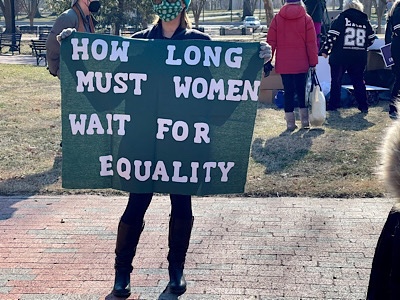
I visited the National Gallery this morning with a friend and then walked to the White House to join those raising their voices in support of the Equal Rights Amendment.
By now, the news of scandal has become widespread on the internet. The Huffington Post has put in its two cents in the way that modern journalism does–highlight the bad, forecast turmoil, and invite continued readership. Put John Friend or Anusara scandal into your favorite search engine and you will get a couple of dozen blog entries about broken-hearted yoga teachers feeling they need to resign from the organization (though many say they will be teaching the method, just not articulating it as the brand, which confuses me somewhat).
Last week, I chose to post only a guest blog on the District Kula website (since that posting, District Kula is no longer affiliated with Anusara). Though I have much more information now than I did last week, I am still waiting to see. I will be gradually revealing more of my thoughts here as things develop now that I believe that those far beyond the immediate (though large) community of practitioners are discussing the allegations and potential repercussions with intelligence and kindness or gleeful malice or somewhere in between.
One thing I can say, is that I have always consistently separated the man from the message, and I continue to believe in the soundness of the Anusara principles. I also believe that the situation is emblematic of the uneasy, but inseparable relationship between spiritual practice and commercial enterprise in our current market-driven world. While it is unfortunate and sad that it is in my chosen community, I am no stranger to upheaval and controversy in either workplaces or communities and there may have been no better time to have this discussion both within the community and as a broader societal matter.
Part of the reason “around town” is within several blocks of my house since the pandemic began is the limits on being able to find a safe bathroom. I prefer that to dehydrating prior to going out. I’m lucky to have the choice.

One sign reads: “Our lives begin to end the day we are silent about the things that matter.” The other sign reads: “Biden/ Harris/ text “UNITED to 30330”
Self-care is part of collective care, but only if it is in balance with active care of the collective.
This morning, before reading the news and working hard, I sat for meditation and put up lentil soup in the slow cooker.