Restorative Yoga in the Sun

Meanwhile, I was on a work telephone call. But I will make time for some nourishing practice for my own body/mind/spirit at the end of the workday.
Meanwhile, I was on a work telephone call. But I will make time for some nourishing practice for my own body/mind/spirit at the end of the workday.
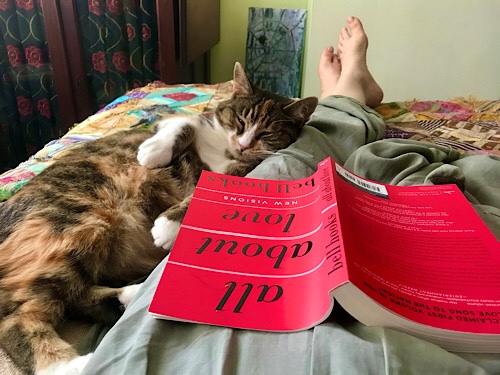
What are you reading this week?
I think I have “found” this exhortation before, but if so, it’s a good reminder, if not a mantra.
My favorite sutra in Patanjali’s Yoga Sutra’s is, II.16, “heyam dukham anagatam.” This translates roughly as “the pain that is yet to come can be avoided.” What does this have to do with a forecast of a hard freeze?
My chard, beets, and turnip greens are still flourishing. They can manage with a night or two in a row in the high 20sF, and that is all we have had so far. The forecast for later in the week, though, is for the first true cold snap since 1994 (you may remember that as the year when lots of people’s pipes froze). My winter garden (which does not have a cold frame due to lack of space — maybe I’ll get more creative next year, and I’ll try an experiement with plastic bags on Thursday night) cannot survive lows in the low teens highs in the twenties.
I could suffer today by bemoaning the coming cold, worrying about the garden, and remembering that I don’t like cold. That would be present suffering in anticipation of potential future suffering. I certainly can avoid that. I can also do what I did yesterday, which was harvest lots of the chard and most of the beets, put the beets into cold storage (vegetable bin in the refrigerator) and make pasta with sauteed garlic and chard. Between now and Wednesday night, I’ll harvest most of the remaining greens. I’ll make a big vegetable soup with the beets and the chard, maybe make chard pie or calzones (truly delicious), and eat the rest over the following days. I’ll feel grateful that in the bitter cold, I can be eating fresh garden greens. I’ll be even more grateful that I can just shop at the grocery store or the farmers’ market and don’t need to rely on my garden feeding me year round. I’ll also be happy for the hard frost. Part of the reason the aphids and the mosquitoes have been so bad is the absence of a hard frost in winter.
Some bitter cold in winter in a temperate zone is inevitable, as are sickness and death. We can avoid suffering by not just getting anxious and unhappy and suffering in the present, but not taking action to alleviate potential suffering. With preparation and practice, we can avoid some suffering. Just has preparing for winter in the garden can allow it to be productive for greater parts of the year, so too, with a steady practice of asana, pranayama, and meditation we can avoid some physical and emotional pain and suffering. Most important, with steady preparation (preparing for the potential for difficulties in the future is not the same as being anxious about it), when the inevitable comes, we will likely suffer less, at least in our hearts, if not in our bodies.
Last weekend, I went with a friend to see The Steins Collect at the Metropolitan Museum. I made a special effort to see the exhibit because of the incredible impact on art and culture that the Steins had by virtue of their collecting. Many of the paintings in the exhibit were familiar; I’d seen them before either at the Met for those from its own collection, at other museums, or in books. Some, which have ended up in other private collections or in the collections of museums that I have not visited, were completely new to me.
Among the paintings in the exhibit is Picasso’s Boy Leading a Horse (which, as you can see from the link, the MOMA website currently indicates as “not on view”). I’ve seen the painting many times before at MOMA. The shift of location and context shook up my perceptions of the painting, and I indicated that to my friend. Another woman who was looking at the painting too engaged in the conversation. “It seems wrong here,” she said. “It’s a different view,” I replied. “It is disconcerting, but seeing it in different light, context, and company is enabling me to see new things in the painting and to find a more enhanced appreciation.”
I have been thinking this week, and talking about it in my classes, how a change of context can bring us new vision. How often, when things just keep going in a set pattern, do they collect dust and cobwebs (literally or figuratively)? I asked my therapeutic students whether they had preconceived notions about various challenges of embodiment, especially the chonic ones. Do you see them as part of your identity, something that causes you pain instead of giving you the joy of movement? What if you embraced being ever more conscious of alignment instead of being conscious of pain and limitation (and learning better and sooner when you cannot get out of injury without outside help)?
What of it? What of the change of perspective? After all, things get rearranged for us and the dissolution can be gradual or violent or something of both and be something of greater or lesser magnitude. Times of flux and dissoluti9on are the perpect time for questioning, for new vision, for discovering new ways to experience what had become too familiar, for seeing how one might wish to shift one’s own perspective for the good, to know and take responsibility for one’s own place and piece of this relationship to whatever it is that is shifting, dispersing, or dissolving., to seek to become unbound from the habitual binds of whatever invisible clothing we might be wearing.
Got sick right after and so did not post then. More coincidence than correlation. At the Capitol, the energy includes those giving their all for truth, decency, fairness, inclusion, etc. At the White House there is no balance.