Asana, Pranayama, and Yoga Practice | Food for the Mind (Yoga Philosophy, etc) | Meditation | Photos
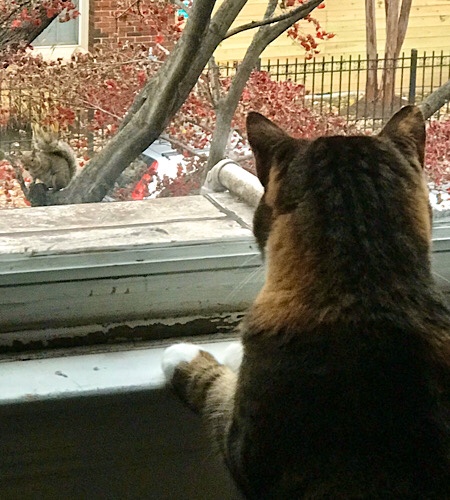
Ekagrata (Squirrel Meditation)
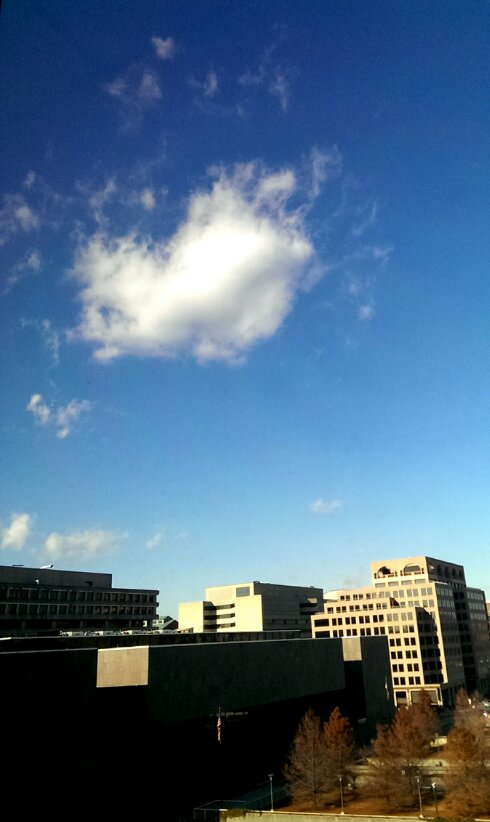
On seeing me snap a picture with my phone of our shared view of the highway, homeless shelter, tax court, and an array of office buildings apparently designed in the school of Mies Van Der Rohe gone terribly wrong, my next door office mate asked, “are you taking a picture of what you will be missing while you are in India?”
“No, I’m taking a picture of a heart-shaped cloud. When I’m having a day as stressful as the one I’m having, I like to remind myself that there’s always a heart-shaped cloud out there to put things in perspective.” I held up my phone so that she could see the photo, as sometimes people don’t see the heart shape until I’ve photographed it.
“That’s pretty cool,” she observed.
She’s going to water my plants when I’m gone, and I’ll look for a little something from India for her that will make a hard day at the office a bit easier to take–perhaps a murti of Ganesha (the elephant god who is said to be the remover of obstacles).
Peace and light, E — Posted with WordPress for BlackBerry.
I spent a few hours this weekend reading Joseph Campbell’s Baksheesh and Brahman, which is Campbell’s journals from a year in India from 1954-55 (I’m now about a third of the way through). Campbell writes that he went to India to find Brahman and instead found politics. He approached his visit from the perspective of a mythologist. In contrast to Allen Ginsberg and the Beats, who went to India to find God, Joseph Campbell went to observe religious practices. Although the journals evidence his own perspective and prejudices, he makes cogent observations on the difference between religiosity and spirituality (not all that dissimilar to the distinctions made in the Bhagavad Gita about the difference between rigidly practicing ritual and truly believing). He also makes very interesting and still timely and cogent comparisons between the relationship of Hinduism and to the then rather new Indian nationalism and American Protestantism to democracy.
Ultimately, though, it is evident that this year was important for Campbell’s life path and work, as it was for the Beats, and has been for many of my friends who have gone, though not for all. I think about going to India. It will be when I have several weeks and don’t have a venerable and ancient cat who cannot be left behind for a long stretch of time. In the meantime, reading of such journeys can stimulate thought and can be applied to other aspects of my life, though reading and studying (especially in the yoga tradition), is never a substitute for experience. Just reading of spiritual experiences, but not doing the practices to open the door to one’s own experience is like reading cooking or gardening books, but never going into the kitchen or the garden.
May the long light of the solstice illuminate wisdom and compassion.
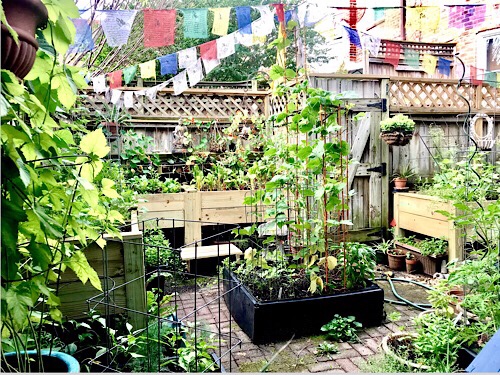
About a week ago, maybe even a little earlier in the month, daylight savings time started feeling artificial. My body started insisting on sleeping nearly an hour later, and I found that I wasn’t really using the hour of light at the end of the day. It was time to go inside and cook or read or otherwise move inward. When we change the clocks this weekend, I will already have shifted, and the clock will feel as natural as living by a clock can feel. Part of the refinement of a deeper yoga practice is learning to pay attention to such subtleties, to learn what is most optimal and when, both time of day and time of year. This applies to asana practice (i.e., when to emphasize forward bending v. backbending),what we eat and how much, and what kind of activities we choose.