Be Here Now (Var.)

There was a joyous celebration at the US Supreme Court this afternoon to celebrate the historic appointment of Justice Ketanji Brown Jackson. May this nation heal.

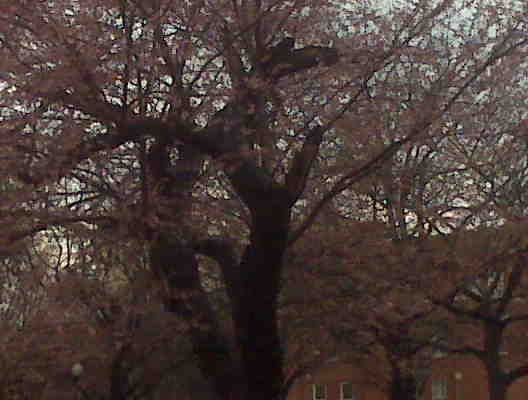
As I have walked around town enjoying the spring surge of blossoming trees, I found myself remembering that our most famous cherry blossoms were a gift from the Japanese, which remembrance sent a deeper yearning to help send healing.
At one sunny, pink-blossomed drenched moment yesterday, I found myself asking how could one’s heart not reach out to a people who brought us such beauty. I then thought that this country had no problem incarcerating “those” people on “our” soil and bombing their country when the arrival of the gift of our famous cherry trees was still in living memory. At that time, “they” had become our country’s enemies because of the actions and statements of those in power. The gift had become irrelevant in the context of war.
The peril in both thoughts is that they distance us from opening and relating to the essential identity and humanity in all of the individuals we meet of various nationalities and alliances–whether in a time of gift-giving or in a time when we cannot abide the actions or ideas of those in power.
Peace and light, E — Posted with WordPress for BlackBerry.
For the past couple of weeks, I have been spending as much time as possible in the garden. When it is too rainy or cold to be in the garden, I have been doing indoor spring cleaning. As the days get noticeably brighter and longer, it is delightful to see the new growth in the garden and to polish my treasures and make room to use and enjoy what I have. I’ve been noticing how the first major activities in the garden make a mess. Inside, activities such as cleaning out the refrigerator and the closets also makes things seem messier before they they get cleaner. I’ve persisted, though, and now the garden is teeming with visible new life, unencumbered by the detritus of dead growth on the perennials or spent annuals from last year. With things I do not need given away or repurposed and things clean and repaired, I can more easily use and appreciate what I have in the house. It seemed like quite a mess for a while, though, when I was taking things off of shelves and out of drawers and closets in preparation for cleaning.
There can be phases in our sadhana –both asana practice and meditation and related practices — where all the practice seems to be doing is bringing up old stuff. It seems like we are more physically or emotionally challenged than we would have been if we weren’t practicing. The thought may cross our mind that we would be happier just going to the movies and going on an eating tour of Italy.
Although sometimes strong reactions can mean that a practice is not right for us (at a certain point in time or not at all — similar to a reaction to food), it can also mean that the practice is doing the equivalent of spring cleaning. Part of sadhana is learning how to react in a more optimal way to what manifests and arises from our practice. When a host of old memories or emotions arise or we press up against our limits by digging in deep physically to find where and how to rearrange our bones, muscles, sinews, and energy channels to clear an old injury, we have an opportunity to clear out and let go to make room for new growth. We don’t have to shove the stuff back into our mind-body closet or leave it where it obstructs new growth. The old patterns and memories come up in practice so we can either release them or change our relationship to them so they can become something that serves instead of weighing us down.
When I get into one of those messy spots, I remind myself how good I feel when I’ve done my spring cleaning, and I try to keep going forward, doing the best I can with the teachings I’ve been given. I admit that it is easier to persist because I love the actual activity of the practices (though the ones I need to do most can be the ones that are not my favorite, but that’s a whole other train of thought).
I thought perhaps that I was still dreaming when I heard the soft patter of early morning rain. It has been so unfortunately dry. There was no rain in the forecast–only impending blistering heat–for days to come. But a cool rain it was indeed, nourishing the garden and giving temporary relied to my soul, anxious about drought.
As I enjoyed the unexpected rain, I thought about the practice of opening to grace. We cannot make it rain, though we might pray or dance for it. We can, though, make the ground and garden ready to receive it, even as we simultaneously plan and prepare to live as mindfully as we can with drought.
When we simultaneously open to the gifts of grace and work in recognition of challenges and limitations, we can experience and offer the most joy and fullness of being for ourselves and others.

Peace and light, E — Posted with WordPress for BlackBerry.