Similar Posts
Louise Bourgeois
What a magnificent life: to have made art, explored truth, and felt the freedom to allow for contradictions:
- Asana, Pranayama, and Yoga Practice | Food for the Mind (Yoga Philosophy, etc) | Meditation | Photos
Watching the Clouds Dissipate
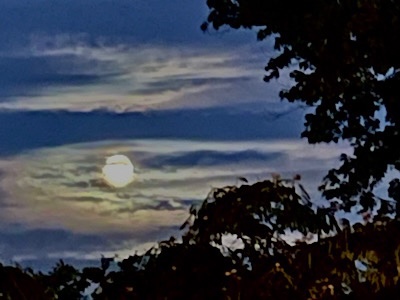
Tonight (technically very early tomorrow morning), will be the first full lunar eclipse on the winter solstice in 350 years. Part of me wants the sky to be clear so that I can witness this extraordinary event. The other part yearns for a cloudy forecast so I can stay warm in my bed at 3 a.m. without feeling that it would be my own inaction that led me to miss the eclipse.
I think we all feel this way about our practice sometimes. We want to have the great openings that come from a deep and steady practice, but it would be oh so nice if they came without effort. And an excuse not to practice that comes from somewhere out of our control makes it so much easier to accept not getting the benefits.
Unlike a cloud cover blocking our view of the moon, though, there aren’t many things that actually prevent practicing, although they might change what kind of practices we can do at a particular time in our lives.
- Art and Culture | Asana, Pranayama, and Yoga Practice | Food for the Mind (Yoga Philosophy, etc) | Meditation
The Search Continues (based on some dreaming)
In 2000 or 2001, shortly before I started practicing Anusara yoga, a teacher who regularly played music in class, played for us a recording of Alice Coltrane singing a tantric chant to Siva and the Goddess Bhuvaneshvari. I only heard the chant once while we were in savasana — corpse pose/final relaxation. Although I only heard the chant once, for several months afterwards, I found myself having a recurring dream that I was wondering in a neighborhood that looked like the one where I grew up and went to high school and chanting the full chant. At the time I merely found it curious that I seemed to have learned the sanskrit just by hearing the chant one time. I have since learned that the recording may have been done right near my high school; that is where the Coltrane’s had a recording studio. I also learned that the chant was a tantric chant. At the time, my teachers were coming from a classical yoga perspective. Did I actually learn the chant by osmosis? Was having the very vibration of the chanting near where I lived and studied the catalyst for me, as a receptive being, discovering a path of tantric yoga?
I have found other recordings of the chant. One is Atman’s “Dancing to the Goddess” on the Eternal Dance CD, which is an electronica version. The other is Ragani’s “Om Mata” on the Best of Both Worlds, which is a very nice kirtan/pop version. I have several of Alice Coltrane’s recordings, which are great jazz, if you aren’t familiar with Alice Coltrane as a fabulous musician in her own right. Recently I searched again on the internet to see if the bootleg had become available. There was nothing on YouTube (though some good Alice Coltrane things to watch). I bought Alice Coltrane’s “Radha-Krsna Mana Sankirtana,” which was originally recorded in 1977 (when I was in high school) and reissued in 2005, as I thought that was a promising source. It has some good things on it, but no luck finding the recording I wanted to hear.
The chant goes like this:
Samba sadasiva, samba sadasiva, samba sadasiva, samba shambo.
Om mata, om mata, om sri mata, jagade mata.
Om bhuvaneshvari, sri bhuvaneshvari, hari parashakti, devi bhuvaneshvari.
It is a chant to the benevolent, auspicious one within, the radiant goddess, the creatrix of the world. Bhuvaneshvari is one of the ten wisdom goddesses.
Please advise if you have access to the Alice Coltrane or another recording of this beautiful chant.
Found Quotation (About Intention-Setting)
Should setting an intention, whether the yoga practice of sankalpa or otherwise, be one of yours at the changing of the year, important to keep in mind.