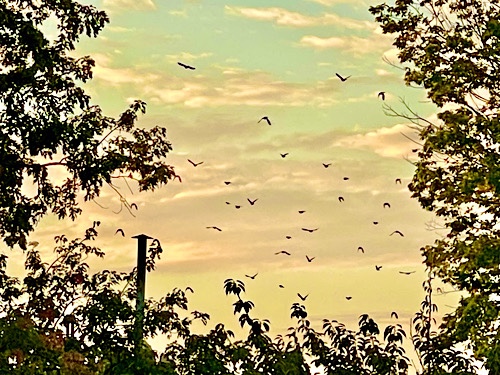
A Brilliant Light Show After a Long, Challenging Day

I’m pretty sure that I am not alone in wishing that I would be assisted or touched–in yoga class or elsewhere–exactly when and how suits me without my having to say a word. But permeable/bridgeable boundaries require clear and steady awareness and communication.
I’m in the middle of a weekend workshop at Sun and Moon Yoga out in Fairfax (a whole different place from where I live and spend my time in the DMV, but that’s another story) with Dianne Bondy (check her out on social media or get her book) on making yoga more inclusive and accessible to all.
One of the many things discussed was consent. Since I wrote about my reaction to having to say yes or no to physical assists by hand raising, I’ve also been at a studio with cards that one takes and puts on one’s mat to say “no; please don’t touch me.” What if the card ends up under a prop? What if you don’t want other students to see that you don’t want (or want) assists? What if you change your mind?
The solution Dianne has seems the best I’ve seen. Every body gets a card (she uses playing cards from the dollar store). Face up means I am open to the possibility of an assist. Face down means leave me completely alone. Students can change which side is up throughout the practice.
If the card is face up, it’s just agreeing to further the conversation. Seeing that level of consent, Dianne said (as I was taught in my Anusara teacher trainings), if she thought there was something beneficial to offer, she then would ask while approaching if it was ok to offer an assist. If the answer was “yes,” then she would give a verbal assist. Only if the verbal assist was insufficient, would she ask if she could offer a physical assist and would say where she would touch the student to give the assist BEFORE doing so. The student would then have another opportunity to say “no” or provide limits on the permission.
Of course, in a big public class, this all gets done quite quickly, but I think this really is the only thing that works. I’m also sure, from my personal teaching experience, that there might be an occasional moment, like catching a student about to fall and maybe take down another student, that an urgent intervention must be done regardless of prior permission for assists generally–but those should be rare indeed.
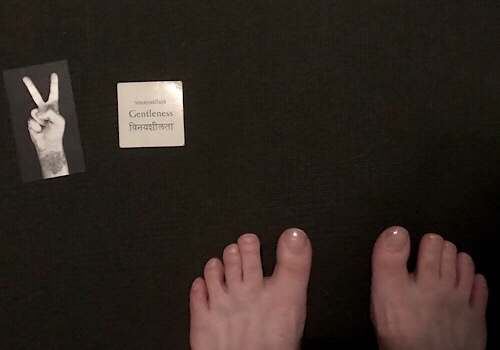

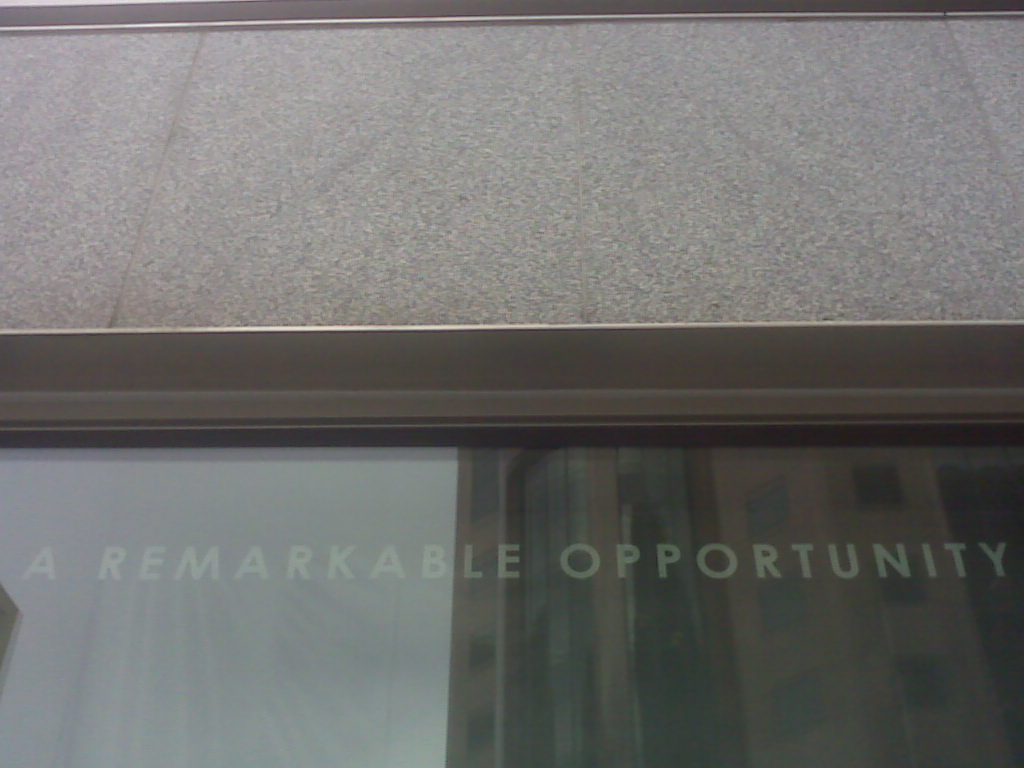
An exhortation if we take it as a reminder that every moment is an opportunity to act gracefully and to respond graciously and to find and offer the highest good, no matter the challenge. Oh yes, I exhort myself.
Peace and light, E — Posted with WordPress for BlackBerry.
Towards the end of a yoga session I start thinking about what would be a good theme for the next. I start by observing what is going on in the world — from the change of seasons, to whether it is rainy or drought, to what is going on in the political climate, noticing what is recurring in my own practice and the practices of my students, watching what is arising in my contemplations and meditations, and seeing what is resonating most in what I am learning from my own teachers. I will go into my library, reading and rereading things to see what resonates with what I am observing and experiencing. I also take into account the length of the session to be sure that it will fit well within the number of classes. Once I have set the session theme, I spend the week in which I will teach a particular principle, contemplating it, reading about it, practicing with it, and thinking about its relationship to my life off of the mat.
When I selected the tattvas this session it was for a whole array of reasons (some of which have been set out in previous posts). The order I picked to teach them, and which I chose to emphasize, were for what I thought would be the best way to share knowledge and experience and not for the outside calendar. It was then, by sheer serendipity that the themes fit as they did with the calendar:
Now this week, the last week of the session, parama shiva — the highest tattva. Shiva tattva is the most subjective principle and the most universal. It represents the essence of being (sat), consciousness (cit), and bliss (ananda). It is everywhere and nowhere, in all beings and not. It is whatever ever we think of as spirit or force or web of being or light or pulsation or divine — whatever we believe is the very essence of being. It is most interesting that by my series of contemplations and choices over the winter holidays, that I gave myself the homework assignment, as it were, to be specifically contemplating, practicing with, and studying the shiva tattva as I offer peace to Becky as she departs and seek my own peace in my grief over the loss of her physical presence.