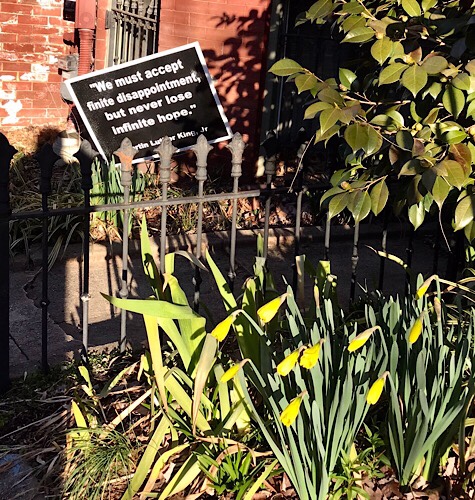
Blossoms Around Town (Which Ones Survived the Storm)

Last week, when my friend Suzanne and I were walking out of the Conservatory of Flowers in Golden Gate Park to catch the bus back downtown, we came across an island of dahlias in the middle of the parking lot. We were filled with excitement and joy at the outrageous effulgence. In the past, I’ve never had any particular feelings one way or the other about dahlias, though I knew that gardeners can get completely obsessed with them. This exuberant showing gave me a flash of insight as to why dahlias can inflame passion and dedication. It was a sweet reminder always to be open to new wonder, even from things we have previously experienced and thought we knew.
After a day of teaching and more discussion and emails regarding the upheaval, I had a memory of petting one of the temple cows at Chidambaram. I was jetlagged and in sensory overload, and then I petted a most wonderful cow. I dropped into a space where I was perfectly at peace and unaware of the time and all the things going on around me. This space is always there for us, even in the absence of a sacred cow, and we practice so that we can find it more and more consistently, especially when we are being challenged.
I did not photograph the Chidambaram temple cow, although a nice Indian lady asked me if her husband could photograph the two of us with the cow, so she has a photograph of herself with the strange American lady in a sari who was petting the cow. I stopped to pet many cows after that. In one town, a man told me, as I was scritching a cow between ears and horns, that the cow would enjoy a banana.
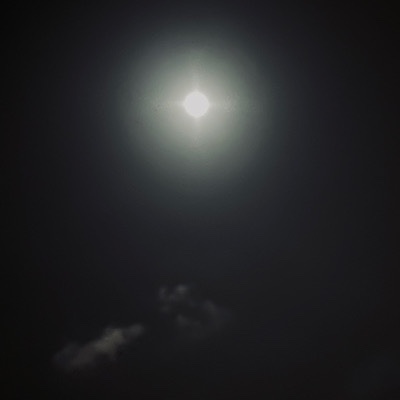
Wolf moon fiercely lit.
Wind howls in response; what might
Be illuminated?
Is it benign multitasking or a sign of being too attached to social media that I am writing while I am waiting for the bus home? I have taken my moment to appreciate the beauty of the Dome.
Tonight, I think it is the former. I have twelve minutes to spare. Writing now means that I will not even be tempted to turn on the computer when I get home. I will pet the cats and wash and sit for meditation before getting ready for bed.
I can pause, here, thinking about the synchronicity of the centering Batya used at the beginning of class I took tonight (level 4 at Willow Street, Takoma Park). She told us of a story she had heard on a podcast about a woman who described having a stroke as freeing her mind from its incessant chatter when the language center of the brain was temporarily immobilized. That quiet is, in part, what comes from a deep and consistent meditation practice. The synchronicity was that I am reading Ram Das’s “Be Love Now” (hot off the press), which is inevitably leading me to think about the interconnection between yoga practice and facing a stroke. It is not something I think of often.
The more we are open and aware, though, the more we will see connections and synchronicities. The more consistently we practice, the more likely we are to experience the good in even the greatest of challenges.
And now, the bus is here, and I am on my way home.

Earlier this week I was talking to a long-time friend of the family (my father has known him and his wife for over 60 years; they have known me since I was riding around in the womb). My parents had sent me an email while I was on the meditation intensive with Paul Muller-Ortega last month, to tell me that our friend was in intensive care recovering from an operation. I waited until I knew he was home to call because it can be so tricky to get the right time at the hospital. When we spoke, I told him that my father had said that his intrepid cheerfulness was a complete inspiration. “What choice do I have,” he asked, “what can you do when you wake up in intensive care on your 82nd birthday, but look for the gift it will have to bring?”
In the past several weeks, a number of other friends and family members have been seriously ill or lost loved ones or home or work or more than one of these. The outrageous suffering from a seemingly relentless series of natural disasters and war and the financial crisis is a staple in the news. In trying to stay present for my friends and community, while still taking care of my own needs and emotions, I found myself led to practice bhavana on (deeply contemplate) the first sutra in Patanjali’s Yoga Sutras: atha yoganusasanam–now begins the practice of yoga and how it relates to the Anusara first principle of “opening to grace.”
Teachers and commenters say of the Yoga Sutras that it was not meant for beginners, but was meant for students who have already established a practice and reached a level of initiation (diksha) that established they were ready to be given the teachings. I have also often heard said that one is drawn to the practices because of other experiences in this or a previous life; in some sense, the first time we show up, we are not a beginner and are ready for the teachings. Whatever knowledge and skill we bring to our studies and practice on any given day, they start new. They are starting “now.”
Now begins the practice of yoga (yug)–of uniting ourselves with each other and with spirit and linking our mind and body one-pointedly to the fullness of the teachings. The teachings are methods for knowing and experiencing this perfect union. In that regard, I think that an essential element of the teaching conveyed by the Anusara first principle of “opening to grace,” is this now, this beginning anew both to know what already is in our hearts and to learn how the practices can make it ever more accessible, whether we are beginners to what we understand to be yoga or meditation or have been practicing seriously for years. We want this “now” in every moment. As we get more skilled, and part of developing our skills is challenging ourselves deeply in the controlled environment of class and our own practice so that we will spontaneously open to grace in the moment when, as my friend said, there is no viable choice but to be cheerful (to “open to grace”).
The “now” of Patanjali, the practice of “opening to grace” in Anusara yoga, is a way to teach those of us (like me) who do not otherwise learn or intuit from living itself that there is no viable choice other than cheerfulness in the face of the most difficult of challenges. The “now” conveys that it is now time to go deep, time to expand understanding and practice, time to discover truly how the practices can connect us to spirit and alleviate suffering. Now is the time to be and to learn better how to stay grounded in and connected to the flow of energies, not just so that you can face what you yourself might be experiencing, but also to have ever more space for love, compassion, support, and service for others who are in need. Now is the time to open to grace.
 Photo from exhibit in San Francisco on the 10,000 year clock project.