| |

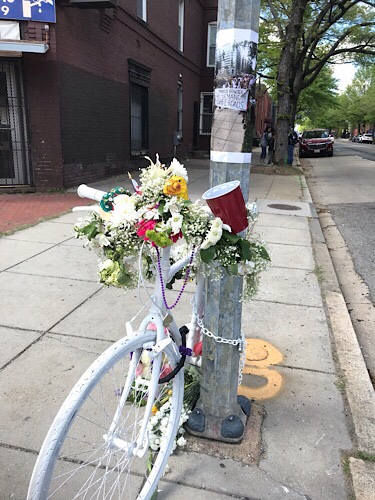
In Memorium (Be Wary and Be Aware)

I did not know the cyclist, but know people who did. If you’re walking or on a bicycle or skateboard or wheelchair please be wary and be aware. Car drivers please watch out for pedestrians and cyclists, etc.

12th Street and Florida Avenue, Northeast, Easter 2019

Similar Posts

  • | | |

    Ecstatic Serenity

    When I was eight or nine, a teacher asked everyone in my class to say what they wanted to be when they grew up.  The other children named the various jobs or professions that appealed to them at the time.  I responded that I wanted to be independently wealthy.  At that age, I was expressing something I already knew from family issues.  Though I did not have the words for it or a clear understanding, what I was saying was not just false precocity.  I knew at a basic level what is taught in yoga:  I would need enough material support (ardha) to follow my heart in love (kama) and work (dharma); then my life could be free (moksha).

    When I was 22 and visiting my friend Dan, he asked me what I really wanted to do with my life.  We had just graduated from college.  Dan was working for a sculptor who was a professor in the art department; I had just moved back to New York, had just gotten over a failed attempt to serve as an office manager for an off-off Broadway theater, was in a place of deep emotional and financial struggle, and was trying to determine what work and corresponding further education I wanted.  “I want to be content,” I said.  “That’s too passive,” he replied.  “No, that’s not what I mean,” I tried to explain.  “For me being content being satisfied and engaged with my work and life, but still working hard and having goals.  It’s not just hanging out.”  I had all sorts of things that I found interesting and possibilities for a life path, but I didn’t have one specific career or life plan that I was certain would be more fulfilling than any of the others.  They just would have satisfied me in different ways.  Because of the dilemma of too many choices, I wanted to be able happy with whatever choice I made, even if it seemed like a compromise.  I was conscious that once I picked, because of the inherent limitations of time and space, that I would either have to be content with my choice or be unhappy.  I have since learned to think of contentment (samtosha), which is one of the niyamas of the path of yoga expounded by Patanjali, as a practice rather than a goal (and it is a very important and continuing practice for me).  Contentment is not an end, as I had thought when I was 22; it is just one part of the path to a goal of living liberated (jivanmukti), experiencing self as spirit in all that one does.

    On a recent telephone seminar, Paul Muller-Ortega, my meditation and philosophy teacher, in the midst of a broad dialogue regarding various studies and practices, spoke a little of ecstatic serenity.  Memories of the discussions I had had long ago about what I wanted welled up in the forefront of my thoughts.  In thinking about what is my intention now, especially with regard to my practice (sadhana), I witnessed my previously stated intentions as just stages on the path to this discovery.  As soon as I heard Paul say the phrase, I thought, “that’s what I want; I want to be ecstatically serene.”   I seek to be always in some part of my conscious being still and peaceful, while simultaneously being passionately engaged in what life brings to me and I bring to life.

  • | |

    Samskara (and the awesome and the awful)

    Those of you who have been attending my classes for the past couple of weeks already know that my overall theme for the fall session is cultivating a sense of wonder (abhuta). Feeling wonder is one aspect of the Anusara principle of “opening to grace.” It is seeing who we are and what we are within space and time with a sense of amazement at the limitations and the foibles, as well as the strengths and delights.

    This week I was thinking about abhuta in the context of samskara — the markings or grooves or scars in our being from how we have lived our lives (and perhaps past lives, if those were also lived by us — personally not sure about that). I had a dialogue earlier this week that resulted from over 110 years of combined history that was not optimal. Reflecting on the precipitating factors, though, and marveling at the web of history, environment, education, and action that combined to give rise to the conversation led me to a sense of wonder indeed. It is by cultivating the ability to step back and appreciate the wondrousness of the dance that we learn from a steady practice that, I think, can help make it possible to shift in how we behave and react to things.

    From a physical perspective, most of our challenges and difficulties are based on what we have done with and in our bodies over the course of our lives. We use the yoga alignment principles to create new grooves and to shift from the old repetitive patterns, so that we can not only alleviate pain and misalignment, but to expand the possibility of discovering ever more joy and wonder in and through our bodies and senses. Both the physical and meditation practices help us shift similar patterns (dissolve and transform samscaras and their impact), so that instead of deepening old grooves, we erase or dissolve them and create new life-enhancing ones.

    It may seem odd to marvel at our stuff, especially when it does not appear to be serving us, but keep in mind that both the awesome and the awful, being both all about awe, can give rise to a recognition of the great and exquisite mysteries of being.

Leave a Reply

Your email address will not be published. Required fields are marked *

This site uses Akismet to reduce spam. Learn how your comment data is processed.