Untitled
Or just sat quietly? Or did some gentle stretches?
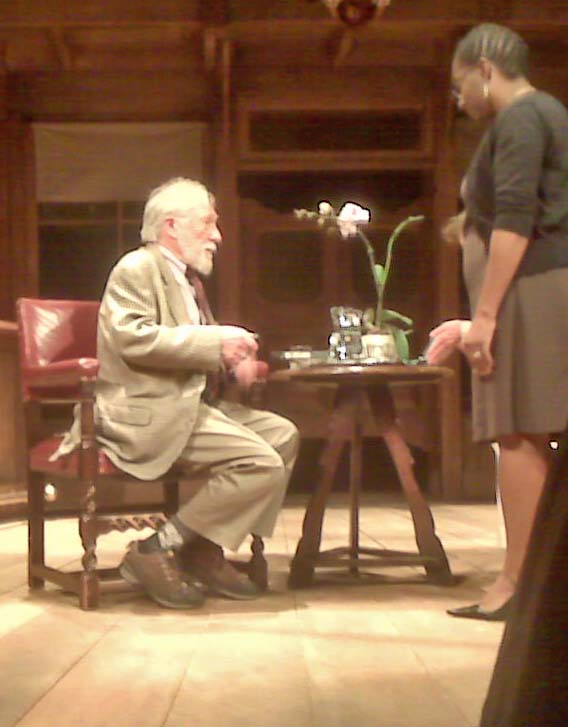
Last night I had the singular pleasure of hearing Gary Snyder read his poetry at the Folger Shakespeare Library. At the end of the reading, Mr. Snyder answered a few questions. In response to one question about advice he gives to aspiring poets, he said: “Don’t be journalists. Do hard physical labor that leaves y0ur mind open.” This is not surprising advice, coming from one who has chosen a life requiring regular manual labor. “Meditate only for its own sake,” he added, in an apparent non sequitur and without elaboration.
Gary Snyder’s poetry is evidently influenced by his dedicated study and practice of Buddhism. The insight and clarity of his poetry surely reflects not only his intellectual study, but the deep wisdom of a dedicated, long-standing, and steady meditation practice. The advice to “meditate for its own sake” seemed almost the offering of a koan by the master (poet) to his pupils. Meditation, in my experience, definitely enhances clarity, insight, creativity, and health. Meditation is not meditation, though, unless when engaging in meditation that is all one is doing and without any goal (like the “actionless action” of the Bhagavad Gita). It is the deepest of practices to engage fully, but not be doing except for the sake of doing itself (and in alignment with the deepest truths).
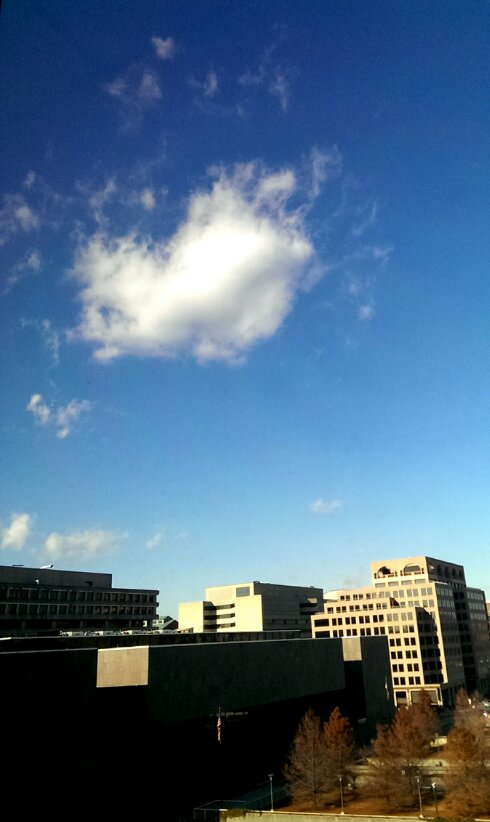
On seeing me snap a picture with my phone of our shared view of the highway, homeless shelter, tax court, and an array of office buildings apparently designed in the school of Mies Van Der Rohe gone terribly wrong, my next door office mate asked, “are you taking a picture of what you will be missing while you are in India?”
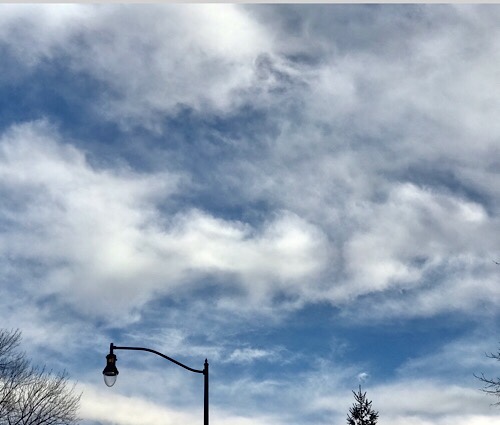
“No, I’m taking a picture of a heart-shaped cloud. When I’m having a day as stressful as the one I’m having, I like to remind myself that there’s always a heart-shaped cloud out there to put things in perspective.” I held up my phone so that she could see the photo, as sometimes people don’t see the heart shape until I’ve photographed it.
“That’s pretty cool,” she observed.
She’s going to water my plants when I’m gone, and I’ll look for a little something from India for her that will make a hard day at the office a bit easier to take–perhaps a murti of Ganesha (the elephant god who is said to be the remover of obstacles).