Untitled
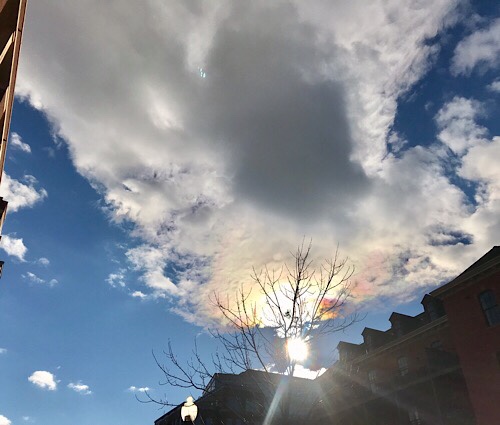
The first two days, including the Solstice, of the Anusara Grand Gathering were bright and blue and sunny and pleasantly cool in the morning and warm in the afternoon–“perfect” New England summer days. The third morning dawned cloudy. By the time the morning session was underway, a pleasant drizzle had turned into a deluge. Rain started coming in from the sides where the tent was open, and then the roof started leaking. The clouds were sufficiently dense that the light was no more than at dawn or dusk. It was getting pretty dark and wet in the tent. At one point, after having told stories about rain being regarded as blessings in Hindu rituals and exhorting us in surya namaskar to jump forward and splash in a puddle like a kid, John said, “I would turn the lights on, but there aren’t any lights to turn on. So this is perfect!”
One of the conundrums in explaining the philosophical principle of purna, which means “perfect” or “fullness” is reconciling it with the evident fact that our divine perfection or fullness aside, we are still working to shift and realign our minds and bodies through the practices. The divine consciousness, which is everything, say the yogis, is utterly perfect as it is and completely full (or fully empty and thus all potential, depending on how you look at it). We are told that we (and all of being) are the divine consciousness manifest and then given a slew of techniques and instruction to help us change ourselves.
If we are completely perfect and full, what is the point of learning all the technique and seeking to expand and shift our bodies and minds? The yoga teachings say that we forget that we are this fullness and perfection, and it is our forgetting that leads to suffering (which is different than pain, but discussing that distinction will have to wait for another blog entry). The practices are not to perfect or improve us, but rather to shift our alignment (mind and body) so that we remember the perfection of ourselves as spirit. When we remember, we are better able to recognize the perfection in ourselves, other people, beings, things, or events, even what we find challenging or difficult. From this space of recognition, in my experience, we naturally become happier and more generous of spirit.
I think that moment at the Anusara Grand Gathering is a perfect (word choice intentional) illustration of the apparent dichotomy of seeking change and appreciation of the perfection of every moment. If there had been lights to turn on, John would have turned on the lights so that we could have observed the alignment better during the demonstrations and he and the assistants could have seen the students more easily. The universe did not have it in store for us to have a light-filled dry day; we were getting a wet and dark one whether we liked it or not. Having no lights to turn on, John reminded us in a light-hearted way that the teachings and practices would invite us to fully embrace and enjoy the weather we got and practice space we had (while staff were busily making alternative arrangements for classes later in the day), getting the most out of it. I thought it was pretty fun to practice in the cool rain, though it’s easy for me to say since I and my things stayed dry, and the rain was a welcome respite from the worsening drought in the DC area.

When a student asks a question and I do not know the answer, I do not try to answer it then and there. I do go home and take the time to try and find an answer. If I find enough information to be useful, I follow up. Last night, before the William Penn House class, a student asked whether I had received a recent mass e-mailing from John Friend in which he mentioned teaching about biotensegrity. I knew the answer to whether I had received the email–yes, a friend had forwarded it. I did not know, though, how John was using the term biotensegrity. I went and did a little research.
Buckminster Fuller coined the word “tensegrity”as the conjunction of tension and integration. The idea of tensegrity is being actively taught by anatomy teacher Tom Myers, a student of both Buckminster Fuller and Ida Rolf and a teacher of certain of my yoga teachers. It also bears a trademark when called “Carlos Castenada tensegrity.” I never got into the “magical passes” of Castenada’s students turned teachers, but at some point relatively recently found a used copy of “Magical Passes.” As I had delved fairly deeply into Carlos Castenada in my youth, I picked up the book and made it part of my library, though did not read it at the time.
I am not surprised that John is talking about biotensegrity. From my few hours of reading, it seems resonant with the “universal principles of alignment” that were the foundation of his Anusara teachings and also consistent with his movement towards the exploration and teaching of “sacred geometry” near the end of his Anusara days.
Yes, I know I haven’t actually said what is tensegrity or biotensegrity in the yoga/body awareness and movement context. But I do not teach unless I have learned something well enough to integrate it fully into mind and body such that I can articulate it in my own words, and I have not thought enough about the term tensegrity as it relates to yoga practice, though the concept makes initial intuitive sense. If the links inspire interest, I invite you to look more deeply. And I’m going to put “Magical Passes” on my stack of reading, though not necessarily at the top.
Under the busy
Overpass, it felt as if I’d
Entered a cathedral.