Signs Around Town (It’s All Illusory?)
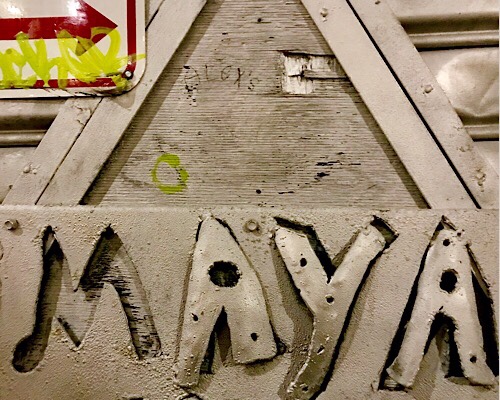
As the nights get longer and colder and darker, it can be very tempting to hibernate. It is not a bad thing to focus more on the indoor things, but for health and happiness make sure to get out and soak up some light every day.
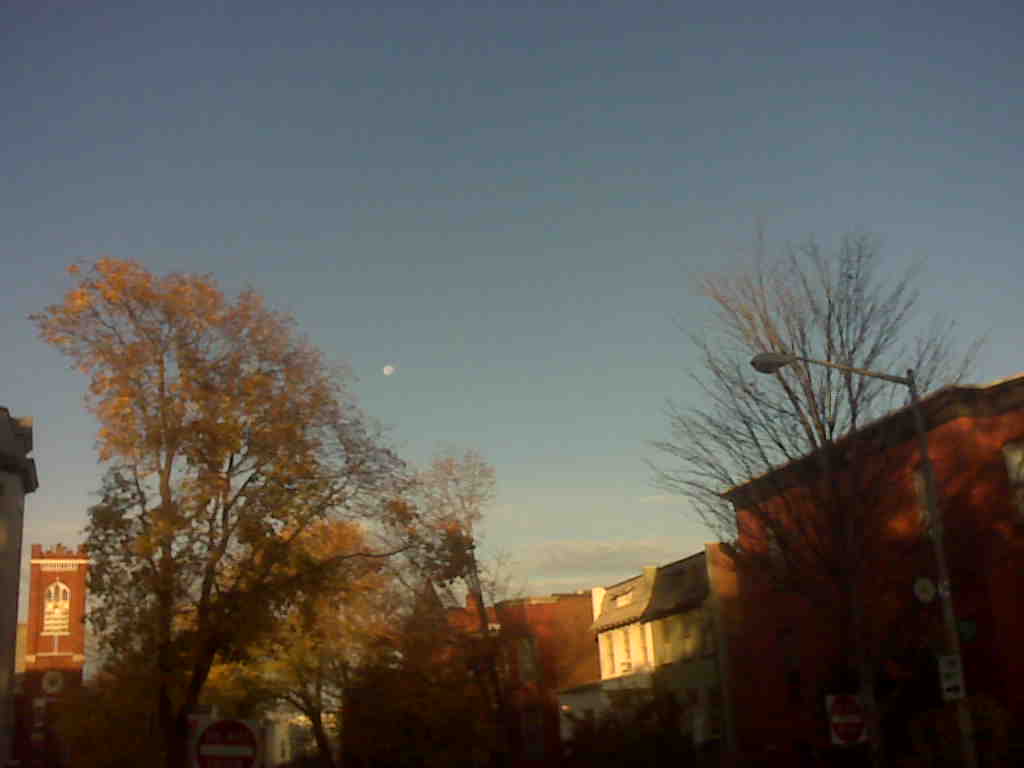
The moon just past full greeted me this early morning as I headed for the metro to ride up to Silver Spring to assist at the therapeutics workshop with the wonderful Todd Norian who has come to visit and make offering to our community. Seeing the moon over the vivid trees made me glad I had a reason to get out of the house extra early on a Sunday morning.
Peace and light, E — Posted with WordPress for BlackBerry.
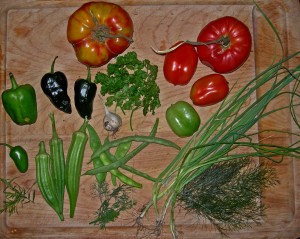 Could not resist the french name. More fun than summer local vegetable stew. An alternative name could be: how to make three okra and six beans into dinner for two. Or maybe four. When I was out in the garden this morning, I simply picked what needed to be picked. Featured here: three okra, six beans, one jalapeno, two ancho chiles (one partly dried on the plant), two large tomatoes (both of which are only partly viable), two ripe and one green (fell off while I was picking the ripe ones) roma tomatoes, one very small garlic clove, baby leeks, garlic chives, tarragon, parsley, dill, and herb fennel. Serve over quinoa, couscous, rice, or pasta, and it is easily a meal for two. Add some red beans or other dried beans, and it could be dinner for four.
One of the things I like about eating from the garden is the necessity of being creative. Cooking from a cook book, who wants an ingredient list this long? I could also be disappointed that no one of my plants is giving me enough to create a dish out of mostly one or two ingredients. If I were getting these ingredients from the store, I would get more okra or beans or peppers. There is a great joy in finding a sense of abundance and sparked creativity and celebrating pleasure, art, fulfillment, delight, offerings with what we have been given, whether it is the food from our garden, our bodies, our talents, our families, or the time and place into which we were born. In finding the highest sense of abundance and creativity within our limitations, we are truly experiencing the yoga concept of jivan mukti, living liberation.
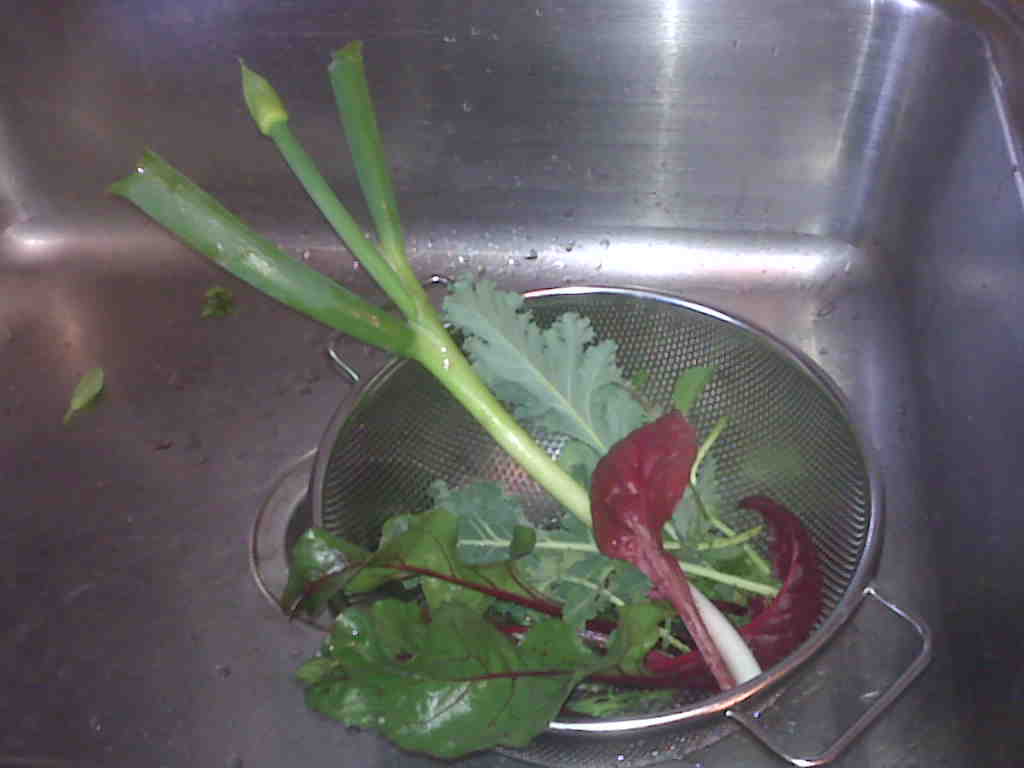
Beet greens, ruby chard, green chard, kale, spring onion, parsley, oregano, tarragon.
Peace and light, E — Posted with WordPress for BlackBerry.
Could you find your innards gorgeous–the blood, sinovial fluid, organs of digestion and elimination? What about your inner thoughts and memories, the ones you do not want to share?
That, of course, is not the point, here. What does it mean to be gorgeous inside? As a found exhortation it is to invite us to find (and seek) the wondrous and exquisite place where external (including your internal critic) judgment and values become irrelevant (even while recognizing that we are still working on things).
To find that gorgeous and glorious inner space and rest in it is one of the reasons to meditate–especially those of us who have a tendency to hear at times all too loudly the inner and outer voices of criticism.

Peace and light, E — Posted with WordPress for BlackBerry.
When my friend Mac asked if I would let my readers know that his dance group Human Landscape Dance will be performing at Dance Place on Saturday and Sunday, July 9th and 10th, I agreed without hesitation. As I was contemplating what to write, I found myself thinking about the koshas–the energetic sheaths of the body. The yogis claim that the individual has five koshas. The outermost, the annamaya kosha, is the “food body.” “Food” in this context encompasses everything that comes into our body through all of our senses–touch, taste, sight, hearing, smell. I thought about what it might mean to “eat local” if eating meant everything that we encounter with our senses.
I am not a locavore (I too thoroughly enjoy avocado, coconut and, in winter, citrus), but I do try to emphasize local food as the mainstay of my diet. I do it mostly for energetic reasons. I want fresh food to have been picked as recently as possible and not to have grown weary from travel. I want as few hands as possible to have touched the food I buy, and those hands to be those of a person who is happy with farming and is paid a living wage by the sale of the produce. When your food growers, transporters, and preparers live nearby you are getting to know your neighbors and community, and not just getting food from a faceless corporate entity. Over the years, you get to know each other a bit and learn what friends you have in common. More threads are woven into the fabric of your community.
Just as knowing the person who grows and sells you food means you can be more certain that it was raised and offered for sale with nourishment intended at every stage, so too having the art and entertainment we bring into our senses be created within our community creates a network of connection and support that we do not get when we only consume commercially prepared entertainment (though I cheerfully buy music from my favorite “stars,” go to the movies, and enjoy trips to Lincoln Center,and London’s West End, etc., just as I get avocados and citrus along with the greens from my garden and the fruits from the local farmers’ market).
I feel blessed to be able to connect with Mac as a neighbor (Mac, his wife Jennifer Mueller, who is a student of mine and fellow yoga teacher on the Hill, and their delightful daughter live several blocks from me) and others who are performing next Saturday as fellow dancers at the Sunday Contact Improv Jam. My dancing and personal explorations are raised up by the company of the wonderful dancers and friends who share that space, including those who will be performing next weekend.
Why wouldn’t I want to both support my friends and learn more about them by going to Dance Place to receive the dance offering they are so lovingly preparing for all of us? Such is the nature of feeding mindfully the annamaya kosha to help lead us to the opening and nurturing of our innermost spirit, finding and creating more bliss in ourselves and in the very essence of our community.
FYI. I’m looking for company to carpool or walk together to and from the Brookland Metro (for safety on the way home). Perhaps Sunday CI Jam, dinner on the Hill, and the Sunday night show?
 Photo courtesy of Human Landscape Dance.

Ayyappa is the half-brother of Ganesha and Subramanyam. Ganesha and Subramanyam’s mother is Siva’s wife Parvati. Ayyappa’s mother is Siva’s brother Vishnu while he was the woman Mohini. Even in the glossed over versions that don’t get into what a modern reader might think of Ayyappa’s mother, he is the extra and unwanted child of the family, although he is needed to save the world from evil. Ayyappa is the character in the story who represents those who have ever been or felt unwanted or third-wheel or lost or excluded or is somehow missing in society or in relationship, but is still inherently worthy and divine and essential to the functioning of society, even though he is cast out into the wilds of the forest.
Being the god of such, at the festivals at a major temple in Kerala on the pilgrimage route, all castes are welcomed. No need to be a Brahmin.
But only prepubescent girls and elderly, post-menopausal women are permitted; women who have the capacity to conceive are forbidden. Those connecting with the god of the unwanted, the extra, the missing, the cast out, themselves deliberately exclude from access to this god others they make even less privileged. Even for the men of the lowest caste, the step-brothers, the bastards, and the otherwise unwelcome and unrecognized for their intrinsic worth, by the exclusion of all women of child-bearing age/capacity, Ayyappa’s pilgrims get to experience the sense of inclusion and privilege in society of the more powerful and glorified and popular brothers who have never been themselves cast out.
Could this by design? Is it that one cannot really understand what it means to be excluded unless one also experiences the power of being able to exclude in turn? If yes, how easy to pick, in a patriarchal culture, women of child-bearing age as the outcast and denied. (Do they ask any woman who shows up whether she still bleeds? If a woman has stopped bleeding, but doesn’t look “elderly,” does the prohibition still apply?).
I have personally experienced far too many things that have been partly or completely closed off to me, overtly or invidiously, because I am a woman or not of a particular social or religious background, and much where it was worth risking ease to challenge the status quo.
As for an Ayyappa pilgrimage, I’ve seen photos of half a million escstatic and determined male worshippers surging towards the temple for festival (looks something like returning to the tube station after seeing the Rolling Stones at Wembley Stadium in 1982 or the infield on a muddy day at the Preakness only more testosterone than that), and what first came to mind was not, wow, I really want to join that party. Rather, I asked myself where do they urinate and defecate.
I personally cheerfully leave this one to the men (and my more intrepid and determined sisters), even if it makes some of them feel special in part because they have excluded a whole class of people from being able to formally worship. I’d much rather spend time with Kali. Thank you very much.
Maybe I’d go stand outside Sabarimala in off season, when the temple is closed. I’d take a photograph and contemplate what the idea of Ayyappa–god of the unwanted, the unwelcome, the third wheel, the excluded, the extra, the cast out from the benefits but saddled with the hardest task–means to me–both as one who has experienced the pain of exclusion and one who has excluded others (as most all of us do even when we try not to), and how it can inform me to relate to others with more grace and compassion.