Consignment Shop Find
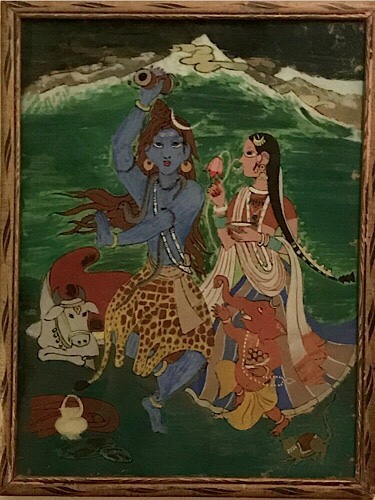
Siva, Parvati, Ganesha, and Nandin, reverse painting on glass, mid 20th century

Siva, Parvati, Ganesha, and Nandin, reverse painting on glass, mid 20th century
Whether or not one believes in an uber-creator, such belief is no excuse to abdicate one’s own need to be conscious of how individuals are part of the whole fabric of being and our duty (dharma) to act in recognition of that interrelationship. Taking responsibility for our own lives and relationship to others and our place in the ecosystem is an essential part of aligning with the ideal of the divine.
It is reasonable and perfectly appropriate to practice to enhance our own peace, joy, and well-being. Equally important is that the practices lead us to live with more mindfulness and compassion.
Doing the practices without ever refining how we are in the world is not, as some claim, enough to serve as a grand contribution to making the world a better place, though if we are happier and healthier we are likely to be more pleasant to be around.
Peace and light, E — Posted with WordPress for BlackBerry.
I have been deeply touched by how so many have been inquiring of themselves how we can best respond from the light to the tragedy in Arizona. I received an email from Common Cause today with this beautiful quote from Martin Luther King, Jr.:
“When evil men (and women) plot,
good men (and women) plan.
When evil men (and women) burn and bomb,
good men (and women) must build and bind.
When evil men (and women) shout ugly words of hatred,
good men (and women) commit themselves to the glories of love.
Where evil men (and women) would seek to perpetuate an unjust status quo,
good men (and women) must seek to bring into being a real order of justice.”
– Rev. Dr. Martin Luther King, Jr.
The light woke me early on this summer solstice. The sky is bright blue, the air clear and pleasantly temperate, the mountains lushly green, and friends surround me. The practice yesterday was lustrous, and the next two days promise to be equally delightful.
The delight from being surrounded by beauty and good friends can give us a taste of the possibilities of experiencing true bliss. As the surface enjoyment of being on vacation (albeit an extraordinarily good one), though, it has a shadow side, just as the picture below of a smiling ganesha at the base of a tree in the middle of a heart is flanked by a fire hydrant and a pile of trash bags.
It is really easy to imagine ananda — divine bliss, under these circumstances. It is important for all of us to find moments within our means when it is easy to experience the spark of spontaneous happiness. When it is challenging to find it, when grief or hardship confront us, it is ever more important to be able to tap into a space of bliss so that we can bring the most light to our challenges. Having the sweet times helps us find it in the bitter.
Ananda, John reminded us at the afternoon philosophy lecture yesterday, is the joy that has no opposite. It is a deep contentment with what is–hearts and trees and fire hydrants and trash bags and all–that fully accepts the play of opposites.
Those of us who do not know and live ananda spontaneously and naturally all of the time have the yoga. We challenge ourselves on the mat, knowing the exhilaration of heart opening and the challenge of stiffness; we sit for meditation on good days and bad, finding sometimes the pulsing, vibration of the fullness of consciousness and other times our to do list; we practice pranayama to open our energy channels; we chant to remind ourselves of why we practice: to open our hearts and discover the best in ourselves and in all beings.
Happy solstice to all and hope see you soon for the yoga.
Peace and light, E — Posted with WordPress for BlackBerry.
Thanks to the generous Cate Stillman for this podcast. What I like most about Cate’s perspective is her teaching that truly practicing Ayurveda is paying attention at the deepest level, including paying attention to what in the classic teaching of Ayurveda work for you and what do not–being that they are imbued with cultural elements of the Indian subcontinent that do not necessarily support or resonate with our culture or individual constitutions.
As I study more, I find that it turns out that I had been practicing Ayurveda already by keeping to a regular daily and weekly routine, eating seasonally and locally, eating with sensitivity to impact on my digestion and energy level, and by having a steady practice. Not being interested in detox (more some other time on the dangers of detox) or constitution types, or arcane herbal remedies (many of these, by the way, are becoming endangered species), it turns out, does not mean having rejected Ayurveda. I do know that whether I call it Ayurveda or just plain common sense, the more I live in a balanced, sensitive, and steady way in terms of diet, sleep, entertainment, work, and consumption in general, the more I optimize my health and sense of well-being.