Blossoms Around Town
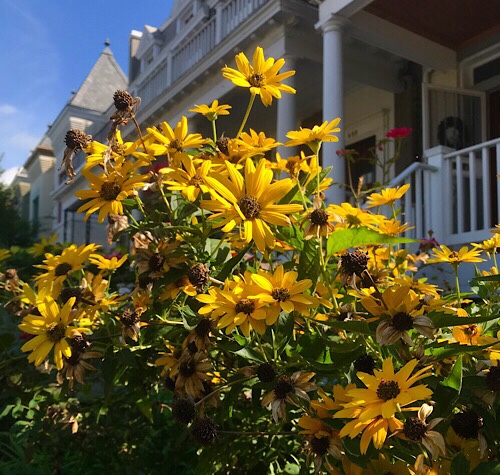
Last night I went to my neighbors’ “comfort food pot luck.” Comfort food tends to mean for many of us in winter warm, dense, heavy, rich food that is likely to be white, beige, or otherwise pale in color. There is much to be said for the emotional impact of great mashed potatoes or macaroni and cheese, especially when it is cold.
As I was deciding what to bring and remembering that last time I went to this pot luck there were three kinds of macaroni and cheese, mashed potatoes, and multiple kinds of bread, I thought about what would bring me comfort in that context.
My diet is not subject to any particular label. I mostly do not eat meat or cow dairy–perhaps vegetarian/vegan preferred would be a good label to the extent one would need to give a label (we are so fond of those in this society). I also prefer local and organic food, in that order, when available, and find my health benefits from a fair percentage of my diet being raw, fresh fruit and vegetables.
Based on my assumptions of what others would likely bring, I thought that it would give me great comfort to have something fresh, bright, crunchy, raw, organic, and mostly local to go with mashed potatoes (they were delicious Marlene) and assorted casseroles. I took a look at what was in the kitchen and found I had red cabbage, a couple of apples, an onion, and some carrots from the farmers’ market; organic celery, raisins, ginger, lemon, apple cider vinegar, and white miso from the food coop and the organic grocery store; and mung beans sprouting on the counter.
The red cabbage salad and sprout salad was a hit as a foil for the traditional “comfort food.”
Since you asked, here’s how its made:
Mince some onion and dice a small red cabbage. Splash some apple cider over the onion and cabbage so it can start pickling while you are cutting up the rest of the ingredients.
Dice some carrots and celery and add to the cabbage and onions.
Throw in some raisins.
Mince some ginger and add to vegetables.
Mix a couple of tablespoons of mild white/blonde miso and some Dijon mustard to taste (a darker miso will be too strong) and stir in hot water to thin until the miso-mustard mix is a creamy consistency and stir into the vegetables.
Dice an apple or two and mix in with the other ingredients.
Add some fresh bean sprouts if you have them (I always have sprouts growing except in the hottest weather; a good source for supplies is www.sproutpeople.org; best to add the sprouts while they are still short so they are the same texture and size of the other ingredients in this chopped salad).
Squeeze in some lemon juice to taste (or more vinegar if you don’t have a lemon on hand or want to be completely local). If necessary to get the dressing spread evenly over the vegetables, add a little more water.
Add another apple or additional raisins if you need more sweetness to offset the saltiness of the miso and the astringency of the vinegar and lemon juice.
This salad benefits from sitting for at least a few hours. It can sit overnight without the apples and the sprouts–the miso starts to ferment the cabbage as for sauerkraut, which is nice– but the apples and sprouts will get mushy and are better added at the end.
Enjoy. Play with ingredients and quantities and please comment if you come up with a delightful variation.
I have been revisiting these cooking and gardening books from among my varied collection as I prepare for the “Yoga of Eating” Workshop. In addition to having recipes and/or gardening techniques each teaches about health, ecology, plants, and seasonal eating, is written in a way that would appeal to both novice and expert cook/gardener alike (including some recipes in the gardening books), and some have very pretty pictures. The key words for this focus in the titles: enjoyment, art, healthy, ecological, seasonal, healthy, earth, practical — essential attributes/attitudes/directions for eating with yoga consciousness.
Cookbooks:
Bishop, Jack, A Year in a Vegetarian Kitchen: Easy Seasonal Dishes for Friends and Family (Houghton Mifflin2004)
Sass, Lorna, Recipes from an Ecological Kitchen, Healthy Meals for You and the Planet (Wm. Morrow & Co. 1992)
Shaw, Diana, The Essential Vegetarian Cookbook (Clarkson Potter 1997) (Your Guide to the Best Foods on Earth: What to Eat; Where to Get It; How to Prepare It)
Tiwari, Maya, Ayurveda: A Life of Balance (Healing Arts Press 1995) (The Complete Guide to Ayurvedic Nutrition and Body Types with Recipes)
Waters, Alice, Chez Panisse Vegetables (Harper Collins 1996)
Kitchen Gardening:
Bremner, Lesley, The Complete Book of Herbs: A Practical Guide to Growing and Using Herbs (Dorling Kindersley – London 6th Ed. 1993)
Gilberti, Sal, Kitchen Herbs: The Art and Enjoyment of Growing Herbs and Cooking with Them (Bantam 1988)
Guerra, Michael, The Edible Container Garden, Growing Fresh Food in Small Spaces (Fireside 2000)
Lloyd, Christoper, Gardener Cook (Willow Creek Press 1997)
Pavord, Anna, The New Kitchen Garden (Dorling Kindersley Am. Ed. 1996) (A Complete Practical Guide to Designing, Planing, and Cultivating a Decorative and Productive Garden)
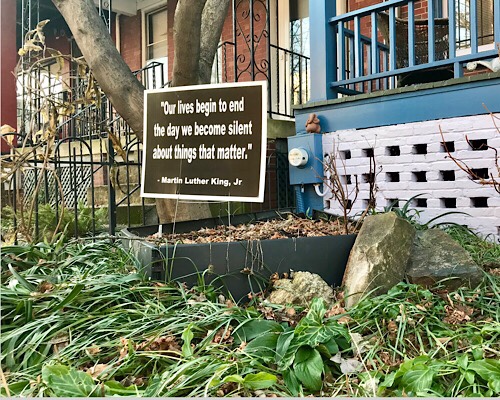
Long time neighbors and participants in the rose garden yoga posse, who have now retired and are moving to be nearer children and grandchildren, gave me their yard sign.
I will miss them for practice and around the neighborhood. I like, if they must go, that I will think of them fondly every time I come home to this exhortation and its call to practice.
I ordered some seeds for the garden–Malabar spinach–a spinach-like green that supposedly likes heat and humidity–from Calabash Tea and Tonic. I’m looking forward to seeing whether it will thrive in the summer. It’s hard to find greens that do well in the long, hot summer.
As I was running low, I also got some powdered ginger. Even though I can make my own, because it came with a good story, I included some Jamaican curry powder in my order. They arrived almost immediately, along with an exhortation.

Dear Friends ,
Greetings to all in this strange, but glorious Spring. As I sit down to write, I cannot help but recall that in my new year’s letter, I wrote of the practice in some Indian temples of cracking open a coconut to symbolically break open the head to get out of old living patterns that do not serve us. I blithely wrote how blessed I was that in having taken myself to India, I was intentionally choosing to be challenged, while recognizing that we don’t always get to pick when challenges will come. Less than two weeks after I returned, my family gathered to visit my father who was in the hospital for a hip replacement (he’s healing well). Only a couple of weeks after that, the Anusara yoga community was turned topsy turvy,. When I wrote of choosing to break myself open to discover new paradigms and possibilities, little did I know what was going to happen to the yoga community that has been and continues to be such an important part of my life.
Even Spring is not behaving according to settled expectations. It burst forth especially early–the cherry blossoms are already gone and azaleas and roses are blooming almost a month early. Records were set around the country for the warmest March on record, and we are approaching drought conditions (again) in the Washington metropolitan area.
Not surprisingl for one who likes things to be settled and secure, while admiring the wild blooming around me, I have been thinking about how disconcerting change can be. For someone who prefers warmer weather to winter, getting Spring early is delightful, but I cannot help but recognize that it has come with disastrous storms and high risks for farmers and our food sources, evidence of the fraying relationship between our populous society and the earth. What is a gardener, a yogi, and a member of society to do?
As a gardener, it is necessary to remember old teachings and methods (for example, just because it was prematurely warm does not mean that the danger of last frost is earlier than in other, colder years), but it was also necessary to plant and tend the garden earlier to make sure that cool weather plants, such as greens and snow and sugar snap peas, actually have an opportunity to grow. The erratic weather is also serving as a reminder to try and shift to be more in alignment with the forces of nature and to contribute less to global climate change. In a word, a true gardener, like the dedicated yogi (on and off the mat) will rely on the lineage of teachings and experience, continue to be fully engaged without giving up, be adaptable to the vagaries of season–both serendipity and calamity, and seek to live in a way that fosters the good in oneself and all beings.
It is going with the flow, but in an active and intelligent way. In this time of uncertainty, I believe that an ever deeper and more open study and practice of yoga is a great gift. Yoga when practiced sincerely and in community provides us opportunities to connect more deeply and techniques to turn unsought changes into opportunities for growth and transformation. In that light, in my own yoga offerings to you, there is both stability and change:
The big change in my yoga classes is moving my long-running gentle/therapeutics class at Willow Street to Friday nights. I am very excited about this shift. On a personal level, it gives me free weekends for the first time in six years, which will give me more time and space to study, practice and explore. For you, I intend that the class will now be a perfect transition from the work week to the weekend, fostering and enhancing the ability to heal and celebrate. Those who like things to be steady can still expect the same full hour and a half of nurturing, alignment-based, therapeutic poses and restorative practices. Registration for the full session is preferred, but drop-ins are always welcome. New to the class and want to know what it is about? Please come join me on Friday, April 13th, as part of free class week.
The Tuesday night all levels group practice at William Penn House continues. As always, a portion of the proceeds support the work of William Penn House, and if you cannot pay the suggested donation ($12-15), do not let that keep you away. We want to make the yoga available to those who truly seek it.
I hope to see many of you soon. Please feel free to be in touch by email or Facebook message when you cannot make it to class. For in-between newsletter information, please “like” my “Rose Garden Yoga” page on Facebook, and there are always new photographs and musings about yoga on and off the mat on the blog.
Peace and light,
Elizabeth


Peace and light, E — Posted with WordPress for BlackBerry.