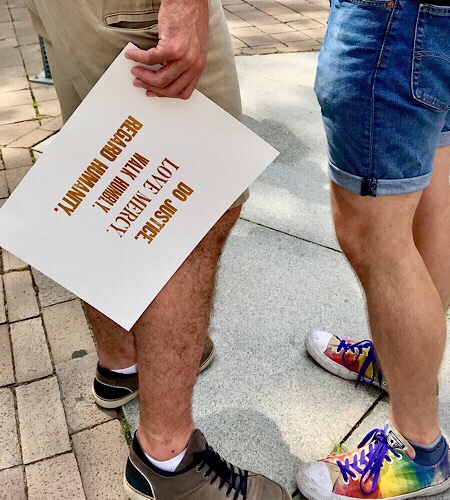
Found Exhortation

Freedom Plaza, August 12, 2018

Freedom Plaza, August 12, 2018
Whether or not you celebrate Christmas, and if you do, how you celebrate, wishing you peace and joy.

When a student asks a question and I do not know the answer, I do not try to answer it then and there. I do go home and take the time to try and find an answer. If I find enough information to be useful, I follow up. Last night, before the William Penn House class, a student asked whether I had received a recent mass e-mailing from John Friend in which he mentioned teaching about biotensegrity. I knew the answer to whether I had received the email–yes, a friend had forwarded it. I did not know, though, how John was using the term biotensegrity. I went and did a little research.
Buckminster Fuller coined the word “tensegrity”as the conjunction of tension and integration. The idea of tensegrity is being actively taught by anatomy teacher Tom Myers, a student of both Buckminster Fuller and Ida Rolf and a teacher of certain of my yoga teachers. It also bears a trademark when called “Carlos Castenada tensegrity.” I never got into the “magical passes” of Castenada’s students turned teachers, but at some point relatively recently found a used copy of “Magical Passes.” As I had delved fairly deeply into Carlos Castenada in my youth, I picked up the book and made it part of my library, though did not read it at the time.
I am not surprised that John is talking about biotensegrity. From my few hours of reading, it seems resonant with the “universal principles of alignment” that were the foundation of his Anusara teachings and also consistent with his movement towards the exploration and teaching of “sacred geometry” near the end of his Anusara days.
Yes, I know I haven’t actually said what is tensegrity or biotensegrity in the yoga/body awareness and movement context. But I do not teach unless I have learned something well enough to integrate it fully into mind and body such that I can articulate it in my own words, and I have not thought enough about the term tensegrity as it relates to yoga practice, though the concept makes initial intuitive sense. If the links inspire interest, I invite you to look more deeply. And I’m going to put “Magical Passes” on my stack of reading, though not necessarily at the top.
I am looking forward to February’s meeting of the Willow Street Book Club this coming Sunday, where we will be discussing David Frawley’s, Spiritual Secrets of Ayurveda: Tantric Yoga and the Wisdom Goddess. Especially since many of us will likely have been to hear some or all of Professor Douglas Brooks’ discussion of the great goddesses last weekend, the meeting promises to be full of lively, thoughtful, and insight-provoking discussion.
One of the things I have been pondering on this latest read is how I can fully imbibe the wisdom that is offered with the imagery and stories of the goddesses, without getting caught up in being troubled from a feminist perspective. Many yoga practitioners I know rely on the call in the texts to worship the “goddess” as a way of saying that women are not diminished in the classic texts. My conundrum is that when one looks at the texts and the images about the goddesses, all the stereo-typical notions of beauty and youth are inextricably intertwined. Like the Western fairy tales I gobbled up in my youth and their entrancing but insidiously prejudicial archetypes, the sweet, loving, desirable goddesses are the young and fair; the fierce and powerful goddesses are the ugly crones.